HiMedia Laboratories GmbH, Marie-Curie-Str. 3, 64683, Einhausen, Germany.

 Your enquiry has been submitted
Something problem with the server. Try again.
 Your enquiry has been submitted
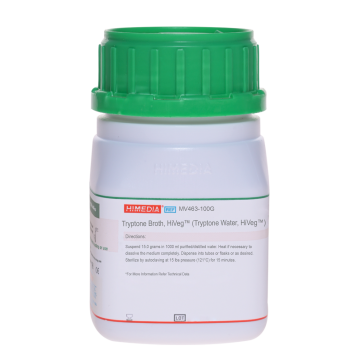
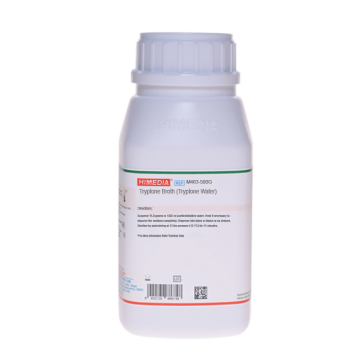
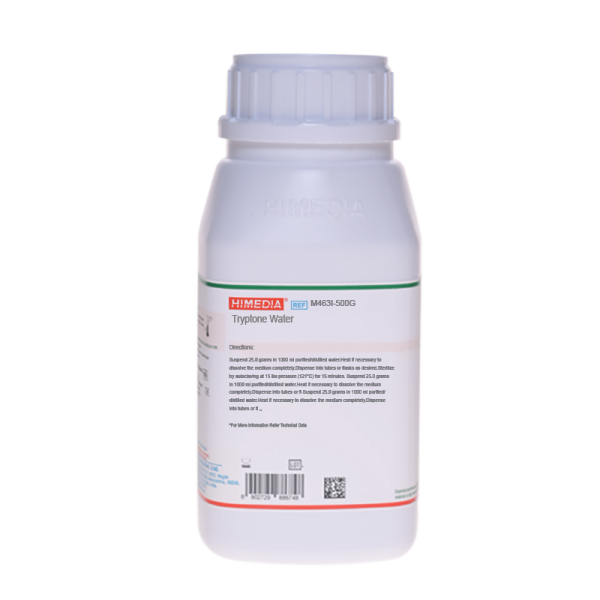
Tryptone Water is used for the detection of indole production by coliforms.
| Ingredients | Gms/Litre |
|---|---|
| Casein enzymic hydrolysate | 20.000 |
| Sodium chloride | 5.000 |
Final pH (at 25°C): 7.5±0.2
**Formula adjusted, standardized to suit performance parameters
Dissolve 25 grams in 1000 ml distilled water. Heat if necessary to dissolve the medium completely. Dispense into tubes and sterilize by autoclaving at 15 lbs pressure (121°C) for 15 minutes.
Tryptone Water is recommended by APHA (1) and ISO Committee (2) for detection of indole production by coliforms, which is a key feature in differentiation of bacteria. A slight modification of Tryptone Water (M463I) is recommended by ISO committee (3) for the same purpose. This test demonstrates the ability of certain bacteria to decompose the amino acid tryptophan to indole which accumulates in the medium (4).
Casein enzymic hydrolysate is a good substrate for indole production because of its high tryptophan content. Certain organisms breakdown the amino acid tryptophan with the help of enzymes that mediate the production of indole by hydrolytic activity (5).
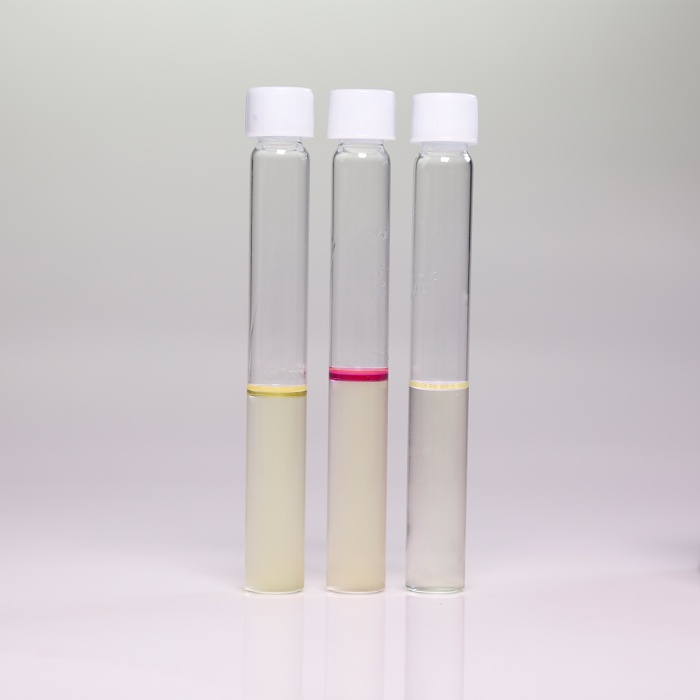
The indole produced can be detected by either Kovacs or Ehrlichs reagent (6). Indole combines with the aldehyde present in the above reagent to give red colour in the alcoholic layer. The alcohol layer extracts and concentrates the red colour complex.
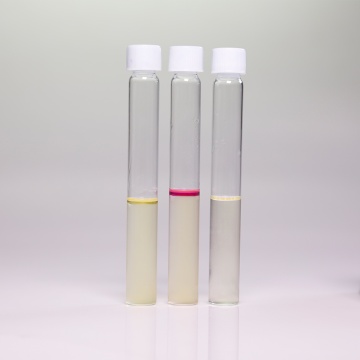
Tryptone Water is used in conjunction with Brilliant Green Bile Broth 2% (M121) to determine the most probable number (MPN) of E. coli in food sample. Growth and gas production in M121 and indole production in Tryptone Water following incubation of both media at 44 ± 1°C is used as the basis for the presumptive E. coli test. For determination of indole, inoculate the medium with inoculum of an 18-24 hours pure culture. Incubate the tubes at 35 ± 2°C for 18-24 hours. Add 0.5 ml of indole reagent (R008) directly to the tube and agitate. Allow the tubes to stand for 5-10 minutes. Formation of red ring at the top of the tube indicates indole production.
Indole testing is recommended as an aid in the differentiation of microorganisms based on indole production. For complete identification of the organisms, further biochemical confirmation is necessary.
Appearance: Cream to yellow homogeneous free flowing powder
Colour and Clarity of prepared medium: Yellow coloured clear solution without any precipitate
Reaction: Reaction of 2.5% w/v aqueous solution at 25°C. pH: 7.5±0.2
pH: 7.30-7.70
Cultural Response: Cultural characteristics observed after an incubation at 35-37°C for 24 hours. Add 0.2-0.3ml kovac's indole reagent (R008) to each tube after incubation.
| Organism | Inoculum (CFU) | Growth | Indole reaction |
|---|---|---|---|
| Escherichia coli ATCC 25922 | 50-100 | luxuriant | positive reaction, red ring at the interface of the medium |
| Enterobacter aerogenes ATCC 13048 | 50-100 | luxuriant | negative reaction, no colour development / cloudy ring |
Store below 30°C in tightly closed container and the prepared medium at 2 - 8°C. Use before expiry date on the label.
| Product Name | Tryptone Water |
|---|---|
| SKU | M463I |
| Product Type | Regular |
| Physical Form | Powder |
| Origin | Animal |
| Packaging type | HDPE |
| References | 1. Greenberg A. E., Clesceri L. S. and Eaton A. D., (Eds.), 1998, Standard Methods for the Examination of Water andWastewater, 20th Ed., APHA, Washington, D.C. 2.International Organization for Standardization (ISO), 1993, Draft ISO/DIS 9308-1. 3.International Organization for Standardization (ISO), 1990, Draft ISO/DIS 7251:1993. 4.Collee J. G., Fraser A. G., Marmion B. P., Simmons A., (Eds.), Mackie and McCartney, Practical Medical Microbiology,1996, 14th Edition, Churchill Livingstone. 5.MacFaddin J. F., 2000, Biochemical Tests for Identification of Medical Bacteria, 3rd Ed., Williams and Wilkins, Baltimore. 6.Finegold S. M. and Baron E. J., 1986, Bailey and Scotts Diagnostic Microbiology, 7th Ed., The C.V. Mosby Co., St. Louis.gensen,J.H., Pfaller , M.A., Carroll, K.C., Funke, G., Landry, M.L., Richter, S.S and Warnock., D.W. (2015)Manual of Clinical Microbiology, 11th Edition. Vol. 1. |
| Customized Product Available | No |