HiMedia Laboratories GmbH, Marie-Curie-Str. 3, 64683, Einhausen, Germany.

 Your enquiry has been submitted
Something problem with the server. Try again.

| Ingredients | Gms / Litre |
|---|---|
| Peptonized milk | 15.000 |
| Yeast extract | 6.100 |
| Dextrose | 16.100 |
| Tomato juice | 12.200 |
| Dipotassium phosphate | 0.310 |
| Monopotassium phosphate | 0.310 |
| Magnesium sulphate | 0.120 |
| Sodium chloride | 0.006 |
| Ferrous sulphate | 0.006 |
| Manganese sulphate | 0.006 |
| Agar | 12.000 |
Final pH (at 25°C) 6.3±0.2
**Formula adjusted, standardized to suit performance parameters
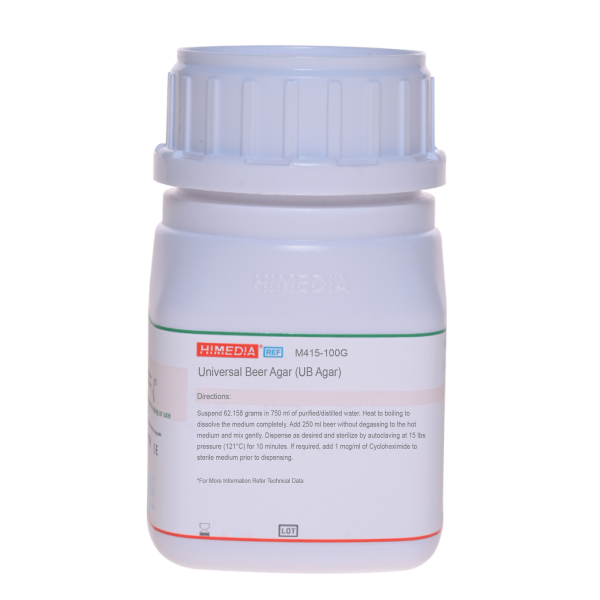
Suspend 62.158 grams in 750 ml of distilled water. Heat to boiling to dissolve the medium completely. Add 250 ml beer, without degassing, to the hot medium and mix gently. Dispense as desired and sterilize by autoclaving at 15 lbs pressure (121°C) for 10 minutes. If required, add 1 mcg/ml of Cycloheximide to sterile medium prior to dispensing.
Kozulis and Page (1) developed Universal Beer Agar Medium, a basal medium to which beer is added. This medium, used for detecting microbial contamination, has conditions found in typical brewery products and thus helps in growth of most variants of lactic acid bacteria.
Universal Beer Agar supports the growth of Lactobacilli , Pediococci , Acetobacter , Lymomonas species and wild yeast strains which may be found infecting the pitching yeast, the cooled wort or during fermentation or storage of the finished beer.
Due to the presence of beer in these media, it is selective for growth of microorganisms that have adapted themselves to the existent conditions in the brewery. The presence of hop constituents and alcohol inhibits growth of many airborne microorganisms not adapted to this environment (2). Yeast extract is a source of trace elements, vitamins and amino acids. Peptonized milk contains lactose as an energy source. Tomato juice is a source of carbon, protein and nutrients. Dextrose provides additional carbon. Dipotassium and monopotassium phosphates provide buffering capability. Magnesium sulphate, ferrous sulphate and manganese sulphate are sources of ions that simulate metabolism. Sodium chloride maintains the osmotic equilibrium
The presence of spoilage microorganisms in pitching yeast may be detected from diluted samples by direct surface plating or by pour plate techniques. Incubate the plates aerobically and anaerobically.
Appearance
Cream to yellow homogeneous free flowing powder
Gelling
Firm, comparable with 1.2% Agar gel.
Colour and Clarity of prepared medium
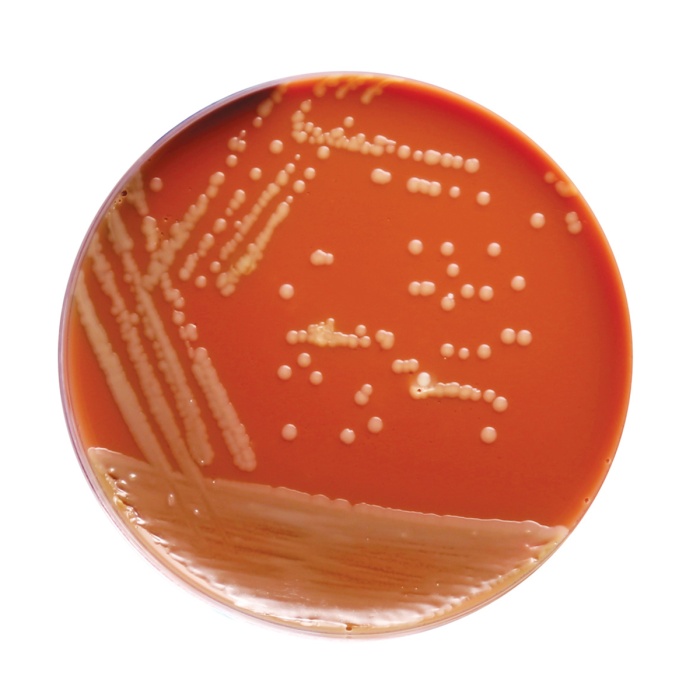
Medium amber coloured clear to slightly opalescent gel forms in Petri plates.
Reaction of 6.22% w/v aqueous solution at 25°C. pH: 6.3±0.2
pH 6.10-6.50
M415: Cultural characteristics observed after an incubation at 35-37°C for 40-48 hours with added cycloheximide.
| Organism | Inoculum (CFU) | Growth | Recovery |
|---|---|---|---|
| Acinetobacter calcoaceticus ATCC 23055 | 50-100 | good-luxuriant | >=50% |
| Lactobacillus acidophilus ATCC 4356 | 50-100 | good-luxuriant | >=50% |
| Lactobacillus fermentum ATCC 9338 | 50-100 | good-luxuriant | >=50% |
| Proteus vulgaris ATCC 13315 | 50-100 | fair-good | 30-40% |
| Pediococcus acidilacti ATCC 8081 | 50-100 | Good-luxuriant | >=50% |
| Lactobacillus johnsonii ATCC 11506 | 50-100 | Good-luxuriant | >=50% |
Store below 30°C in tightly closed container and the prepared medium at 2-8°C. Use before expiry date on the label.
| Product Name | Universal Beer Agar (UB Agar) |
|---|---|
| SKU | M415 |
| Product Type | Regular |
| Physical Form | Powder |
| Origin | Animal |
| Packaging type | HDPE |
| References | 1. Weber and Black, 1948, Soap Sanitary Chem., 24:134. 2.Favero (Chm.), 1967, A State of the Art Report, Biological Contamination Control Committee, American Association for Contamination Control. 3.MacFaddin J. F., 1985, Media for Isolation-Cultivation-Identification-Maintenance of Medical Bacteria, Vol. 1, Williams and Wilkins, Baltimore4.American Society for Testing and Materials, 1991, Standard Test Methods for preservatives in water-containing cosmetics,E640-7 |
| Customized Product Available | No |