HiMedia Laboratories GmbH, Marie-Curie-Str. 3, 64683, Einhausen, Germany.

 Your enquiry has been submitted
Something problem with the server. Try again.

Recommended for confirming the presence of Enterococci in water supplies and other sources.
| Ingredients | Gms / Litre |
|---|---|
| Tryptone | 5.000 |
| Yeast extract | 5.000 |
| Dextrose (Glucose) | 5.000 |
| Sodium azide | 0.400 |
| Methylene blue | 0.010 |
| Agar | 15.000 |
Final pH (at 25°C): 8.0±0.2
**Formula adjusted, standardized to suit performance parameters
Suspend 30.41 grams in 1000 ml purified / distilled water. Heat to boiling to dissolve the medium completely. Dispense in tubes or flasks as desired. Sterilize by autoclaving at 15 lbs pressure (121°C) for 15 minutes. Allow the agar tubes to cool to 45-50ºC in a slanted position.
Enterococcus Confirmatory Agar formulated by Sandholzer and Winter (5) is used for the detection of Enterococci in water supplies, swimming pools, sewage etc. Enterococci are found as normal flora in the gastrointestinal tracts of humans and animals. They are becoming increasingly important agents of human diseases largely because of their resistance to antimicrobial agents to which other Streptococci are generally susceptible (2). The Enterococcus is a subgroup of the fecal Streptococci group that includes Enterococcus faecalis, Enterococcus faecium, Enterococcus gallinarum, and Enterococcus avium (1). Enterococci are differentiated from other Streptococci by their ability to grow in 6.5% sodium chloride, at pH 9.6 and at 10°C and 45°C (1).
The ability of organisms to grow in the presence of variable amounts of sodium chloride is a test that has been used to characterize several bacteria, including the viridans Streptococci. It is useful for presumptive identification of the Entercoccal group D organisms which have the specific ability to grow in the presence of 6.5% NaCl incorporated into the medium. A positive test is the presence of bacterial growth in the medium. If the organism is bile esculin positive and grows in 6.5% NaCl broth, the organism is an Enterococcus species and if the organism is bile esculin positive and fails to grow in the 6.5%NaCl broth, the organism belongs to a group D Streptococci. The enterococcal portion of the faecal Streptococcus group is a valuable bacterial indicator for determining the extent of faecal contamination of recreational surface waters (1).
Tryptone, yeast extract, dextrose provide essential growth nutrients for Enterococci. Sodium azide inhibits contaminating flora. The positive presumptive tests are confirmed by inoculating from Enterococcus Presumptive Broth (M419) to Enterococcus Confirmatory slant-broth combination prepared with an Azide Agar medium (Enterococcus Confirmatory Agar, M392) overlaid with a Salt Azide Penicillin Broth (Enterococcus Confirmatory Broth, M394). A negative catalase test is considered confirmed positive evidence of the presence of Enterococci. Single strength medium can be used for small inoculum. Production of acid and turbidity in an azide presumptive broth when incubated at 45°C is considered positive presumptive evidence for the presence of Enterococci, which is confirmed by inoculating on Confirmatory Agar (M392).
Water samples
For water samples, follow appropriate techniques for sample collection, processing as per guidelines and local standards.
(1) After use, contaminated materials must be sterilized by autoclaving before discarding.
Read the label before opening the container. Wear protective gloves/protective clothing/eye protection/ face protection. Follow good microbiological lab practices while handling specimens and culture. Standard precautions as per established guidelines should be followed while handling specimens. Safety guidelines may be referred in individual safety data sheets.
Performance of the medium is expected when used as per the direction on the label within the expiry period when stored at recommended temperature.
Appearance: Light yellow to yellow homogeneous free flowing powder
Gelling: Firm, comparable with 1.5% Agar gel
Colour and Clarity of prepared medium: Light blue coloured clear to slightly opalescent gel forms in tubes as slants
Reaction: Reaction of 3.04% w/v aqueous solution at 25°C. pH : 8.0±0.2
pH: 7.80-8.20
Cultural Response: Cultural characteristics observed after an incubation at 45°C for 18-24 hours.
| Organism | Inoculum (CFU) | Growth |
|---|---|---|
| Escherichia coli ATCC 25922 (00013*) | >=10⁴ | inhibited |
| Enterococcus faecalis ATCC 29212 (00087*) | 50-100 | good-luxuriant |
Key : (*)Corresponding WDCM numbers.
Store between 10-30°C in a tightly closed container and the prepared medium at 20-30°C. Use before expiry date on the label. On opening, product should be properly stored dry, after tightly capping the bottle in order to prevent lump formation due to the hygroscopic nature of the product. Improper storage of the product may lead to lump formation. Store in dry ventilated area protected from extremes of temperature and sources of ignition. Seal the container tightly after use. Product performance is best if used within stated expiry period.
User must ensure safe disposal by autoclaving and/or incineration of used or unusable preparations of this product. Follow established laboratory procedures in disposing of infectious materials and material that comes into contact with sample must be decontaminated and disposed of in accordance with current laboratory techniques (3,4).
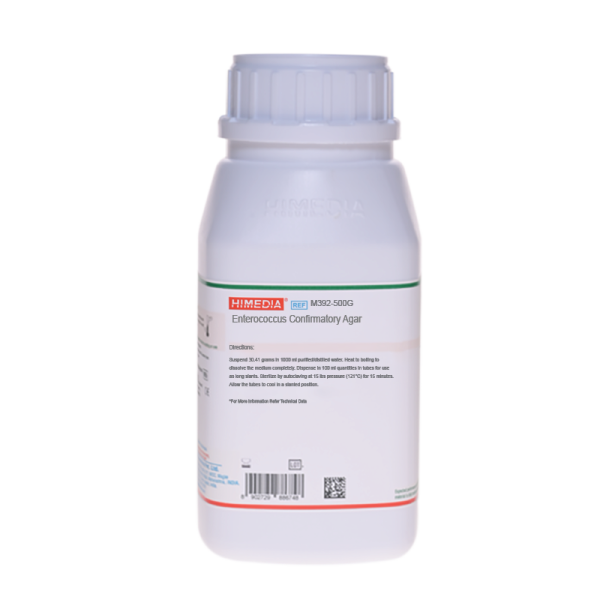
| Product Name | Enterococcus Confirmatory Agar |
|---|---|
| SKU | M392 |
| Product Type | Regular |
| Physical Form | Powder |
| Origin | Animal |
| Packaging type | HDPE |
| References | 1. Murray P. R., Baron J. H., Pfaller M. A., Jorgensen J. H. and Yolken R. H., (Ed.), 2003, Manual of Clinical Microbiology, 8th Ed., American Society for Microbiology, Washington, D.C. ,, 2.Mueller J. H. and Hinton J., 1941, Proc. Soc. Exp. Biol. Med., 48:330. 3.National Committee for Clinical Laboratory Standards, 2000, Approved Standard: M7-A 5.Methods for Dilution Antimicrobial Susceptibility Tests for Bacteria that grow aerobically, 5th Ed., NCCLS, Wayne, Pa. |
| Customized Product Available | No |