HiMedia Laboratories GmbH, Marie-Curie-Str. 3, 64683, Einhausen, Germany.

 Your enquiry has been submitted
Something problem with the server. Try again.

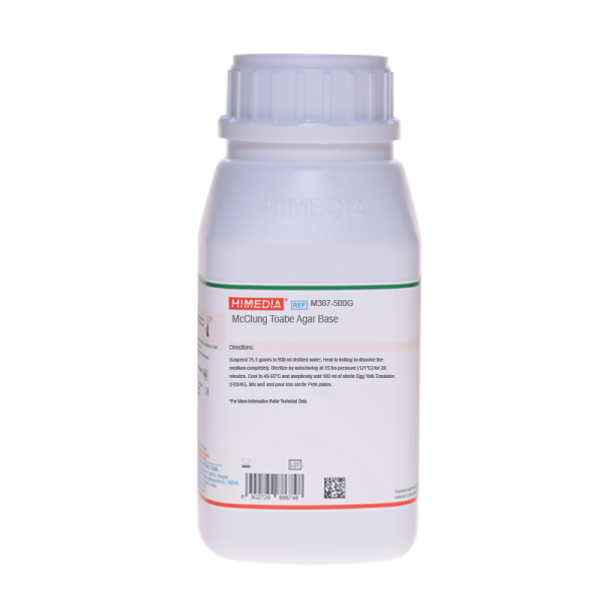
McClung Toabe Agar is used for detection and isolation of Clostridium perfringens from food samples.
| Ingredients | Gms / Litre |
|---|---|
| Proteose peptone | 40.000 |
| Dextrose | 2.000 |
| Disodium hydrogen phosphate | 5.000 |
| Monopotassium phosphate | 1.000 |
| Sodium chloride | 2.000 |
| Magnesium sulphate | 0.100 |
| Agar | 25.000 |
Final pH ( at 25°C): 7.6±0.2
**Formula adjusted, standardized to suit performance parameters
Suspend 75.1 grams in 900 ml distilled water. Heat to boiling to dissolve the medium completely. Sterilize by autoclaving at 15 lbs pressure (121°C) for 20 minutes. Cool to 50°C and aseptically add 100 ml of sterile Egg Yolk Emulsion (FD045). Mix well and pour into sterile Petri plates.
Clostridium perfringens food poisoning is one of the most common types of human foodborne illness. The foods usually involved are cooked meat or poultry products containing large number of viable cells. A heat-labile enterotoxin produced only by sporulating cells induces the major symptoms of diarrhea in perfringens poisoning. Although the enterotoxin is not preformed in the food, the foods in which conditions are favourable for sporulation may contain enterotoxin (1). Therefore, enumeration of these microorganisms in food plays a significant role in investigation of food borne illness (2).
McClung and Toabe (3, 4, 5) formulated a medium for isolating and differentiating Clostridium species from foods on the basis of their lecithinase and lipase activity. With the addition of 50% egg yolk emulsion, C. perfringens and a few other Clostridium species show the lecithinase reaction. Lecithinase enzyme lyses egg yolk lecithin, producing an opaque zone of precipitation surrounding the slightly raised colonies. Proteose peptone provides nitrogenous growth nutrients. Dextrose is the fermentable carbohydrate. Phosphates form a good buffering system. Sodium chloride provides essential ions. Magnesium sulphate provides divalent cations and sulphate.
Add 25 grams of food sample to be tested in two tubes containing 25 ml Fluid Thioglycollate Medium (M009) with inverted Durhams tube. Incubation is carried out at 46°C for 4-6 hours. Observe for growth and gas production. Streak the presumptive C. perfringens on McClung Toabe Agar plates and incubate at 35-37°C for 18-24 hours.
Appearance: Cream to yellow homogeneous free flowing powder
Gelling: Firm, comparable with 2.5% Agar gel.
Colour and Clarity of prepared medium: Basal medium : Amber coloured clear to slightly opalescent gel.After addition of egg yolk emlusion : Yellow coloured opalescent gel forms in Petri plates.
Reaction: Reaction of 7.5% w/v aqueous solution at 25°C. pH : 7.6±0.2
pH: 7.40-7.80
M387: Cultural characteristics observed after an incubation at 35-37°C for 18-24 hours under anaerobic condition with added sterile Egg Yolk Emulsion (FD045).
| Organism | Inoculum (CFU) | Growth | Recovery | Lecithinase | Lipase activity |
|---|---|---|---|---|---|
| Clostridium perfringens ATCC 12919 | 50-100 | luxuriant | >=70% | positive reaction, opaque zone around the colony | negative reaction, no irridescent sheen on the growth surface |
| Clostridium sporogenes ATCC 11437 | 50-100 | luxuriant | >=70% | negative reaction | positive reaction, irridescent sheen on the growth surface |
| Staphylococcus aureus ATCC 25923 | 50-100 | luxuriant | >=70% | positive reaction, opaque zone around the colony | positive reaction, irridescent sheen on the growth surface |
Store below 30°C in tightly closed container and the prepared medium at 2 - 8°C. Use before expiry date on the label.
| Product Name | McClung Toabe Agar Base |
|---|---|
| SKU | M387 |
| Product Type | Regular |
| Physical Form | Powder |
| Origin | Animal |
| Packaging type | HDPE |
| References | 1. Hyslop N., St. G. and Osborne A. D., 1959, Vet. Rec. 71 : 1082 2.Conner D. E., Brackett R. E., and Beuchat L. R., 1986, Appl. Environ. Microbiol., 52: 59 3.Doyle M. P., Meske L. M. and Marth E. H., 1985, J. Food Prot., 48:740 4.McBride M. E. and Girard F., 1960, J. Lab. Clin. Med., 55:153. 5.Vanderzant C. and Splittstoesser D. F., (Eds.), 1992, Compendium of Methods for the Microbiological Examination ofFoods, 3rd Ed., APHA, Washington, D.C. 6.Wehr H. M. and Frank J. H., 2004, Standard Methods for the Microbiological Examination of Dairy Products, 17th Ed., APHA Inc., Washington, D.C. 7.Dowell, Hill and Altemeier, 1964, J. Bacteriol., 88:18 8.FDA Bacteriological Analytical Manual, 2005, 18th Ed., AOAC, Washington, DC. 9.McClain D. and Lec W., 1989, Lab. Comm No. 57, Revised, May 24, 1989, U.S. Dept. of Agric., FSIS, Microbiol. Div.,Beltsville, MD. |
| Customized Product Available | No |