HiMedia Laboratories GmbH, Marie-Curie-Str. 3, 64683, Einhausen, Germany.

 Your enquiry has been submitted
Something problem with the server. Try again.
 Your enquiry has been submitted
Recommended for maintenance of iron bacteria especially those belonging to the Sphaerotilus-Leptothrix group.
| Ingredients | Gms / Litre |
|---|---|
| Tryptone | 5.000 |
| Yeast autolysate | 1.000 |
**Formula adjusted, standardized to suit performance parameters
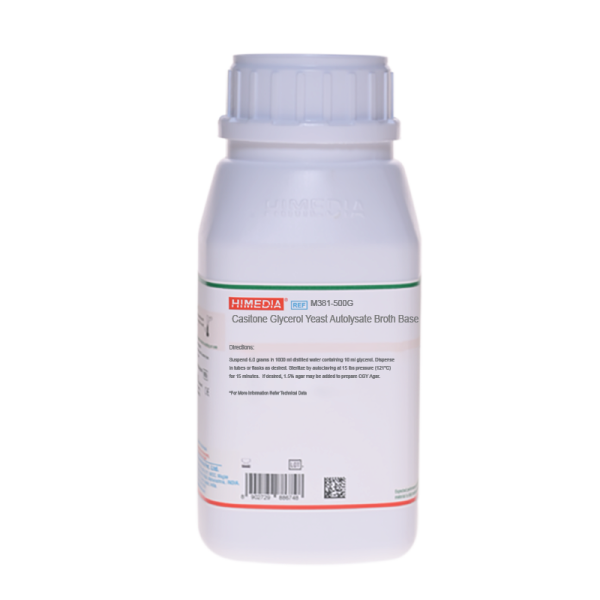
Suspend 6 grams in 1000 ml purified / distilled water containing 10ml glycerol. Dispense into test tubes and sterilize by autoclaving at 15 lbs pressure (121°C) for 15 minutes. If desired 1.5% agar may be added to form CGY Agar.
Iron bacteria are considered to be capable of metabolizing reduced iron present in their aqueous habitat and of depositing it in the form of hydrated ferric oxide on or in their mucilaginous secretions. Sphaerotilus natans belonging to the Sphaerotilus genus normally occurs in polluted waters. In unpolluted water containing iron, iron hydroxide may be deposited in or on the sheaths, which turn yellow-brown and may become encrusted with ferric ions. Individual cells, under some environmental conditions, accumulate large amounts of poly-b-hydroxy butyrate (7).
CGY Broth is formulated in accordance with APHA (1) and it supports growth of Iron bacteria especially those belonging to the Sphaerotilus-Leptothrix group but not of the more rapidly growing organisms.
Pure cultures are isolated from BOD-Lactate Broth by picking a filament and streaking on 0.05% Meat Extract Agar. BOD-Lactate Broth acts as a partially selective medium for Sphaerotilus (2). After 24 hours incubation at 25°C, the typical curling filaments are transferred to CGY Broth, which is a good maintenance medium (4). If a pellicle with no underlying turbidity develops in 2 to 3 days, filament is transferred to CGY Agar slant. In addition alfalfa straw or pea straw may be used for enrichments.
Water samples
For water samples, follow appropriate techniques for sample collection, processing as per guidelines and local standards.(3)
After use, contaminated materials must be sterilized by autoclaving before discarding.
Read the label before opening the container. Wear protective gloves/protective clothing/eye protection/ face protection. Follow good microbiological lab practices while handling specimens and culture. Standard precautions as per established guidelines should be followed while handling specimens. Safety guidelines may be referred in individual safety data sheets.
Performance of the medium is expected when used as per the direction on the label within the expiry period when stored at recommended temperature.
Appearance: Off-white to yellow homogeneous free flowing powder
Colour and Clarity of prepared medium: Light yellow coloured, clear solution without any precipitate
Cultural Response: Cultural characteristics observed after an incubation at 25-30°C for upto 3 days.
| Organism | Growth |
|---|---|
| Sphaerotilus natans ATCC 13338 | luxuriant |
Store between 10-30°C in a tightly closed container and the prepared medium at 15-25°C. Use before expiry date on the label. On opening, product should be properly stored dry, after tightly capping the bottle in order to prevent lump formation due to the hygroscopic nature of the product. Improper storage of the product may lead to lump formation. Store in dry ventilated area protected from extremes of temperature and sources of ignition Seal the container tightly after use. Use before expiry date on the label.
Product performance is best if used within stated expiry period.
User must ensure safe disposal by autoclaving and/or incineration of used or unusable preparations of this product. Follow established laboratory procedures in disposing of infectious materials and material that comes into contact with clinical sample must be decontaminated and disposed of in accordance with current laboratory techniques (5,6).
| Product Name | Casitone Glycerol Yeast Autolysate Broth Base (CGY) |
|---|---|
| SKU | M381 |
| Product Type | Regular |
| Physical Form | Powder |
| Origin | Animal |
| Packaging type | HDPE |
| References | 1. Brewer, 1940, J. Am. Med. Assoc., 115:598. 2.U. S. Pharmacopeia, 2002, USP 25/NF 20, Asian Edition, United States Pharmacopeial Convention, Inc., Rockville, MD. 3.Cunniff P. (Ed.), 1995, Official Methods of Analysis of the Association of Official Analytical Chemists, 16th ed., AOAC, Washington, D.C. 4.Marshall, Gunnison and Luxen, 1940, Proc. Soc. Exp. Biol. Med., 43:672. 5.Nungester, Hood and Warren, 1943, Proc. Soc. Exp. Biol. Med., 52:287. 6.Portwood, 1944, J. Bact., 48:255. 7.MacFaddin J.F., 1985, Media for Isolation-Cultivation-Identification-Maintenance of ,,Medical Bacteria, Vol. 1, Williams and Wilkins, Baltimore. 8.Federal Register, 1992, Fed. Regist., 21:113.26. |
| Customized Product Available | No |