HiMedia Laboratories GmbH, Marie-Curie-Str. 3, 64683, Einhausen, Germany.

 Your enquiry has been submitted
Something problem with the server. Try again.
 Your enquiry has been submitted
Recommended for distinguishing the Salmonella arizonae from the Bethesda Ballerup group of Enterobacteriaceae. The composition and performance criteria are in accordance with ISO 6579-1:2017. Also recommended by ISO 10273:2003 for Yersinia enterocolitica.
ISO 6579-1 and ISO 10273:2003 Specification - Lysine decarboxylation medium (LDC)
| Ingredients | g / L |
|---|---|
| L-Lysine monohydrochloride | 5.000 |
| Yeast extract | 3.000 |
| Dextrose (Glucose) | 1.000 |
| Bromocresol purple | 0.015 |
Final pH (at 25°C): 6.8±0.2
**Formula adjusted, standardized to suit performance parameters
Suspend 9.01 grams in 1000 ml purified / distilled water. Heat if necessary to dissolve the medium completely. Dispense 5 ml amount into screw-capped test tubes. Sterilize by autoclaving at 15 lbs pressure (121°C) for 15 minutes. Cool the tubed medium to 45-50ºC in an upright position and overlay with 2-3 ml of sterile mineral oil.
Decarboxylase media were first described by Moeller (1,2,3) for detecting lysine and ornithine decarboxylase and arginine dihydrolase. Falkow developed a lysine decarboxylase medium for the identification and differentiation of Salmonella and Shigella (4). Falkows Medium was further modified by Taylor (5) by deleting peptone from the formulation (M376I), thus eliminating false positives caused by Citrobacter freundii and its paracolons. Taylor's modification has same advantage of Falkow's formulation over Moeller; it does not require the special conditions of anaerobic culture and low pH.
During the initial stages of incubation, fermentation of dextrose by the organisms, with acid production results in a colour change of the indicator to yellow. On further incubation, if L-Lysine is decarboxylated to cadaverine, there will be an alkaline reaction and the indicator colour will then revert back to purple. If the colour remains yellow, the decarboxylase reaction is negative. S. Typhi, S. Paratyphi B, S. Paratyphi C, Salmonella Gallinarum and Salmonella pullorum gives positive Lysine decarboxylase while S. Paratyphi A gives negative Lysine decarboxylase. Lysine Decarboxylase Broth w/o Peptone is also recommended by APHA (6).
Yeast extract provide essential growth nutrients. Dextrose is the fermentable carbohydrate and bromo cresol purple is the pH indicator. Dextrose non-utilizers will not show any change in the medium colour.
Food and meat samples; milk and milk products, animal feed, animal faeces.
ISO 6579-1:2017 Processing : (7)
Pre-enrichment : Samples (25 grams in 225 ml) are preenriched in Buffered Peptone Water (M1494I) and incubated at 34°C to 38°C for 18 h ± 2 hours.
Selective enrichment: 0.1 ml of pre- enriched sample is inoculated in 10 ml RVS Broth (M1448I) or MSRV Agar (M1428I) and incubated at 41.5 ± 1°C for 24 ± 3 hours and 1 ml of culture is inoculated in MKTTn broth (M1496I) and incubated at 37± 1°C for 24 ± 3 hours. Incase of Salmonella Typhi and Salmonella Paratyphi A selective enrichment is carried out in Selenite Cystine broth and then incubated at 37± 1°C for 24 h ± 3 h and 48 h ± 3 h.
Isolation : The culture thus obtained is then plated on Bismuth Sulphite Agar (BS) (M027) and incubated at 37± 1°C for 24 ± 3 hours. An additional incubation of 24 ± 3 hours is recommended. Simultaneously plating on isolation agar XLD Agar, Modified (M031I) is carried out.
Confirmation : Inoculate just below the surface of the liquid medium. Incubate at 37 °C for 24 h ± 3 h. Turbidity and a purple colour after incubation indicate a positive reaction. A yellow colour indicates a negative reaction.
ISO 10273:2003 Processing : (8)
Enrichment : For the first initial suspension place the sample (x) in known volume of the PSB broth (M941I), to give a dilution of 1/10 dilution (by mass/volume or volume/volume). Homogenize the suspension using a peristaltic blender for 2 min. Incubate at 22°C to 25°C for 2 to 3 days with or 5 days without agitation. For the second inition suspension in the same way with the ITC broth (M1220) so as to obtain a test portion/enrichment medium dilution of 1/100 (mass/volume or volume/volume). Incubate at 25°C for 48 hours.
Isolation : 1. Inoculate the culture obtain from PSB culture on the surface of CIN agar plate (?) and incubate at 30°C for 24 to 48 hours. 2. Alkaline treatment : Using sterile pipette transfer 0.5 ml of the PSB culture into 4.5 ml of KOH solution and mix for 20 seconds only. Immediately inoculate on CIN agar plate. Incubate at 30°C for 24 to 48 hours. 3. Using ITC culture inoculate the surface of SSDC agar plate (?). Incubate at 30°C for 24 to 48 hours.
Purification : Streak the selected colonies on the surface of Nutrient Agar (M561A). Incubate at 30°C for 24 hours.
Confirmation : Inoculate just below the surface of the liquid medium. If the tubes are not full of medium and airtight, cover the surface with molten (heated then just cooled so that it remains still liquid) vaseline oil or sterile liquid paraffin. Incubate at 30°C for 24 hours.
A violet color after incubation indicates a positive reaction. A yellow color indicates a negative reaction.
Read the label before opening the container. Wear protective gloves/protective clothing/eye protection/face protection. Follow good microbiological lab practices while handling specimens and culture. Standard precautions as per established guidelines should be followed while handling specimens. Safety guidelines may be referred in individual safety data sheets.
Performance of the medium is expected when used as per the direction on the label within the expiry period when stored at recommended temperature.
Appearance Light yellow to greenish yellow homogeneous free flowing powder
Colour and Clarity of prepared medium Purple coloured clear solution without any precipitate
Reaction Reaction of 0.9% w/v aqueous soloution at 25°C. pH : 6.8±0.2
pH 6.60-7.00
Cultural Response Cultural characteristics observed after an incubation at 37 °C for 24 h ± 3 h.
| Organism | Lysine decarboxylation |
|---|---|
| ISO 6579-1:2017 | |
| Salmonella Typhi ATCC 6539 | positive reaction, purple colour |
| Salmonella Paratyphi A ATCC 9150 | negative reaction, yellow colour |
| Salmonella Paratyphi B ATCC 8759 | positive reaction, purple colour |
| Salmonella Paratyphi C ATCC BAA 1714 | positive reaction, purple colour |
| ISO 10273:2003 | |
| Yersinia enterocolitica ATCC 27729 | negative reaction, yellow colour |
Key : * Corresponding WDCM numbers.
Store between 10-30°C in a tightly closed container and the prepared medium at 20-30°C. Use before expiry date on the label. On opening, product should be properly stored dry, after tightly capping the bottle inorder to prevent lump formation due to the hygroscopic nature of the product. Improper storage of the product may lead to lump formation. Store in dry ventilated area protected from extremes of temperature and sources of ignition. Seal the container tightly after use. Product performance is best if used within stated expiry period.
User must ensure safe disposal by autoclaving and/or incineration of used or unusable preparations of this product. Follow established laboratory procedures in disposing of infectious materials and material that comes into contact with sample must be decontaminated and disposed of in accordance with current laboratory techniques (9,10).
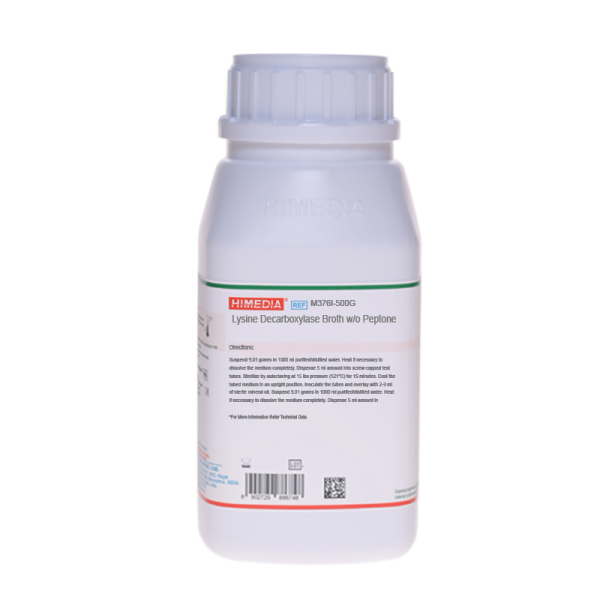
| Product Name | Lysine Decarboxylase Broth w/o Peptone |
|---|---|
| SKU | M376I |
| Product Type | Regular |
| Physical Form | Powder |
| Origin | Animal Free (Microbial) |
| Packaging type | HDPE |
| References | 1. Moeller V., 1954, Acta. Pathol. Microbiol. Scand., 34:102. 2.Moeller V., 1954, Acta. Pathol. Microbiol. Scand., 34:259. 3.Moeller V., 1955, Acta. Pathol. Microbiol. Scand., 36:158. 4.Falkow, 1958, Am. J. Clin. Pathol., 29:598. 5.Eaton A. D., Clesceri L. S., Rice E. W. and Greenberg A. W., (Eds.), 2005, Standard Methods for the Examination of Waterand Wastewater, 21st Ed., APHA, Washington, D.C. 6.Downes F. P. and Ito K., (Eds.), 2001, Compendium of Methods for the Microbiological Examination of Foods, 4th Ed.,American Public Health Association, Washington, D.C. 7.Isenberg (Ed.), 1992, Clinical Microbiology Procedures Handbook, Vol. 1. American Society for Microbiology, Washington,D.C. 8.FDA Bacteriological Analytical Manual, 2005, 18th Ed., AOAC, Washington, DC. |
| Customized Product Available | No |