HiMedia Laboratories GmbH, Marie-Curie-Str. 3, 64683, Einhausen, Germany.

 Your enquiry has been submitted
Something problem with the server. Try again.

Sugar Free Agar is recommended for the examination of butter in accordance with International Dairy Federation.
| Ingredients | Gms / Litre |
|---|---|
| Casein enzymic hydrolysate | 7.500 |
| Pancreatic digest of gelatin | 7.500 |
| Sodium chloride | 5.000 |
| Agar | 14.000 |
Final pH (at 25°C): 7.6±0.2
**Formula adjusted, standardized to suit performance parameters
Suspend 34 grams in 1000 ml distilled water. Heat to boiling to dissolve the medium completely. Sterilize by autoclaving at 15 lbs pressure (121°C) for 15 minutes. Mix well and pour into sterile Petri plates.
Butter may be contaminated in the manufacturing process, from contaminated water sources, air or unsanitary equipment. Yeast, moulds and coliforms do not survive pasteurization and are rarely found in butter made under sanitary conditions. Estimates of the number of coliforms, yeasts and moulds or Enterococci in samples of butter taken at various stages of processing are useful in tracing the source of contamination (1). Sugar Free Agar is prepared as recommended by the International Dairy Federation (2) and is based on the formulation developed by Ritter and Eschmann (3) for the detection and enumeration of contaminating bacteria in butter and other processed dairy products.
The medium contains pancreatic digest of gelatin and casein enzymic hydrolysate which provide essential nutrients to the microorganisms. The medium is free of any fermentable carbohydrate and has relatively little nutrient value. Therefore microorganisms that do not form the normal flora of butter and other processed milk products can be grown selectively on this medium. Psychrotrophic and mesophilic gram-negative bacteria also grow well on this medium. Some Lancefield group D streptococci are not able to grow on this medium and hence do not interfere in the total count of the gram-negative bacteria (3). This medium aids differentiating non-lactic acid contaminants from lactic acid bacteria.
Appearance Cream to yellow homogeneous free flowing powder
Gelling Firm, comparable with 1.4% Agar gel
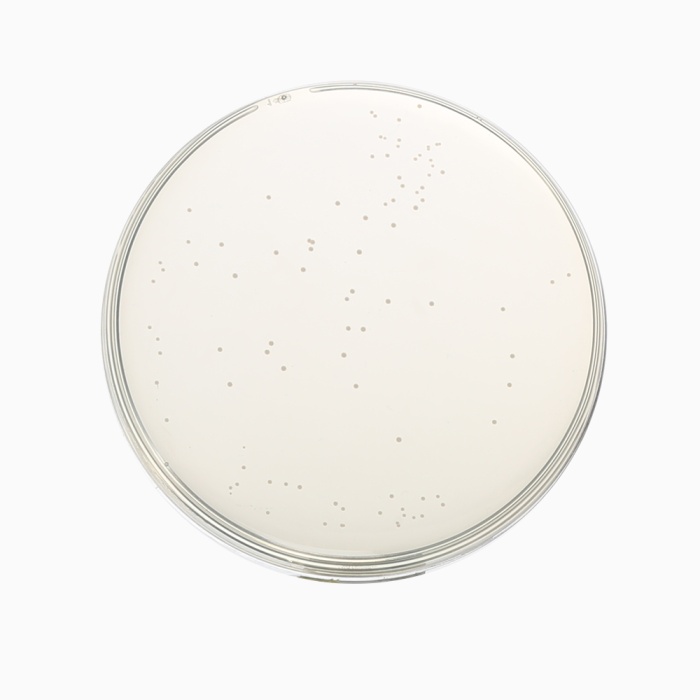
Colour and Clarity of prepared medium Medium amber coloured clear to slightly opalescent gel forms in Petri plates
Reaction Reaction of 3.4% w/v aqueous solution at 25°C. pH : 7.6±0.2
pH 7.40-7.80
M307: Cultural characteristics observed after an incubation at 35-37°C for 18-48 hours.
| Organism | Inoculum (CFU) | Growth | Recovery |
|---|---|---|---|
| Escherichia coli ATCC 25922 | 50-100 | good-luxuriant | >=70% |
| Bacillus cereus ATCC 10876 | 50-100 | good-luxuriant | >=70% |
| Candida albicans ATCC 10231 | 50-100 | good-luxuriant | >=70% |
| Enterococcus faecalis ATCC 29212 | 50-100 | good-luxuriant | >=70% |
| Leuconostoc mesenteroides ATCC 8293 | 50-100 | good-luxuriant | >=50% |
Store below 30°C in tightly closed container and the prepared medium at 2 - 8°C. Use before expiry date on the label.
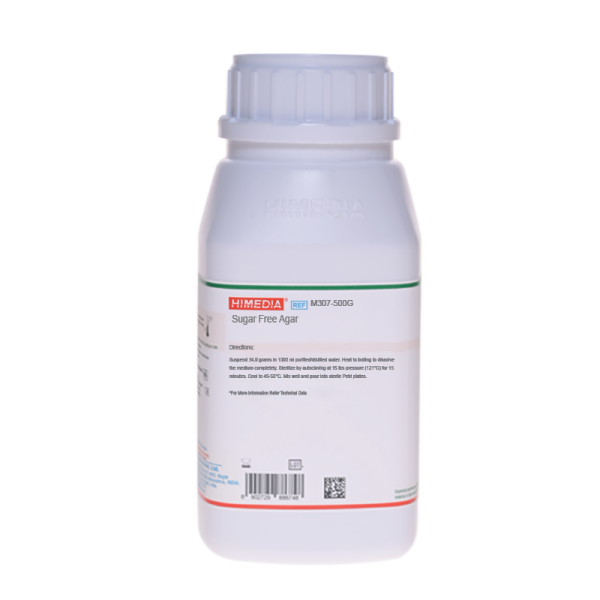
| Product Name | Sugar Free Agar |
|---|---|
| SKU | M307 |
| Product Type | Regular |
| Physical Form | Powder |
| Origin | Animal |
| Packaging type | HDPE |
| References | 1. Stuart, 1946, Glasgow Med. J. 27:131. 2.Stuart, Toshach and Patsula, 1954, Can. J. Public Health, 45:73. 3.Ringertz, 1960, Acta Pathol. Microbiol. Scand., 48:105. 4.Maintenance of Medical Bacteria, Vol. I, Williams and Wilkins, Baltimore. 5.Crookes E.M.L. and Stuart R.D., 1959, J. Path. Bact., 78:283. 6.Isenberg, H.D. Clinical Microbiology Procedures Handbook. 2nd Edition. 7.Jorgensen,J.H., Pfaller , M.A., Carroll, K.C., Funke, G., Landry, M.L., Richter, S.S and Warnock., D.W. (2015)Manual of Clinical Microbiology, 11th Edition. Vol. 1. |
| Customized Product Available | No |