HiMedia Laboratories GmbH, Marie-Curie-Str. 3, 64683, Einhausen, Germany.

 Your enquiry has been submitted
Something problem with the server. Try again.

Recommended for the selective isolation of Staphylococci causing food poisoning.
| Ingredients | g / L |
|---|---|
| Tryptone | 10.000 |
| Yeast extract | 2.500 |
| Gelatin | 30.000 |
| D-Mannitol | 10.000 |
| Sodium chloride | 55.000 |
| Ammonium sulphate | 75.000 |
| Dipotassium hydrogen phosphate | 5.000 |
| Agar | 15.000 |
Final pH ( at 25°C): 7.0±0.2
**Formula adjusted, standardized to suit performance parameters
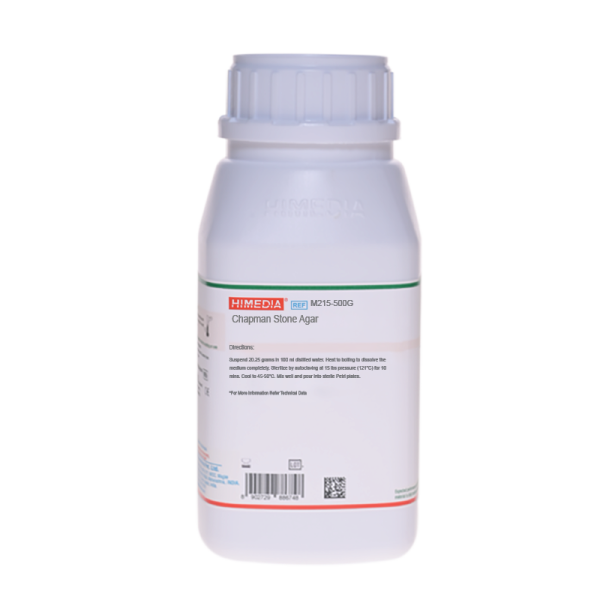
Suspend 20.25 grams in 100 ml purified / distilled water. Heat to boiling to dissolve the medium completely. Sterilize by autoclaving at 15 lbs pressure (121°C) for 10 minutes. Cool to 45-50°C. Mix well and pour into sterile Petri plates.
Staphylococcus aureus is one of the pathogens most frequently isolated from clinical specimens. In fact, S.aureus is currently the most common cause of nosocomial infections (1). Treatment of infection caused by S.aureus has become more problematic since the development of multiple drug resistant strains. To identify S.aureus from contaminated samples more easily and reliably, selective media have been developed.
Chapman Stone Agar is a selective media used for the isolation of food poisoning staphylococci. Foods commonly contaminated with S.aureus included synthetic creams, custards and high-salted food. Chapman Stone Agar is prepared according to the modification of Staphylococcus Medium 110 described by Chapman (1). It is similar to Staphylococcus Medium 110, previously described by Chapman (2), except that the sodium chloride concentration is reduced to 5.5% and additionally ammonium sulfate is included in the formulation. The main modification consists the inclusion of ammonium sulfate in the medium that allows the direct observation of gelatin hydrolysis, instead of adding reagents to the plate medium. Chapman Stone Medium is especially recommended for suspected food poisoning studies involving Staphylococcus (3). It is selective, due to the relatively high salt content, and is differential due to pigmentation, mannitol fermentation and the presence or absence of gelatin liquefaction.
Tryptone, yeast extract provide nitrogen, carbon, sulphur, vitamin B and trace elements. Sodium chloride acts as a selective agent, which inhibits most of the bacterial species. Mannitol is the fermentable carbohydrate and its fermentation can be detected by adding a few drops of bromocresol purple resulting in production of yellow colour. Gelatin hydrolysis is observed as clear zones around colonies. Due to the presence of ammonium sulphate in the medium itself there is no need to flood the plate with ammonium sulphate solution for detection of gelatin liquefaction by the isolates, which is known as Stones method (3). Dipotassium phosphate provides buffering capability. Material under test is inoculated on the surface and incubated at 30°C for 48 hours to produce separated colonies. After incubation, cream to golden yellow colonies surrounded by clear zones are presumptively identified as S.aureus. White or non-pigmented colonies, with or without a clear zone, are presumptively identified as S.epidermidis. Coagulase activity should be performed to confirm the findings.
Enterococci and/or Group D streptococci may exhibit growth on the medium and show slight mannitol fermentation. The colonies, however, are tiny and can easily be differentiated from staphylococci by gram stain and the catalase test (4).
Food samples
For food samples, follow appropriate techniques for sample collection and processing as per guidelines (5). After use, contaminated materials must be sterilized by autoclaving before discarding.
Read the label before opening the container. Wear protective gloves/protective clothing/eye protection/ face protection. Follow good microbiological lab practices while handling specimens and culture. Standard precautions as per established guidelines should be followed while handling specimens. Safety guidelines may be referred in individual safety data sheets..
Performance of the medium is expected when used as per the direction on the label within the expiry period when stored at recommended temperature.
Appearance Cream to yellow coarse free flowing powder
Gelling Firm, comparable with 1.5% Agar gel and 3.0% Gelatin gel
Colour and Clarity of prepared medium Light amber coloured, opalescent gel forms in Petri plates
Reaction Reaction of 20.25% w/v aqueous solution at 25°C. pH : 7.0±0.2
pH 6.80-7.20
Cultural Response Cultural characteristics observed after an incubation at 25 - 30°C for 18 - 48 hours.
| Organism | Inoculum (CFU) | Growth | Recovery | Mannitol fermentation | Gelatinase production |
|---|---|---|---|---|---|
| Escherichia coli ATCC 25922 (00013*) | >=104 | inhibited | 0% | ||
| Staphylococcus aureus ATCC 25923 (00034*) | 50-100 | luxuriant | >=50% | positive reaction, production of yellow colour on addition of Bromo cresol purple | positive reaction, clearing or halo |
| Staphylococcus epidermidis ATCC 12228 (00036*) | 50-100 | luxuriant | >=50% | negative reaction, no production of yellow colour on addition of Bromo cresol purple | positive reaction, clearing or halo |
Key : *Corresponding WDCM numbers.
Store between 10-30°C in a tightly closed container and the prepared medium at 20-30°C. Use before expiry date on the label. On opening, product should be properly stored dry, after tightly capping the bottle in order to prevent lump formation due to the hygroscopic nature of the product. Improper storage of the product may lead to lump formation. Store in dry ventilated area protected from extremes of temperature and sources of ignition. Seal the container tightly after use. Use before expiry date on the label. Product performance is best if used within stated expiry period.
User must ensure safe disposal by autoclaving and/or incineration of used or unusable preparations of this product. Follow established laboratory procedures in disposing of infectious materials and material that comes into contact with sample must be decontaminated and disposed of in accordance with current laboratory techniques (6,7).
| Product Name | Chapman Stone Agar |
|---|---|
| SKU | M215 |
| Product Type | Regular |
| Physical Form | Powder |
| Origin | Animal |
| Packaging type | HDPE |
| References | 1. MacFaddin J. F., 1985, Media for the Isolation-Cultivation-Identification- Maintenance of Medical Bacteria, Vol. 1, Williamsand Wilkins, Baltimore 2.Murray P. R., Baron E. J., Jorgensen J. H., Pfaller M. A., Yolken R. H., (Eds.), 8th (Eds.), 2003, Manual of ClinicalMicrobiology, ASM, Washington, D.C. 3.Mirick G. S., 1943, Exp. Med., 78:255 |
| Customized Product Available | No |