HiMedia Laboratories GmbH, Marie-Curie-Str. 3, 64683, Einhausen, Germany.

 Your enquiry has been submitted
Something problem with the server. Try again.
 Your enquiry has been submitted
Recommended for isolation of Vibrio species from food, animal feeding stuff and environmental samples in the area of food production and food handling. The composition and performance criteria of this medium are as per the specifications laid down in ISO 21872-1: 2017 (E).
| Ingredients | g / L |
|---|---|
| HM extract # | 5.000 |
| Peptone | 3.000 |
| Sodium chloride | 10.000 |
| Agar | 15.000 |
Final pH after sterilization (at 25°C): 7.2±0.2
**Formula adjusted, standardized to suit performance parameters
# - Equivalent to Meat extract
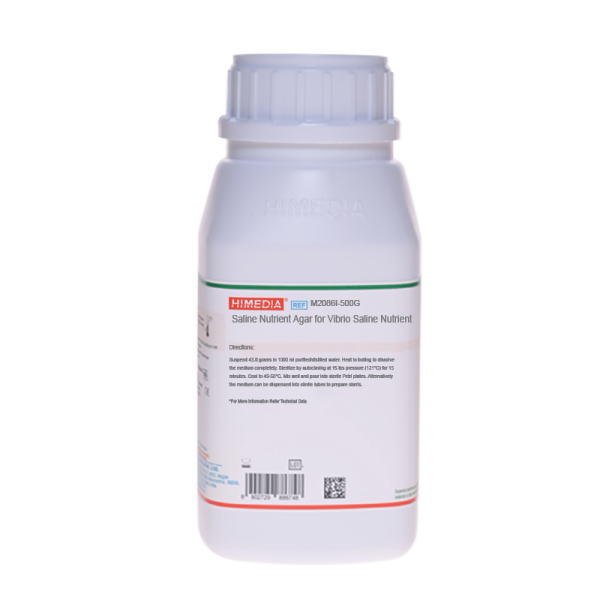
Suspend 33.0 grams in 1000 ml purified/distilled water. Heat to boiling to dissolve the medium completely. Sterilize by autoclaving at 15 lbs pressure (121°C) for 15 minutes. Cool to 45-50°C. Mix well and pour into sterile Petri plates. Alternatively the medium can be dispensed into tubes to prepare slants.
Vibrio's are fairly easy to isolate from both clinical and environmental materials, though some species may require growth factors and /or vitamins. Vibrio parahaemolyticus is the leading cause of bacterial diarrhea associated with the consumption of contaminated food products. Media can be made selective for Vibrio's by adding appropriate selective agents (1). This medium is recommended by ISO to isolate Vibrio species from food, animal feeding stuff and environmental samples from areas in food production and food handling (1). Vibrio furnissii is a non-halophilic Vibrio, which cannot grow in media with a concentration of sodium chloride greater than 5-6% and is able to grow in media lacking NaCl (1).
Peptone and HM extract provide the necessary nitrogen compounds, carbon, vitamins and also some trace ingredients necessary for the growth of bacteria. Sodium chloride maintains the osmotic equilibrium of the medium.
Food and animal feeding stuffs, environmental samples from areas in food production and food handling.
For food and animal feeds, environmental samples in area of food production and food handling, follow appropriate techniques for sample collection and processing as per guidelines (1). After use, contaminated materials must be sterilized by autoclaving before discarding.
Primary Selective enrichment : 25gm or 25ml of test portion in 225ml ASPW, temperature depends upon the target Vibrio species and state of product like deep frozen or fresh for 6 h ± 1 hour (For V. parahaemolyticus & V. furnissii at 41.5± 1°C in fresh foods and 37± 1°C for deep frozen ,dried or salted products, For V.vulnificus at 37± 1°C for all product states).
Secondary Selective enrichment : Transfer 1 ml of culture from primary enrichment broth to 10ml of ASPW (sample is not agitated before taking the aliquot). Incubate the ASPW at 41.5 °C ± 1 °C and/or 37 °C ± 1 °C for 18 h ± 1 hour.
Isolation and identification : The cultures obtained in the ASPW are transfered on TCBS Agar (M189), incubate at 37 °C ± 1 °C for 24 h ± 3 hour, for development of well-isolated colonies. For the second selective medium, examine for the presence of colonies, which, according to their characteristics, may be considered as possible isolates of V. parahaemolyticus, V. vulnificus, and/or V. furnissii.
Confirmation : By molecular PCR and/or biochemical approaches. For biochemical testing, inoculate the colonies selected onto the surface of plates of Saline Nutrient Agar (M2086I). Incubate at 37 °C ± 1 °C for 24 h ± 3 hour. From these isolated colonies are inoculated in Arginine Dihydrolase Saline Broth (M1644I) and/or L- Lysine Decarboxylase Saline Broth (LDC) (M1778I), incubate at 37 °C ± 1 °C for 24 h ± 3 hour.
Read the label before opening the container. Wear protective gloves/protective clothing/eye protection/ face protection. Follow good microbiological lab practices while handling specimens and culture. Standard precautions as per established guidelines should be followed while handling specimens. Safety guidelines may be referred in individual safety data sheets.
Performance of the medium is expected when used as per the direction on the label within the expiry period when stored at recommended temperature.
Appearance: Cream to yellow homogeneous free flowing powder
Gelling: Firm, comparable with 1.5% Agar gel
Colour and Clarity of prepared medium: Light yellow coloured clear to slightly opalescent gel forms in Petri plates
Reaction: Reaction of 3.3 % w/v aqueous solution at 25°C. pH : 7.2±0.2
pH: 7.00 -7.40
Cultural Response: Cultural characteristics observed after an incubation at 37 ± 1°C for 24 ± 3 hours.
| Organism | Inoculum (CFU) | Growth | Recovery |
|---|---|---|---|
| Vibrio parahaemolyticus NCTC 10885 (00185*) | 50-100 | good-luxuriant | >=70% |
| Vibrio furnissii NCTC 11218 (00186*) | 50-100 | good-luxuriant | >=70% |
| Vibrio vulnificus ATCC 27562 (00139*) | 50-100 | good-luxuriant | >=70% |
| Vibrio mimicus ATCC 33653 | 50-100 | good-luxuriant | >=70% |
| Vibrio alginolyticus ATCC 17749 | 50-100 | good-luxuriant | >=70% |
Key : (*) Corresponding WDCM numbers.
Store between 10-30°C in a tightly closed container and the prepared medium at 20-30°C. Use before expiry date on the label. On opening, product should be properly stored dry, after tightly capping the bottle in order to prevent lump formation due to the hygroscopic nature of the product. Improper storage of the product may lead to lump formation. Store in dry ventilated area protected from extremes of temperature and sources of ignition Seal the container tightly after use. Product performance is best if used within stated expiry period.
User must ensure safe disposal by autoclaving and/or incineration of used or unusable preparations of this product. Follow established laboratory procedures in disposing of infectious materials and material that comes into contact with sample must be decontaminated and disposed of in accordance with current laboratory techniques (2,3).
| Product Name | Saline Nutrient Agar for Vibrio |
|---|---|
| SKU | M2086I |
| Product Type | Regular |
| Physical Form | Powder |
| Origin | Animal |
| Packaging type | HDPE |
| References | To be added |
| Customized Product Available | No |