HiMedia Laboratories GmbH, Marie-Curie-Str. 3, 64683, Einhausen, Germany.

 Your enquiry has been submitted
Something problem with the server. Try again.

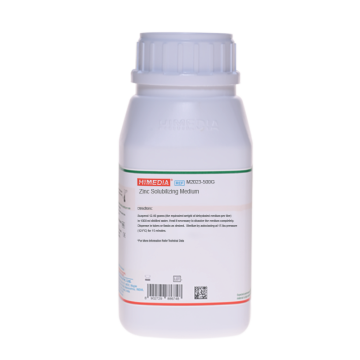
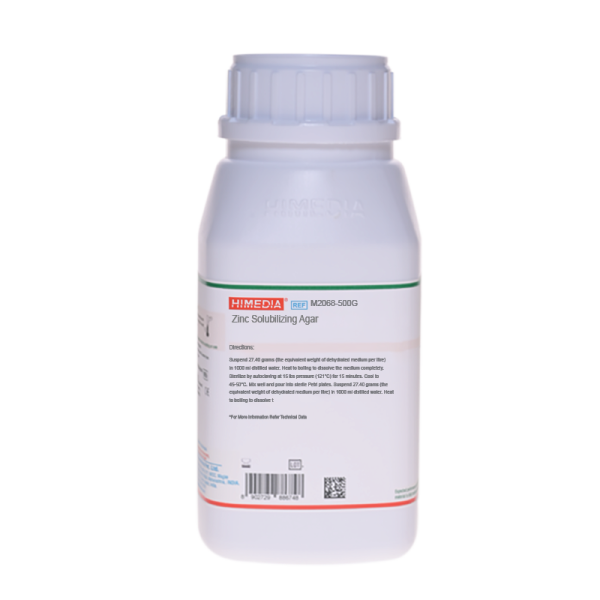
Zinc Solubilizing agar is recommended for isolation and detection of zinc solubilizing soil microorganisms.
| Ingredients | Gms / Litre |
|---|---|
| Dextrose (Glucose) | 10.000 |
| Ammonium sulphate | 1.000 |
| Potassium chloride | 0.200 |
| Dipotassium hydrogen phosphate | 0.100 |
| Magnesium sulphate, heptahydrate | 0.200 |
| Zinc oxide | 1.000 |
| Agar | 15.000 |
**Formula adjusted, standardized to suit performance parameters
Suspend 27.40 grams(the equivalent weight of dehydrated medium per litre) in 1000 ml distilled water. Heat to boiling to dissolve the medium completely. Sterilize by autoclaving at 15 lbs pressure (121°C) for 15 minutes. Cool to 45-50°C. Mix well and pour into sterile Petri plates.
Among all micro nurients, Zinc is a rather unique element for plant nutrition. Zinc (Zn) is one of the essential micronutrients required for optimum plant growth. Substantial quantity of applied inorganic zinc in soil is converted into unavailable form. Zinc solubilising bacteria are potential alternates for zinc supplement. Zinc solubilizing bacteria solubilize both the insoluble zinc compounds, though ZnO is more effectively solubilized in comparison to ZnCO3 (1).
Dextrose acts as an energy source. Different salts provides various essential ions required for promoting growth of zinc solubilizers. Colonies of the microorganism produced clear haloes on solid medium incorporating zinc phosphate, but only when dextrose was provided as the carbon source. Solubilization of zinc phosphate occurred by both an increase in the H+ concentration of the medium, probably a consequence of ammonia assimilation, and the production of gluconic acid (2).
Soil samples
For soil samples follow appropriate techniques for handling specimens as per established guidelines (1,2).
After use, contaminated materials must be sterilized by autoclaving before discarding.
Read the label before opening the container. Wear protective gloves/protective clothing/eye protection/ face protection. Follow good microbiological lab practices while handling specimens and culture. Standard precautions as per established guidleines should be followed while handling specimens. Safety guidelines may be referred in individual safety data sheets.
Performance of the medium is expected when used as per the direction on the label within the expiry period when stored at recommended temperature.
Appearance Cream to white homogeneous free flowing powder
Gelling Firm, comparable with 1.5% Agar gel
Colour and Clarity of prepared medium Creamish white to slightly opalescent gel forms in Petri plate.
Reaction Reaction of 2.74% w/v aqueous solution at 25°C.
Cultural characteristics observed after an incubation at 25-30°C for 3-4 days.
| Organisms | Inoculum (CFU) | Growth | Zinc solubilization |
|---|---|---|---|
| Pseudomonas fluorescens ATCC 49838 | 50-100 | Luxuriant | Clearing around the colony |
| Pseudomonas fluorescens ATCC 13525 | 50-100 | Luxuriant | Clearing around the colony |
| Bacillus cereus ATCC 10876 | 50-100 | Luxuriant | Clearing around the colony |
Store below 10-30°C in a tightly closed container and the prepared medium at 20-30°C. Use before expiry date on the label. On opening, product should be properly stored dry, after tightly capping the bottle inorder to prevent lump formation due to the hygroscopic nature of the product. Improper storage of the product may lead to lump formation. Store in dry ventilated area protected from extremes of temperature and sources of ignition. Seal the container tightly after use. Use before expiry date on the label
Product performance is best if used within stated expiry period.
User must ensure safe disposal by autoclaving and/or incineration of used or unusable preparations of this product. Follow established laboratory procedures in disposing of infectious materials and material that comes into contact with clinical sample must be decontaminated and disposed of in accordance with current laboratory techniques (3,4).
| Product Name | Zinc Solubilizing Agar |
|---|---|
| SKU | M2068 |
| Product Type | Regular |
| Physical Form | Powder |
| Origin | Chemically defined |
| Packaging type | HDPE |
| References | 1.Mueller J. H. and Hinton J., 1941, Proc. Soc. Exp. Biol. Med., 48:330.2.Method for Antifungal Disk Diffusion Susceptibilty Testing of yeasts; Approved Guideline Second Edition M44-A2 Vol.24No.17.3.Present Status and Future Work, WHO Sponsored collaborative study, Chicago, Oct. 1967.4.Bauer A. W., Kirby W. M., Sherris J. L. and Turck M., 1966, Am. J. Clin. Pathol., 45:493.5.Isenberg, H.D. Clinical Microbiology Procedures Handb0ook. 2ndEdition. |
| Customized Product Available | No |