HiMedia Laboratories GmbH, Marie-Curie-Str. 3, 64683, Einhausen, Germany.

 Your enquiry has been submitted
Something problem with the server. Try again.
 Your enquiry has been submitted
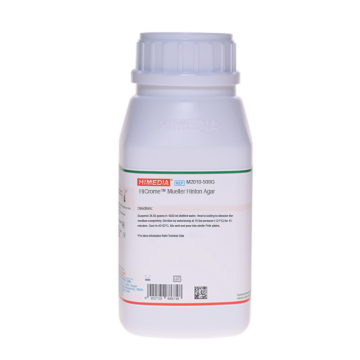
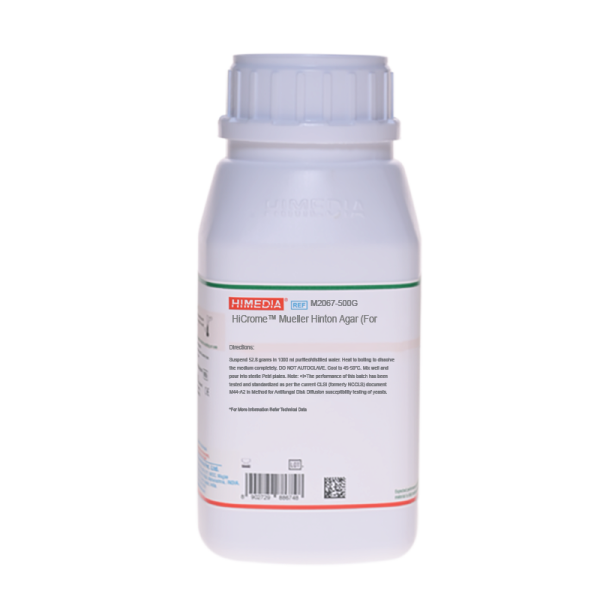
Recommended for the chromogenic differentiation of yeasts from clinical samples and determination of susceptibility to antifungal agents.
| Ingredients | g / L |
|---|---|
| Acicase ## | 14.000 |
| Dextrose | 20.000 |
| Chromogenic mixture | 1.800 |
| Agar | 17.000 |
Final pH ( at 25°C): 7.3±0.1
**Formula adjusted, standardized to suit performance parameters
## - Equivalent to Casein acid hydrolysate
Suspend 52.80 grams in 1000 ml purified / distilled water. Heat to boiling to dissolve the medium completely. DO NOT AUTOCLAVE. Cool to 45-50°C. Mix well and pour into sterile Petri plates. The performance of this batch has been tested and standardized as per the current CLSI (formerly NCCLS) document M44-A2 in Method for Antifungal Disk Diffusion susceptibility Testing of yeasts.
The Mueller Hinton formulation was originally developed as a simple, transparent agar medium for the cultivation of pathogenic species (1). Mueller Hinton Agar, Modified (as per CLSI for antifungal) is recommended for the diffusion of antifungal agents impregnated on paper disc through an agar gel as described in CLSI Approved Standard (2). When supplemented with glucose to a final concentration of 2%, it provides for suitable fungal growth. Kirby-Bauer et al recommended Mueller Hinton Agar for performing antibiotic susceptibility tests using a single disc of high concentration (3). WHO Committee on Standardization of Susceptibility Testing has accepted Mueller Hinton Agar for determining the susceptibility of microorganisms because of its reproducibility (4). Mueller Hinton Agar with 5% sheep blood and Mueller Hinton Agar with Haemoglobin have been recommended for antimicrobial susceptibility testing of Streptococcus pneumoniae and Haemophilus influenzae. Similarly HiCrome®Â® Mueller Hinton Agar is recommended for antifungal susceptibility testing of discs on the basis of chromogenic differentiation. Perry and Miller (5) reported that Candida albicans produces an enzyme ß-N-acetyl-galactosaminidase and according to Rousselle et al (6) incorporation of chromogenic or fluorogenic hexosaminidase substrates into the growth medium helps in identification of C.albicans isolates directly on primary isolation.
Acicase provide nitrogenous and carbonaceous compounds, long chain amino acids, sulphur and other essential nutrients. Starch acts as a protective colloid against toxic substances present in the medium. Starch hydrolysis yields dextrose, which serves as a source of energy. Glucose serves as an energy source for fungal cultures. C.albicans appear as light green coloured smooth colonies, C.tropicalis appear as blue to metallic blue coloured raised colonies. C.glabrata colonies appear as cream to white smooth colonies, while C.krusei appear as purple fuzzy colonies.
Preparation of Inoculum:
Isolated Microorganism from clinical sample.
For clinical samples follow appropriate techniques for handling specimens as per established guidelines (7,8). After use, contaminated materials must be sterilized by autoclaving before discarding.
In Vitro diagnostic Use only. For professional use only. Read the label before opening the container. Wear protective gloves/protective clothing/eye protection/face protection. Follow good microbiological lab practices while handling specimens and culture. Standard precautions as per established guidelines should be followed while handling clinical specimens. Safety guidelines may be referred in individual safety data sheets.
Performance of the medium is expected when used as per the direction on the label within the expiry period when stored at recommended temperature.
Appearance Cream to yellow homogeneous free flowing powder
Gelling Firm, comparable with 1.7% Agar gel
Colour and Clarity of prepared medium Yellow to amber coloured opalescent gel forms in Petri plates.
Reaction Reaction of 5.28% w/v aqueous solution at 25°C. pH : 7.3±0.2
pH 7.10-7.50
Cultural response A luxuriant growth of test organisms was observed on HiCrome®Â® Mueller Hinton Agar in 24-48 hours at 33-37°C along with inhibition zones with respective antibiotic concentrations.
| Organism | Growth | Colour of colony | Sensitivity testing | |
|---|---|---|---|---|
| Fluconazole FLC (25 mcg) | Voriconazole VRC (1 mcg) | |||
| Candida albicans ATCC 90028 | luxuriant | green | 28-39 mm | 31-42mm |
| Candida parapsilosis ATCC 22019 | luxuriant | cream | 22-33mm | 28-37mm |
| Candida tropicalis ATCC 750 | luxuriant | blue | 26-37mm | - |
| Candida krusei ATCC 6258 | luxuriant | purple | - | 16-25mm |
Store between 15-25°C in a tightly closed container and the prepared medium at 2-8°C. Use before expiry date on the label. On opening, product should be properly stored dry, after tightly capping the bottle in order to prevent lump formation due to the hygroscopic nature of the product. Improper storage of the product may lead to lump formation. Store in dry ventilated area protected from extremes of temperature and sources of ignition Seal the container tightly after use. Product performance is best if used within stated expiry period.
User must ensure safe disposal by autoclaving and/or incineration of used or unusable preparations of this product. Follow established laboratory procedures in disposing of infectious materials and material that comes into contact with clinical sample must be decontaminated and disposed of in accordance with current laboratory techniques (7,8).
| Product Name | HiCrome® Mueller Hinton Agar (For antifungal testing) |
|---|---|
| SKU | M2067 |
| Product Type | HiCrome™ |
| Physical Form | Powder |
| Origin | Animal |
| Packaging type | HDPE |
| References | 1. Koneman E. W., Allen S. D., Janda W.M., Schreckenberger P.C., Winn W.C. Jr., 1992, Colour Atlas and Textbook ofDiagnostic Microbiology, 4th Ed., J. B. Lippinccott Company |
| Customized Product Available | No |