HiMedia Laboratories GmbH, Marie-Curie-Str. 3, 64683, Einhausen, Germany.

 Your enquiry has been submitted
Something problem with the server. Try again.
 Your enquiry has been submitted
Recommended for the enumeration of Clostridium perfringens from water samples. The composition and performance criteria of this medium are as per the specifications laid down in ISO 14189:2013.
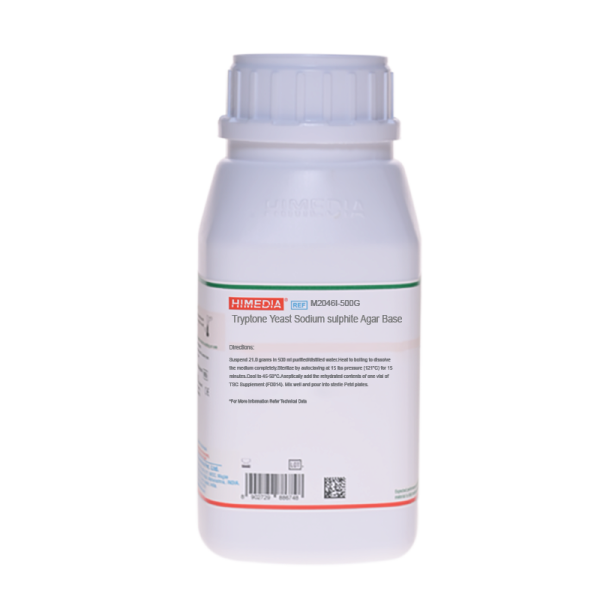
Tryptone Yeast Sodium Sulphite Agar Base M2046I
| Ingredients | g / L |
|---|---|
| Tryptone # | 15.000 |
| Soya peptone ## | 5.000 |
| Yeast extract | 5.000 |
| Sodium metabisulphite | 1.000 |
| Ferric ammonium citrate | 1.000 |
| Agar | 15.000 |
| Final pH (at 25°C) | 7.6±0.2 |
Supplement to be added after autoclaving
| Ingredients | g / L |
|---|---|
| D-cycloserine | 4.000 |
T.S.C. Supplement - FD014
| Ingredients | mg / vial |
|---|---|
| D-Cycloserine | 200mg |
Key : # - Enzymatic digest of casein, ## Enzymatic digest of soya **Formula adjusted, standardized to suit performance parameters
Suspend 21.0 grams in 500 ml purified / distilled water. Heat to boiling to dissolve the medium completely. Sterilize by autoclaving at 15 lbs pressure (121°C) for 15 minutes. Cool to 45-50°C. Aseptically add the rehydrated contents of one vial of T.S.C. Selective Supplement (FD014). Mix well and pour into sterile Petri plates.
Tryptose Sulphite Cycloserine Agar (TSC) was originally formulated by Harmon et al (1) for the enumeration of C. perfringens from food. TSC Agar has been documented as one of the most useful media for the quantitative recovery of C. perfringens while suppressing growth of other facultative anaerobes (2). Tryptone Yeast Sodium sulphite Agar Base has been recommended by the ISO Committee for the isolation of C.perfringens from water samples using membrane filtration technique (3). Tryptone, Soya peptone and yeast extract provide nitrogenous compounds, carbon, long chain amino acids, sulphur, vitamin B complex and trace elements essential for clostridial growth. Sodium metabisulphite and ferric ammonium citrate act as an indicator of sulphite reduction, indicated by black coloured colonies. D-Cycloserine (FD014) help in the selective isolation of C.perfringens by inhibiting accompanying flora. The water sample to be tested is filtered through 0.45 micron filter membrane and the membrane filter is then placed on Tryptone Yeast Sodium sulphite Agar Base and incubated anaerobically at 43-45°C for 18-24 hours. Sulfite reacts with ferric salt to produce sulfide which results in production of black or grey to yellow brown colonies.
Confirmatory test : Smear some growth of 24 hours old culture of Clostridium perfringens from Blood Agar / Columbia Agar Base/ Tryptone Soya Agar (incubated anaerobically at 34-38°C) on sterile filter paper. Add 2-3 drops of Acid phosphatase Reagent (R096) on to the colonies of filter paper, observe for appearance of strong purplish colour developed within 3-4 min which is positive reaction for Clostridium perfringens.
Water samples
For water samples, follow appropriate techniques for sample collection, processing as per guidelines and local standards (3,4).
After use, contaminated materials must be sterilized by autoclaving before discarding.
Read the label before opening the container. Wear protective gloves/protective clothing/eye protection/ face protection. Follow good microbiological lab practices while handling specimens and culture. Standard precautions as per established guidelines should be followed while handling specimens. Safety guidelines may be referred in individual safety data sheets.
Performance of the medium is expected when used as per the direction on the label within the expiry period when stored at recommended temperature.
Appearance Light yellow to brownish yellow homogeneous free flowing powder
Gelling Firm, comparable with 1.5% Agar gel
Colour and Clarity of prepared medium Amber coloured clear to slightly opalescent gel forms in Petri plates.
Reaction Reaction of 4.2% w/v aqueous solution at 25°C. pH : 7.6±0.2
pH 7.40-7.80
Cultural Response
Productivity : Cultural response was observed after an incubation (anaerobic atmosphere) at 44 ± 1°C for 21 ± 3 hours, with added sterile T.S.C. Selective Supplement (FD014). Recovery rate is considered as 100% for bacteria growth on Reference medium - Soyabean Casein Digest Agar (Tryptone Soya Agar).
Selectivity : Cultural response was observed after an incubation (anaerobic atmosphere) at 44 ± 1°C for 21 ± 3 hours, with added sterile T.S.C. Selective Supplement (FD014).
| Organism | Inoculum (CFU) | Growth | Recovery^ | Sulphite Reduction | Acid phosphatase test $ |
|---|---|---|---|---|---|
| Productivity | |||||
| Clostridium perfringens ATCC 12916 (00080*) | 50-100 | luxuriant | >=50% | positive, black coloured colonies | Positive Reaction |
| Clostridium perfringens ATCC 13124 (00007*) | 50-100 | luxuriant | >=50% | positive, black coloured colonies | Positive Reaction |
| Clostridium perfringens ATCC 10543 (00174*) | 50-100 | luxuriant | >=50% | positive, black coloured colonies | Positive Reaction |
| Selectivity | |||||
| ** Bacillus spizizenii ATCC 6633 (00003*) | >=104 | inhibited | 0% | ||
Key : (*) - Corresponding WDCM numbers (**) - Formerly known as Bacillus subtilis subsp. spizizenii ($) - Acid phosphatase test - Positive reaction : Development of purplish colour within 3-4 minutes on addition of R096 -(Acid phosphatase reagent) (^) - Recovery obtained for productivity is >=70% when compared to a previously validated batch of Tryptone Yeast Sodium Sulphite Agar Base
Store between 10-30°C in a tightly closed container and the prepared medium at 2-8°C. Use before expiry date on the label. On opening, product should be properly stored dry, after tightly capping the bottle in order to prevent lump formation due to the hygroscopic nature of the product. Improper storage of the product may lead to lump formation. Store in dry ventilated area protected from extremes of temperature and sources of ignition Seal the container tightly after use. Product performance is best if used within stated expiry period.
User must ensure safe disposal by autoclaving and/or incineration of used or unusable preparations of this product. Follow established laboratory procedures in disposing of infectious materials and material that comes into contact with sample must be decontaminated and disposed of in accordance with current laboratory techniques (5,6).
| Product Name | Tryptone Yeast Sodium Sulphite Agar Base |
|---|---|
| SKU | M2046I |
| Product Type | Regular |
| Physical Form | Powder |
| Origin | Animal |
| Packaging type | HDPE |
| References | 1.Seeliger H. P. R., and Jones D., 1986, Bergeys Manual of Systematic Bacteriology, Vol. The Williams and WilkinsCo., Baltimore. 2.Nieman R. E., and Lorber B., 1980, Rev. Infect. Dis. 2 : 207-227.3.Schuchat A. B., Swaminathan and C. V. Broome, Clin. Microbiol. Rev.4:169-18 |
| Customized Product Available | No |