HiMedia Laboratories GmbH, Marie-Curie-Str. 3, 64683, Einhausen, Germany.


 Your enquiry has been submitted
Something problem with the server. Try again.

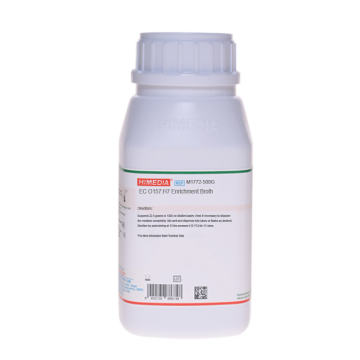
EC 0157:H7 Selective Broth is recommended for the isolation of Escherichia coli O157:H7 from food samples.
| Ingredients | Gms / Litre |
|---|---|
| Part A | |
| Proteose peptone | 5.000 |
| Yeast extract | 3.000 |
| D-Mannitol | 2.500 |
| Sodium pyruvate | 2.500 |
| Potassium monophosphate | 1.500 |
| Sodium phosphate dibasic | 3.500 |
| Sodium chloride | 5.000 |
| Magnesium sulphate, anhydrous | 0.300 |
| Ferrous sulphate green, ACS | 0.040 |
| Sodium thioglycollate | 0.100 |
| Part B | |
| Niaproof 4 | 1.000 |
| Tween 80 | 0.750 |
**Formula adjusted, standardized to suit performance parameters
Suspend 23.44 grams of Part A in 1000 ml purified / distilled water with 1.75 ml of Part B. Heat if necessary to dissolve the medium completely. DO NOT AUTOCLAVE. Cool to 45-50ºC. Dispense into sterile tubes or flasks as desired.
Enterohemorrhagic E.coli strains are also termed as verocytotoxin-producing E.coli (VTEC/ EHEC). Although many different serotypes of Escherichia coli are known to produce verocytotoxin (4) those of Escherichia coli O157:H7 and O157:H are so far the common types causing human infections. O157 VTEC strains have several unusual biochemical characters that are exploited in methods for their laboratory identification. Enterohemorrhagic E.coli (EHEC) can cause severe foodborne disease. EHEC is the primary cause of hemorrhagic colitis. This infection can also lead to hemolytic uremic syndrome (5). It is transmitted to humans primarily through consumption of contaminated foods, such as raw or undercooked ground meat products and raw milk. Its significance as a public health problem was recognized in 1982, following an outbreak in the United States of America. EHEC produces toxins, known as verotoxins or Shiga-like toxins because of their similarity to the toxins produced by Shigella dysenteriae (6).
The media Proteose peptone and yeast extract as carbon and nitrogen sources, long chain amino acids, vitamins and minerals. Phosphates buffer the medium. Magnesium sulphate and ferrous sulphate are sources of ions that simulate metabolism. Sodium chloride maintains the osmotic balance. Mannitol serves as a carbon source.
Food samples
For food samples, follow appropriate techniques for sample collection and processing as per guidelines (3). After use, contaminated materials must be sterilized by autoclaving before discarding.
Read the label before opening the container. Wear protective gloves/protective clothing/eye protection/face protection. Follow good microbiological lab practices while handling specimens and culture. Standard precautions as per established guidelines should be followed while handling specimens. Safety guidelines may be referred in individual safety data sheets.
Performance of the medium is expected when used as per the direction on the label within the expiry period when stored at recommended temperature.
Appearance Part A: Cream to yellow homogeneous free flowing powder Part B: Pale yellow to yellow viscous solution
Colour and Clarity of prepared medium Yellow coloured, opalescent solution with slight precipitate
Cultural Response Cultural characteristics observed after an incubation at 35-37°C for 18-24 hours.
| Organism | Inoculum (CFU) | Growth |
|---|---|---|
| Escherichia coli O157:H7 NCTC 12900 | 50-100 | good |
| Staphylococcus aureus ATCC 25923 (00034*) | >=104 | inhibited |
| Salmonella Typhimurium ATCC 14028 (00031*) | 50-100 | good |
| Enterococcus faecalis ATCC 29212 (00087*) | >=104 | inhibited |
| Escherichia coli ATCC 25922 (00013*) | 50-100 | good |
Key : *Corresponding WDCM numbers.
Store between 10-30°C in a tightly closed container and the prepared medium at 2 - 8°C. Use before expiry date on the label. On opening, product should be properly stored dry, after tightly capping the bottle in order to prevent lump formation due to the hygroscopic nature of the product. Improper storage of the product may lead to lump formation. Store in dry ventilated area protected from extremes of temperature and sources of ignition Seal the container tightly after use. Product performance is best if used within stated expiry period.
User must ensure safe disposal by autoclaving and/or incineration of used or unusable preparations of this product. Follow established laboratory procedures in disposing of infectious materials and material that comes into contact with clinical sample must be decontaminated and disposed of in accordance with current laboratory techniques (1,2).
| Product Name | EC 0157:H7 Selective Broth (Twin Pack) |
|---|---|
| SKU | M2044 |
| Product Type | Regular |
| Physical Form | Powder |
| Origin | Animal |
| Packaging type | HDPE |
| References | To be added |
| Customized Product Available | No |