HiMedia Laboratories GmbH, Marie-Curie-Str. 3, 64683, Einhausen, Germany.

 Your enquiry has been submitted
Something problem with the server. Try again.
 Your enquiry has been submitted
Recommended for presumptive enumeration of Listeria sp. using membrane filtration technique.
| Ingredients | Gms / Litre |
|---|---|
| Tryptone | 10.000 |
| Yeast extract | 1.000 |
| Sodium pyruvate | 10.000 |
| HL extract # | 10.000 |
| Sodium carbonate | 1.000 |
| Magnesium sulfate | 7.400 |
| Dextrose (Glucose) | 1.000 |
| Lithium chloride | 5.000 |
| Acriflavin | 0.015 |
| Agar | 15.000 |
Final pH ( at 25°C): 7.4±0.1
**Formula adjusted, standardized to suit performance parameters
# - Equivalent to Liver extract
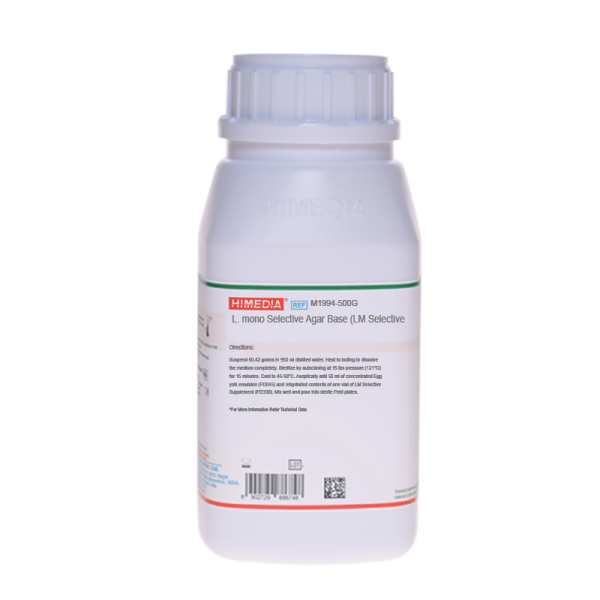
Suspend 60.42 grams in 950 ml purified / distilled water. Heat to boiling to dissolve the medium completely. Sterilize by autoclaving at 15 lbs pressure (121°C) for 15 minutes. Cool to 45- 50°C. Aseptically add 50ml of concetrated Egg yolk emulsion (FD045) and rehydrated contents of 1 vial of LM Selective Supplement (FD330). Mix well and pour into sterile Petri plates.
The genus Listeria constitutes Listeria monocytogenes, Listeria ivanovii, Listeria seeligeri, Listeria welshimerii, Listeria innocua, Listeria grayi, Listeria murrayi and Listeria denitrificans. Among these, L. monocytogenes and L. ivanovii are associated with diseases in humans. The pathogenicity of L. ivanovii is uncertain. L. monocytogenes is found in a wide variety of habitats, including the normal microflora of healthy ruminants, gastrointestinal tract of asymptomatic humans and environmental sources (5).
LM Selective Agar Base is recommended for the direct presumptive enumeration of Listeria species especially Listeria monocytogenes from meat, poultry, dairy products and environmental samples using membrane filtration technique (1).
Tryptone and HL extract supplies nitrogeneous compounds, amino acids and long chain peptides. Yeast extract supplies vitamins especially vitamin B required by the organisms. Dextrose (Glucose) is the carbohydrate and energy sources. Sodium chloride maintains the osmotic equilibrium of the medium. Sodium pyruvate serves as a energy source and helps in the recovery of microrganisms. Sodium carbonate buffers the medium. Lithium chloride and Acriflavin are selective agents. Polymyxin B Sulphate, Nalidixic acid and Moxalactum sodium helps in inhibiting the accompaying microflora. Triphenyltetrazolium chloride is reduced by Listeria species resulting in pink to dark pink-orange coloured colonies.
Prepare the sample homogenate for the sample to be tested. Filter 1 ml of the homogenate through membrane filter. Place the membrane on plates of L.mono Selective Agar Base. Incubate the plates at 35-37°C for 18-48 hours. After incubation observe for pink to pink -red coloured colonies as presumptive Listeria species.
Food samples; Enviormental samples.
For food samples, follow appropriate techniques for sample collection and processing as per guidelines (4).
For enviormental samples, follow appropriate techniques for sample collection, processing as per guidelines and local standards. (5)
After use, contaminated materials must be sterilized by autoclaving before discarding.
Read the label before opening the container. Wear protective gloves/protective clothing/eye protection/ face protection. Follow good microbiological lab practices while handling specimens and culture. Standard precautions as per established guidelines should be followed while handling specimens. Safety guidelines may be referred in individual safety data sheets.
Performance of the medium is expected when used as per the direction on the label within the expiry period when stored at recommended temperature.
Appearance: Cream to yellow homogeneous free flowing powder
Gelling: Firm, comparable with 1.5% Agar gel.
Colour and Clarity of prepared medium: Basal medium : Yellow coloured clear to slightly opalescent gel. After addition of Egg yolk emulsion : Yellow coloured opaque gel forms in Petri plates.
Reaction: Reaction of 6.04% w/v aqueous solution at 25°C. pH : 7.4±0.1
pH: 7.30-7.50
Cultural Response: Cultural characteristics observed on membrane filter with added Egg Yolk emulsion (FD045) and LM Selective Supplement (FD330), after an incubation at 35-37°C for 24-48 hours.
| Organism | Inoculum (CFU) | Growth | Recovery | Colony characteristics |
|---|---|---|---|---|
| Escherichia coli ATCC 25922 (00013*) | >=104 | inhibited | 0% | |
| Listeria monocytogenes subsps. serovar 1 ATCC 19111 (00020*) | 50-100 | luxuriant | >=50% | pink to dark pink-red |
| Listeria monocytogenes ATCC 19112 | 50-100 | luxuriant | >=50% | pink to dark pink-red |
| Listeria monocytogenes ATCC 19117 | 50-100 | luxuriant | >=50% | pink to dark-pink-red |
| Listeria monocytogenes ATCC 19118 | 50-100 | luxuriant | >=50% | pink to dark pink-red |
| Staphylococcus aureus subsp. aureus ATCC 25923 (00034*) | 50-100 | none-poor | <=10% | pale to dark orange |
Key : (*) Corresponding WDCM numbers.
Store dehydrated and the prepared medium at 2-8°C. Use before expiry date on the label. On opening, product should be properly stored dry, after tightly capping the bottle in order to prevent lump formation due to the hygroscopic nature of the product. Improper storage of the product may lead to lump formation. Store in dry ventilated area protected from extremes of temperature and sources of ignition Seal the container tightly after use. Product performance is best if used within stated expiry period.
User must ensure safe disposal by autoclaving and/or incineration of used or unusable preparations of this product. Follow established laboratory procedures in disposing of infectious materials and material that comes into contact with clinical sample must be decontaminated and disposed of in accordance with current laboratory techniques (2,3).
| Product Name | L.mono Selective Agar Base (LM Selective Agar Base) |
|---|---|
| SKU | M1994 |
| Product Type | Regular |
| Physical Form | Powder |
| Origin | Animal |
| Packaging type | HDPE |
| References | 1. Entis, P. and I. Lerner. 2000. Twenty-four hour direct presumptive enmeration of Listeria monocytogenes in foodand environmental samples using ISO-GRID method with LM-137 Agar. J. Food Prot. 63:354- 363 |
| Customized Product Available | No |