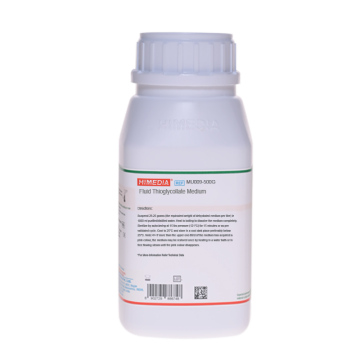
HiMedia Laboratories GmbH, Marie-Curie-Str. 3, 64683, Einhausen, Germany.

 Your enquiry has been submitted
Something problem with the server. Try again.
 Your enquiry has been submitted
Recommended for testing sterility of biological products and for isolation of aerobic and anaerobic organisms.
| Ingredients | Gms / Litre |
|---|---|
| HM peptone B # | 1.500 |
| Yeast extract | 2.000 |
| Peptone | 5.000 |
| Dextrose (Glucose) | 5.000 |
| Sodium chloride | 5.000 |
| Sodium thioglycollate | 1.100 |
| Methylene blue | 0.002 |
| Agar | 1.000 |
Final pH ( at 25°C): 7.2±0.2
**Formula adjusted, standardized to suit performance parameters # Equivalent to Beef extract
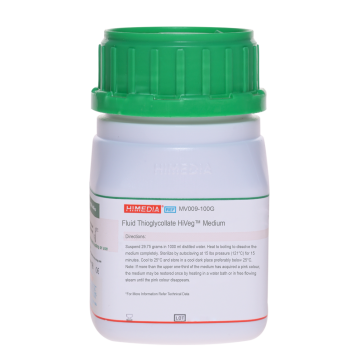
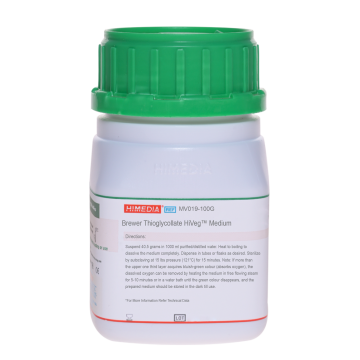
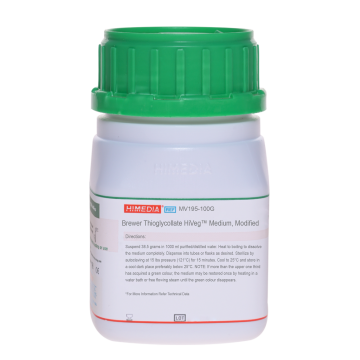
Suspend 20.6 grams in 1000 ml purified/distilled water. Heat to boiling to dissolve the medium completely. Dispense in tubes or flasks as desired. Sterilize by autoclaving at 15 lbs pressure (121°C) for 15 minutes.
Note: If more than the upper one third medium has acquired a green colour, the medium may be restored once by heating in a water bath or free flowing steam until the green colour disappears.
Brewer Thioglycollate Medium is prepared as per the original formula of Brewer (1,2). Brewer thioglycollate medium, modified is modification of original Brewer medium for sterility testing of product containing mercury preservatives. It contains highly nutritious Peptone, HM peptone B and yeast extract, which support luxuriant growth of even fastidious bacteria. Sodium thioglycollate helps to create anaerobic condition as well as neutralize toxicity of mercurial components in the test material. Very small amount of agar helps in maintaining anaerobic condition. Methylene blue will indicate oxygen content of the medium by establishing bluish green colour to the medium, in presence of oxygen. The modified medium contains more thioglycollate and is recommended for sterility testing procedure.
Industrial samples for sterility testing.
For industrial samples, follow appropriate techniques for sample collection, processing as per guidelines (1,2). After use, contaminated materials must be sterilized by autoclaving before discarding.
Read the label before opening the container. Wear protective gloves/protective clothing/eye protection/ face protection. Follow good microbiological lab practices while handling specimens and culture. Standard precautions as per established guidelines should be followed while handling specimens. Safety guidelines may be referred in individual safety data sheets.
Performance of the medium is expected when used as per the direction on the label within expiry period when stored at the recommended temperature.
Appearance: Cream to yellow coloured homogeneous free flowing powder
Colour and Clarity of prepared medium: Yellow coloured clear to slightly opalescent fluid with upper 10% or less medium bluish green on standing.
Reaction: Reaction of 2.06% w/v aqueous solution at 25°C. pH : 7.2±0.2
pH: 7.00-7.40
Cultural Response: Cultural characteristics observed after an incubation at 35 - 37°C for 18 - 48 hours
| Organism | Inoculum (CFU) | Growth |
|---|---|---|
| Bacillus megaterium ATCC 25848 | 50-100 | luxuriant |
| Bacteroides vulgatus ATCC 8482 | 50-100 | luxuriant |
| Candida albicans ATCC 10231 (00054*) | 50-100 | luxuriant |
| Clostridium sporogenes ATCC 11437 | 50-100 | luxuriant |
| Micrococcus luteus ATCC 10240 | 50-100 | luxuriant |
| Neisseria meningitidis ATCC 13090 | 50-100 | luxuriant |
| Staphylococcus aureus subsp. aureus ATCC 25923 (00034*) | 50-100 | luxuriant |
| Streptococcus mitis ATCC 9811 | 50-100 | luxuriant |
| Streptococcus pyogenes ATCC 19615 | 50-100 | luxuriant |
Key : (*) Corresponding WDCM numbers.
Store between 10-30°C in a tightly closed container and the prepared medium at 15-25°C. Use before expiry date on the label. On opening, product should be properly stored dry, after tightly capping the bottle in order to prevent lump formation due to the hygroscopic nature of the product. Improper storage of the product may lead to lump formation. Store in dry ventilated area protected from extremes of temperature and sources of ignition Seal the container tightly after use. Product performance is best if used within stated expiry period.
User must ensure safe disposal by autoclaving and/or incineration of used or unusable preparations of this product. Follow established laboratory procedures in disposing of infectious materials and material that comes into contact with sample must be decontaminated and disposed of in accordance with current laboratory techniques (3,4).
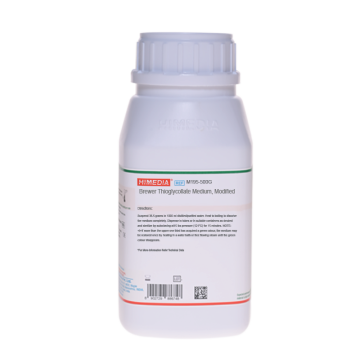
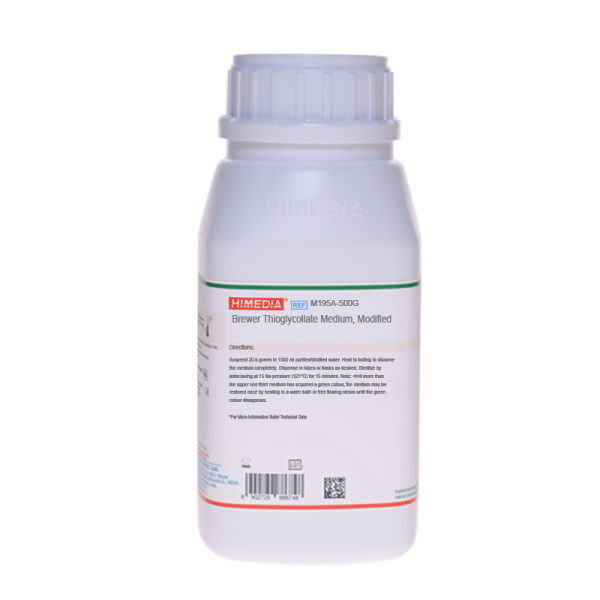
| Product Name | Brewer Thioglycollate Medium, Modified |
|---|---|
| SKU | M195A |
| Product Type | Regular |
| Physical Form | Powder |
| Origin | Animal |
| Packaging type | HDPE |
| References | 1.Miller,R.G.et al.1991.Xylose-Lysine-tergitol 4:an improved selective agar medium for the isolation of SalmonellaPoult.Sci.70:2429-2432.Erratum,Poult.Sci.71:398,1992. 2.Mallinson,E.T.et al.2000.Improved plating media for the detection of Salmonella species with typical and atypical hydrogensulfide production.J.Vet.Diagn.Invest.12:83-87. 3.Mallinson,E.T.1991.Novelsalmonelladetectionsystemdeveloped;combines increased reliability,practicality.Feedstuffs63:40-44. 4.Pollock,H.M. and B.J.Dahlgren.1974,Clinical evaluation of enteric media in the primary isolation of Salmonella and Shigella.Appl.Microbiol.27:197-201. 5.Miki,K.et al.1996.Re-speciation of the original strains of serovars in the Citrobacter freundii (Bethesda-Ballerup group)antigenic scheme of West and Edwards.Microbiol.Immunol.40:915-921. |
| Customized Product Available | No |