HiMedia Laboratories GmbH, Marie-Curie-Str. 3, 64683, Einhausen, Germany.

 Your enquiry has been submitted
Something problem with the server. Try again.
 Your enquiry has been submitted
Recommended for cultivation and studying haemolytic reactions of Bacillus cereus in accordance with ISO 21871:2006.
| Ingredients | g / L |
|---|---|
| Tryptone ## | 15.000 |
| Soya peptone# | 5.000 |
| Sodium chloride | 5.000 |
| Agar | 12.500 |
Final pH ( at 25°C) 7.3±0.2
**Formula adjusted, standardized to suit performance parameters
#- Equivalent to Enzymatic digest of soya
##- Equivalent to Enzymatic digest of casein
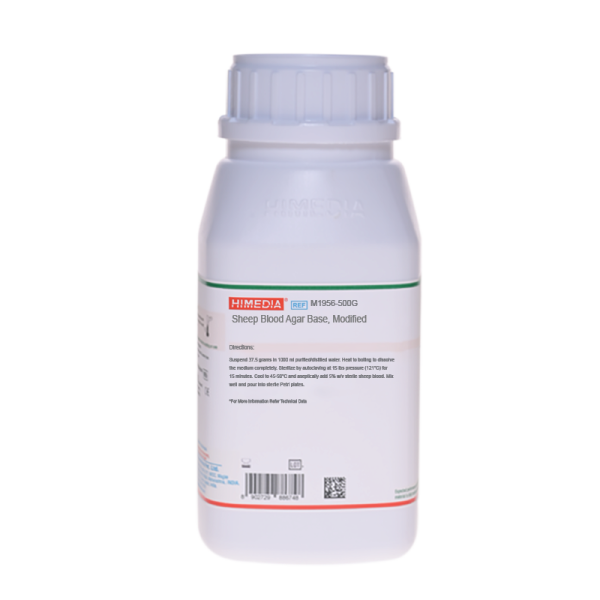
Suspend 37.5 grams in 1000 ml purified / distilled water. Heat to boiling to dissolve the medium completely. Sterilize by autoclaving at 15lbs pressure (121°C) for 15 minutes. Cool to 45-50°C and aseptically add 5% w/v sterile sheep blood. Mix well and pour into sterile Petri plates.
Haemolysins are exotoxins produced by bacteria that lyse red blood cells. The haemolytic reaction can be visualized on blood agar plates. On blood agar plates colonies of haemolytic bacteria may be surrounded by clear, colourless zone where the red blood cells have been lysed and the haemoglobin destroyed to a colourless compound. This is beta haemolysis. Other types of bacteria can reduce haemoglobin to methaemoglobin which produces a greenish zone around the colonies and is called alpha haemolysis (1). Gamma haemolysis is no haemolysis where no change in the medium is observed(2).
Bacillus cereus is Gram -positive aerobic or facultatively anaerobic, motile, spore forming, rod shaped bacterium that is widely distributed environmentally. B. cereus is associated mainly with food poisoning it is increasingly reported to be cause of serious and fatal non- gastointestinal-tract infections. Sheep Blood Agar Base, Modified with added sheep blood was developed to allow maximum recovery of B.cereus without interfering with their haemolytic reactions. This medium is formulated in accordance with ISO (3). It was formulated to be compatible with sheep blood and give improved haemolytic reactions of organisms. Tryptone and Soya peptone provide nitrogen, carbon, amino acids and vitamins. Sodium chloride maintains the osmotic balance.
Food and animal feeding stuff samples.
For food samples, follow appropriate techniques for sample collection and processing as per guidelines (4). After use, contaminated materials must be sterilized by autoclaving before discarding.
Read the label before opening the container. Wear protective gloves/protective clothing/eye protection/ face protection. Follow good microbiological lab practices while handling specimens and culture. Standard precautions as per established guidelines should be followed while handling specimens. Safety guidelines may be referred in individual safety data sheets.
Performance of the medium is expected when used as per the direction on the label within the expiry period when stored at recommended temperature.
Appearance Cream to yellow homogeneous free flowing powder
Gelling Firm, comparable with 1.25% Agar gel
Colour and Clarity of prepared medium Basal medium : Light amber coloured clear to slightly opalescent gel. After addition of 5% v/v sterile defibrinated blood : Cherry red coloured opaque gel forms in Petri plates.
Reaction Reaction of 3.75% w/v aqueous solution at 25°C. pH : 7.3±0.2
pH 7.10-7.50
Cultural Response Cultural characteristics observed with added 5% w/v sterile defibrinated blood, after an incubation at 35-37°C for 18-48 hours.
| Organism | Growth | Inoculum (CFU) | Recovery | Haemolysis |
|---|---|---|---|---|
| Bacillus cereus ATCC 10876 | luxuriant | 50-100 | >=70% | beta |
Store between 10-30°C in a tightly closed container and the prepared medium at 20-30°C. Use before expiry date on the label. On opening, product should be properly stored dry, after tightly capping the bottle in order to prevent lump formation due to the hygroscopic nature of the product. Improper storage of the product may lead to lump formation. Store in dry ventilated area protected from extremes of temperature and sources of ignition. Seal the container tightly after use. Product performance is best if used within stated expiry period.
User must ensure safe disposal by autoclaving and/or incineration of used or unusable preparations of this product. Follow established laboratory procedures in disposing of infectious materials and material that comes into contact with sample must be decontaminated and disposed of in accordance with current laboratory techniques (5,6).
| Product Name | Sheep Blood Agar Base, Modified |
|---|---|
| SKU | M1956 |
| Product Type | Regular |
| Physical Form | Powder |
| Origin | Animal |
| Packaging type | HDPE |
| References | 1.Pelczar M. J. Jr., Reid R. D., Chan E. C. S., 1977, Microbiology, 4th Ed., Tata McGraw-Hill Publishing Company Ltd,NewDelhi.2.Koneman E. W., Allen S. D., Janda W. M., Schreckenberger P. C., Winn W. C. Jr., 1992, Colour Atlas and TextbookofDiagnostic Microbiology, 4th Ed., J. B. Lippinccott Company.3.International Organization for Standardization (ISO),Draft ISO 21871:2006 Microbiology of Food & Animal feeding stuffs.Horizontal method for the determination of low numbers of presumptive Bacillus cereus-Most probable number technique anddetection methods. |
| Customized Product Available | No |