HiMedia Laboratories GmbH, Marie-Curie-Str. 3, 64683, Einhausen, Germany.

 Your enquiry has been submitted
Something problem with the server. Try again.

Recommended for selective and differential cultivation of Salmonella species.
| Ingredients | Gms / Litre |
|---|---|
| Peptone | 5.000 |
| Yeast extract | 3.000 |
| Dextrose (Glucose) | 1.000 |
| L-Lysine | 10.000 |
| Ferric ammonium citrate | 0.800 |
| Sodium thiosulphate | 6.800 |
| Bile salt | 1.500 |
| Lactose | 10.000 |
| Sucrose | 10.000 |
| Bromocresol purple | 0.020 |
| Agar | 15.000 |
Final pH (at 25°C): 6.7±0.2
**Formula adjusted, standardized to suit performance parameters
Suspend 63.12 grams in 1000 ml purifies / distilled water. Heat to boiling to dissolve the medium completely. DO NOT AUTOCLAVE. Cool to 45-50°C and aseptically add rehydrated contents of 1 vial of NO 15 Selective Supplement (FD101). Mix well and dispense into sterile Petri plates.
Salmonella is the main agent of foodborne diseases in several parts of the world, belonging to the family Enterobacteriaceae. Most serovars, however, have a wide spectrum of hosts and typically cause gastroenteritis.
Double Modified Lysine Iron Agar is used for isolation and identification of Salmonella from food (1). Salmonella are known to decarboxylate lysine rapidly and produce large amounts of hydrogen sulphide (2, 3). Many strains of this group ferment lactose very rapidly thus suppressing H2S production on Triple Sugar Iron Agar (M021). So there is a possibility that the organisms frequently found in food poisoning outbreaks could be overlooked. Thatcher and Clark (4) described the isolation of Salmonella species from foods from selective agar and to inoculate it on Lysine Iron Agar and Triple Sugar Iron (M021) together. Using these two media greater discrimination can be made between coliform organisms e.g. Escherichia and Shigella (5,6).
Peptone and yeast extract provides nitrogen, carbon compounds, long chain amino acids, vitamins and other essential nutrients. Dextrose (Glucose) is a source of fermentable carbohydrate. Ferric ammonium citrate and sodium thiosulphate are indicators of H2S formation. Cultures that produce hydrogen sulphide cause blackening of the medium due to ferrous sulphide production. Lysine decarboxylation causes an alkaline reaction (purple colour) to give the amine cadaverine and the organisms which do not decarboxylate lysine, produce acid butt (yellow colour). Organisms that deaminate lysine, form a - ketocarboxylic acid, which reacts with iron salt near the surface of the medium under the influence of oxygen to form reddish-brown compound.
Food samples.
For food samples, follow appropriate techniques for sample collection and processing as per guidelines (7). After use, contaminated materials must be sterilized by autoclaving before discarding.
Read the label before opening the container. Wear protective gloves/protective clothing/eye protection/ face protection. Follow good microbiological lab practices while handling specimens and culture. Standard precautions as per established guidelines should be followed while handling specimens. Safety guidelines may be referred in individual safety data sheets.
Performance of the medium is expected when used as per the direction on the label within the expiry period when stored at recommended temperature.
Appearance Light yellow to greyish yellow homogeneous free flowing powder
Gelling Firm, comparable with 1.5% Agar gel
Colour and Clarity of prepared medium Purple coloured clear to slightly opalescent gel forms in Petri plates.
Reaction Reaction of 6.31% w/v aqueous solution at 25°C. pH : 6.7±0.2
pH 6.50-6.90
Cultural characteristics observed after an incubation at 35-37°C for 18-24 hours.
| Organism | Inoculum (CFU) | Growth | Colour of colony |
|---|---|---|---|
| Citrobacter freundii ATCC 8090 | 50-100 | luxuriant | yellow |
| Escherichia coli ATCC 25922 (00013*) | 50-100 | luxuriant | yellow |
| Proteus mirabilis ATCC 25933 | 50-100 | luxuriant | red with black center |
| Salmonella Arizonae ATCC 13314 | 50-100 | luxuriant | purple with black center |
| Salmonella Enteritidis ATCC 13076 (00030*) | 50-100 | luxuriant | purple with black center |
| Salmonella Typhimurium ATCC 14028 (00031*) | 50-100 | luxuriant | purple with black center |
| Shigella flexneri ATCC 12022 (00126*) | 50-100 | luxuriant | colourless |
Key : (*) Corresponding WDCM numbers.
Store between 10-30°C in a tightly closed container and the prepared medium at 2-8°C. Use before expiry date on the label. On opening, product should be properly stored dry, after tightly capping the bottle in order to prevent lump formation due to the hygroscopic nature of the product. Improper storage of the product may lead to lump formation. Store in dry ventilated area protected from extremes of temperature and sources of ignition. Seal the container tightly after use. Product performance is best if used within stated expiry period.
User must ensure safe disposal by autoclaving and/or incineration of used or unusable preparations of this product. Follow established laboratory procedures in disposing of infectious materials and material that comes into contact with sample must be decontaminated and disposed of in accordance with current laboratory techniques (8,9).
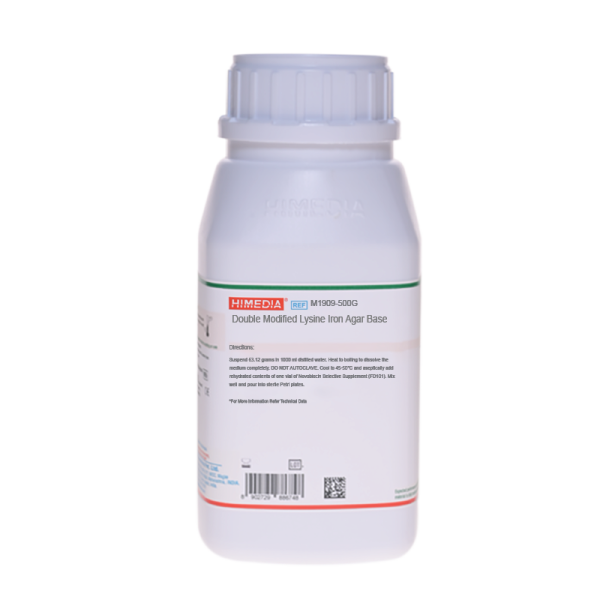
| Product Name | Double Modified Lysine Iron Agar Base |
|---|---|
| SKU | M1909 |
| Product Type | Regular |
| Physical Form | Powder |
| Origin | Animal |
| Packaging type | HDPE |
| References | 1.Microbiology Laboratory guidebook,MLG/FSIS/USDA (2011),Washington,Food Safety and Inspection Service. |
| Customized Product Available | No |