HiMedia Laboratories GmbH, Marie-Curie-Str. 3, 64683, Einhausen, Germany.

 Your enquiry has been submitted
Something problem with the server. Try again.
 Your enquiry has been submitted
Recommended for the selective isolation of Salmonella species from food and clinical samples.
| Ingredients | g / L |
|---|---|
| HI powder # | 12.000 |
| Yeast hydrolysate | 5.000 |
| Tryptose | 5.000 |
| Sodium cholate | 3.000 |
| Sodium taurocholate | 5.000 |
| Sodium deoxycholate | 1.000 |
| Chromogenic mixture | 8.000 |
| Agar | 15.000 |
Final pH ( at 25°C): 7.3±0.2
**Formula adjusted, standardized to suit performance parameters
# Equivalent to Heart Infusion powder
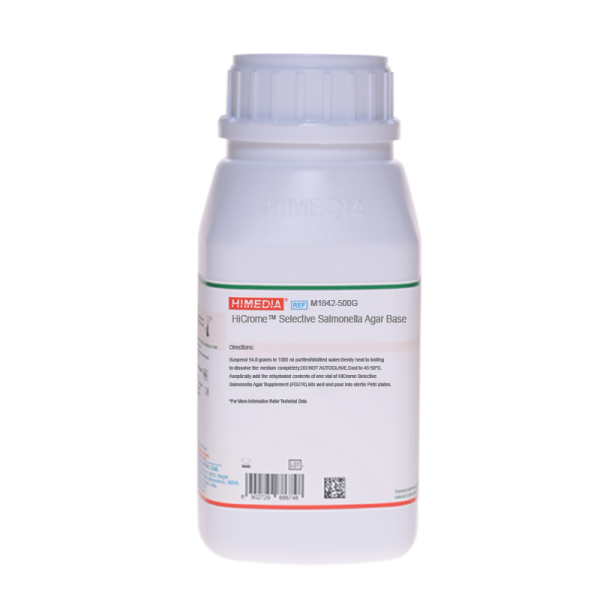
Suspend 54.00 gram in 1000 ml purified/ distilled water. Gently heat to boiling to dissolve the medium completely. DO NOT AUTOCLAVE. Cool to 45-50°C. Aseptically add the rehydrated contents of one vial of NC Selective Supplement (FD274). Mix well and pour into sterile Petri plates.
Salmonella species have been isolated from humans and almost all animals throughout the world. They cause many types of infections from mild, self-limiting gastroenteritis to life threatening typhoid fever. Salmonella Typhi and Salmonella Paratyphi A & B cause gastroenteritis, bacteremia and enteric fever, Salmonella Choleraesuis causes gastroenteritis and enteric fever, especially in children. Salmonella Typhimurium is the most frequently isolated serotype of Salmonella. Salmonella species are the major cause of food poisoning (1).
Various chromogenic media are available for the differentiation of Salmonella species. The original media formulated by Rambach (2) differentiates Salmonella based on propylene glycol utilization and presence of a chromogenic indicator. However HiCrome®Â® Selective Salmonella Agar Base uses chromogenic mixture for identification and differentiation of Salmonella species. Sodium cholate, Sodium taurocholate and Sodium deoxycholate in the medium helps to restrict the growth of other organisms. Besides the selective supplement added to the medium inhibits competing microorganisms.
HI powder, yeast hydrolysate and tryptose in the medium provides nitrogenous, carbonaceous compounds, long chain amino acids, vitamins and other essential growth nutrients. Due to the presence of chromogenic mix in the medium Salmonella are easily distinguishable and forms purple coloured colonies while some Enterobacteriaceae like Klebsiella and Enterobacter forms blue to dark blue coloured colonies.
Conventional method employes the H2S production property for Salmonella detection which is also exhibited by other non Salmonella species such as Citrobacter, Proteus etc. Hence further biochemical confirmation is required for further identification. This medium is specially employed for food samples where the sample is initially enriched in Salmonella Selective Enrichment Broth (M1843) and then isolated on HiCrome®Â® Selective Salmonella Agar Base. Salmonella species give purple coloured colonies due to the enzyme specificity.
Clinical samples- stool, urine, etc; Food samples
For clinical samples follow appropriate techniques for handling specimens as per established guidelines (3,4) .
For food samples, follow appropriate techniques for sample collection and processing as per guidelines (5).
After use, contaminated materials must be sterilized by autoclaving before discarding.
In Vitro diagnostic use. For professional use only. Read the label before opening the container. Wear protective gloves/protective clothing/eye protection/face protection. Follow good microbiological lab practices while handling specimens and culture. Standard precautions as per established guidelines should be followed while handling clinical specimens. Safety guidelines may be referred in individual safety data sheets.
Performance of the medium is expected when used as per the direction on the label within the expiry period when stored at recommended temperature.
Appearance: Light yellow to beige homogeneous free flowing powder
Gelling: Firm, comparable with 1.5 % Agar gel.
Colour and Clarity of prepared medium: Whitish cream coloured, opaque gel forms in Petri plates
Reaction: Reaction of 5.4% w/v aqueous solution at 25°C. pH : 7.3±0.2
pH: 7.10-7.50
Cultural characteristics observed with added NC Selective Supplement (FD274), after an incubation at 35-37°C for 22-24 hours.
| Organism | Inoculum (CFU) | Growth | Recovery | Colour of colony |
|---|---|---|---|---|
| Staphylococcus aureus subsp. aureus ATCC 25923 (00034*) | >=10â´ | inhibited | 0% | |
| Klebsiella pneumoniae ATCC 13883 (00097*) | 50 -100 | good | 40 -50 % | blue |
| Salmonella Typhimurium ATCC 14028 (00031*) | 50 -100 | good-luxuriant | >=50 % | purple |
| Salmonella Enteritidis ATCC 13076 (00030*) | 50 -100 | good-luxuriant | >=50 % | purple |
| Enterococcus faecalis ATCC 29212 (00087*) | >=10â´ | inhibited | 0 -0 % |
Key: (*) Corresponding WDCM numbers
Store dehydrated medium in a tightly closed container and the prepared medium at 2-8°C. Use before expiry date on the label. On opening, product should be properly stored dry, after tightly capping the bottle in order to prevent lump formation due to the hygroscopic nature of the product. Improper storage of the product may lead to lump formation. Store in dry ventilated area protected from extremes of temperature and sources of ignition Seal the container tightly after use. Product performance is best if used within stated expiry period.
User must ensure safe disposal by autoclaving and/or incineration of used or unusable preparations of this product. Follow established laboratory procedures in disposing of infectious materials and material that comes into contact with clinical sample must be decontaminated and disposed of in accordance with current laboratory techniques (3,4).
| Product Name | HiCrome® Selective Salmonella Agar Base |
|---|---|
| SKU | M1842 |
| Product Type | HiCrome™ |
| Physical Form | Powder |
| Origin | Animal |
| Packaging type | HDPE |
| References | 1.Anthony BF, Okada DM, Hobel CJ. Epidemiology of group B Streptoccoccus: longitudinal observations during pegnancy.J.Infect Dis 1978; 137:524-30.2.Murray P.R. , Baron J.H., Manual of Clinical Microbiology Murray P. R., Baron J. H., Pfaller M. A., Jorgensen J. H.and Yolken R. H., (Eds.), 2003, Manual of Clinical Microbiology, 8th Ed., American Society for Microbiology, Washington,D.C.3.Prevention of perinatal group B Streptococcal disease: a public health perspective . Centres for Disease control andPrevention. MMWR Recomm Rep 1996; 51:1-22HiMedia Laboratories Technical Data4.NHS Processing swabs for Group B Streptococcal carriage Issue no.2.1,2006 |
| Customized Product Available | No |