HiMedia Laboratories GmbH, Marie-Curie-Str. 3, 64683, Einhausen, Germany.

 Your enquiry has been submitted
Something problem with the server. Try again.
 Your enquiry has been submitted
Recommended for the selective isolation, cultivation and enumeration of Lactobacilli from food.
| Ingredients | g/L |
|---|---|
| Tryptone | 10.000 |
| Yeast extract | 5.000 |
| Dextrose (Glucose) | 20.000 |
| Sodium acetate | 25.000 |
| Potassium dihydrogen phosphate | 6.000 |
| Ammonium citrate | 2.000 |
| Polysorbate 80 (Tween 80) | 1.000 |
| Magnesium sulphate | 0.575 |
| Manganese sulphate | 0.120 |
| Ferrous sulphate | 0.034 |
| Final pH (at 25°C) | 5.4±0.2 |
**Formula adjusted, standardized to suit performance parameters
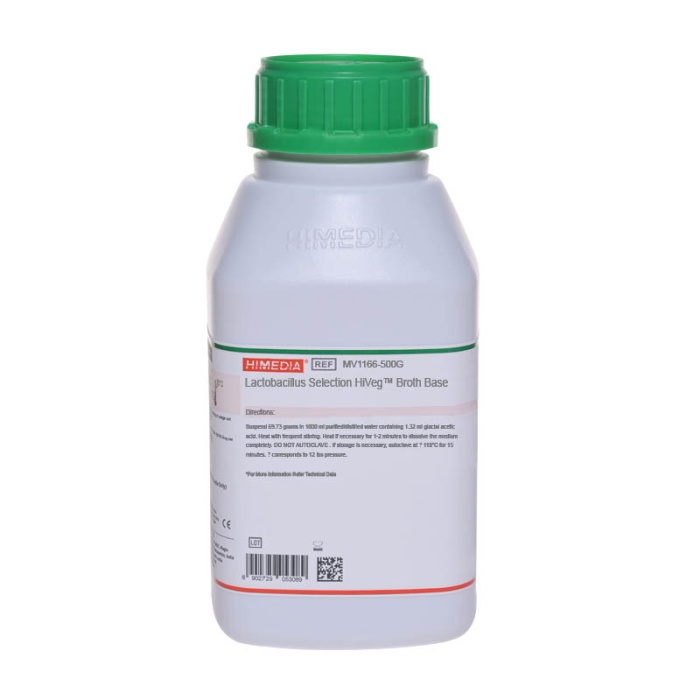
Suspend 69.73 grams in 1000 ml purified / distilled water containing 1.32 ml glacial acetic acid. Heat with frequent stirring for 1-2 minutes to dissolve the medium completely. DO NOT AUTOCLAVE. Dispense in sterile tubes or flasks as desired. If storage of medium is necessary, autoclave at A118°C for 15 minutes. A- corresponds to 12 lbs pressure.
Lactobacilli grow in a variety of habitats, wherever high levels of soluble carbohydrate, protein background products, vitamins and a low oxygen tension occur (1). These sites include the oral cavity, the intestinal tract (2,3), the vagina (4), food products (5) and dairy products (6).
Lactobacillus Selection Broth Base, developed by Rogosa et al (7, 8) is recommended for the isolation and enumeration of lactobacilli. Lactobacillus Selection Medium was demonstrated to be more suitable for growth of lactobacilli than Tomato Juice Medium traditionally used to isolate lactobacilli. Lactobacilli Selection Media can be further enriched by addition of tomato juice (9).
Tryptone and yeast extract serve as sources of nitrogen, carbon and essential nutrients. Dextrose is the carbohydrate and energy source. Polysorbate 80 serves as an additional source of growth factors and fatty acids required for metabolism of Lactobacillus species. Selectivity of the medium is obtained due to the presence of ammonium citrate and sodium acetate. These inhibit the accompanying microbial and fungal flora and also restrict swarming of colonies (10). The low acidic pH of the medium obtained by addition of glacial acetic acid is inhibitory to several bacterial species. Sulphates provide essential ions. Growth from Lactobacillus Selection Broth Base can be isolated on Lactobacillus Selection HiVeg™ Agar Base (MV1180) Since these media are highly selective, they should not be used for maintenance of lactobacilli.
Food and dairy samples.
For food and dairy samples, follow appropriate techniques for sample collection and processing as per guidelines (5,6). After use, contaminated materials must be sterilized by autoclaving before discarding.
Read the label before opening the container. Wear protective gloves/protective clothing/eye protection/face protection. Follow good microbiological lab practices while handling specimens and culture. Standard precautions as per established guidelines should be followed while handling specimens. Safety guidelines may be referred in individual safety data sheets.
Performance of the medium is expected when used as per the direction on the label within the expiry period when stored at recommended temperature.
Appearance Cream to yellow homogeneous free flowing powder
Colour and Clarity of prepared medium Yellow coloured, clear solution in tubes
Reaction Reaction of 6.97% w/v aqueous solution at 25°C. pH : 5.4±0.2
pH 5.20-5.60
Cultural characteristics observed in presence of 3-5% Carbon dioxide(CO2), after an incubation at 35-37°C for 48 hours.
| Organism | Inoculum (CFU) | Growth |
|---|---|---|
| Enterococcus faecalis ATCC 29212 (00087*) | >=104 | inhibited |
| Lactobacillus acidophilus ATCC 4356 (00098*) | 50-100 | luxuriant |
| Lactobacillus rhamnosus ATCC 9595 | 50-100 | luxuriant |
| $Lactiplantibacillus plantarum ATCC 8014 | 50-100 | luxuriant |
| ## Proteus hauseri ATCC 13315 | >=104 | inhibited |
| Staphylococcus aureus subsp. aureus ATCC 25923 (00034*) | >=104 | inhibited |
| Escherichia coli ATCC 25922 (00013*) | >=104 | inhibited |
Key: (*) Corresponding WDCM numbers, (##) Formerly known as Proteus vulgaris , ($)Formerly known as Lactobacillus plantarum
Store dehydrated and the prepared medium at 2-8°C. Use before expiry date on the label. On opening, product should be properly stored dry, after tightly capping the bottle in order to prevent lump formation due to the hygroscopic nature of the product. Improper storage of the product may lead to lump formation. Store in dry ventilated area protected from extremes of temperature and sources of ignition. Seal the container tightly after use. Product performance is best if used within stated expiry period.
User must ensure safe disposal by autoclaving and/or incineration of used or unusable preparations of this product. Follow established laboratory procedures in disposing of infectious materials and material that comes into contact with sample must be decontaminated and disposed of in accordance with current laboratory techniques (11,12).
| Product Name | Lactobacillus Selection Broth Base |
|---|---|
| SKU | M1166 |
| Product Type | Regular |
| Physical Form | Powder |
| Origin | Animal |
| Packaging type | HDPE |
| References | 1.Balows A., Truper H. G., Dworkin M., Harder W., Schleifer K. H., (Eds.), The Prokaryotes, 2nd Edi, 1992, Springer-Verlag2.Wiseman R. F, Sarles W. B, Benton D. A, Harper A. E and Elvehjem C.A., 1956, J. Bacteriol., 72:723.3.Ellis R. F. and Sarles W. B., 1958, J. Bacteriol., 75:272.4.Rogosa M. and Sharpe M. E., 1960, J. Gen. Microbiol., 23:1975.Downes F. P. and Ito K., (Eds.), 2001, Compendium of Methods for the Microbiological Examination of Foods, 4th Ed.,American Public Health Association, Washington, D.C.6.Wehr H. M. and Frank J. H., 2004, Standard Methods for the Microbiological Examination of Dairy Products, 17th Ed.,APHA Inc., Washington, D.C.7.Rogosa M., Mitchell J. A and Wiseman R. F., 1951, J. Bacteriol.,62:132.8.Rogosa M., Mitchell J. A and Wiseman R. F., 1951, J. Dental Res., 30:682.9.Sabine D. B. and Vaselekos J., 1965, Nature, 206:960.10.MacFaddin J.F., 1985, Media for Isolation-Cultivation-Identification-Maintenance of Medical Bacteria, Vol.1, Williamsand Wilkins, Baltimore. |
| Customized Product Available | No |