 HiMedia Laboratories GmbH, Marie-Curie-Str. 3, 64683, Einhausen, Germany.

 Your enquiry has been submitted
Something problem with the server. Try again.

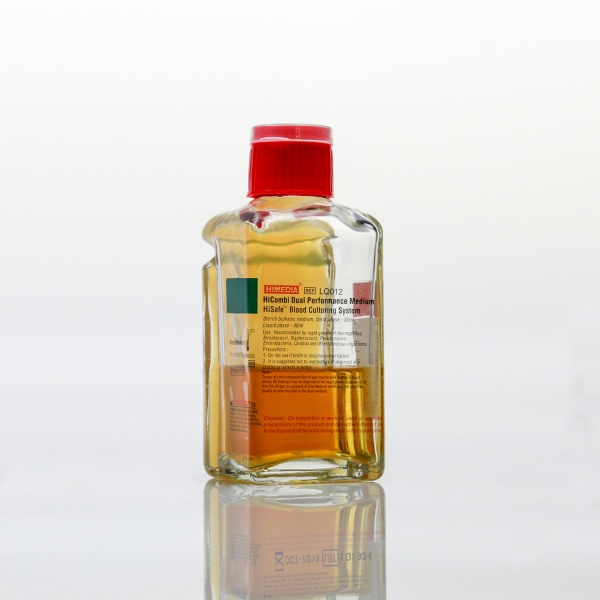
This medium is recommended for rapid growth of Enterobacteria, Pseudomonas, Staphylococci and Candida. Combination of solid (20ml) and liquid (40ml) medium in single bottle. It is recommended for adult use.
Your enquiry has been submitted
Recommended for rapid growth of Enterobacteria, Pseudomonas, Staphylococci and Candida. Combination of solid (20ml) and liquid (40ml) media in single bottle.
| Ingredients | g/L |
|---|---|
| Solid | |
| HM infusion powder # | 20.000 ml |
| BHI powder | 12.500 |
| Proteose peptone | 5.000 |
| Dextrose (Glucose) | 10.000 |
| Sodium chloride | 2.000 |
| Disodium hydrogen phosphate | 5.000 |
| Agar | 2.500 |
| Liquid | |
| Same as solid media without Agar | 40.000 ml |
**Formula adjusted, standardized to suit performance parameters
# Equivalent to Calf brain infusion from
Label the ready to use blood culture bottle. Do not unscrew the cap. Remove the top seal of the cap. Disinfect the part of the rubber stopper which is now exposed. Draw patient's blood with the sterile or disposable needle and syringe. Transfer the blood sample immediately into the culture bottle by puncturing the rubber stopper with the needle and injecting the blood. Incubate the bottle for 4-6 hours at 30-35°C. For adsorption on solid surface. DO NOT SHAKE OR HOLD MORE THAN 15 SECONDS. Revert into an upright position and incubate for 18-24 hours at 30-35°C or longer if necessary. Venting: Use sterile venting needle (LA038). Keep the bottle in an upright position preferably in a biological safety cabinet, place an alcohol swab over the rubber stopper and insert the venting needle with filter through it. Insertion and withdrawal of the needle should be done in a straight line. discard the needle and mix the contents by gently inverting the bottle 2-3 times. Do Not vent the bottle for anaerobic cultures. Incubate at 30-35°C for 18-24 hours and further for seven days. Recommended volume of blood to be tested in LQ012: 8-10 ml (For Adult use).
BHI Medium is useful for cultivating a wide variety of microorganisms since it is a highly nutritive medium. It is also used to prepare the inocula for antimicrobial susceptibility testing. BHI Broth is a modification of the original formulation of Rosenow, where he added pieces of brain tissues to dextrose broth (1). BHI Broth is also the preferred medium for anaerobic bacteria, yeasts and moulds (2,3). This medium is nutritious and well buffered to support the growth of wide variety of organisms (1,4,5). With the addition of 10% defibrinated sheep blood, it is useful for isolation and cultivation of Histoplasma capsulatum (6) and other fungi. For selective isolation of fungi, addition of gentamicin and/or chloramphenicol is recommended (7).
Proteose peptone, HM infusion powder and BHI powder serve as sources of carbon, nitrogen, essential growth factors, amino acids and vitamins. Dextrose serves as a source of energy. Disodium phosphate helps in maintaining the buffering action of the medium whereas sodium chloride maintains the osmotic equilibrium of the medium.
Clinical samples: Blood
For clinical samples follow appropriate techniques for handling specimens as per established guidelines (8,9).
After use, contaminated materials must be sterilized by autoclaving before discarding.
In Vitro diagnostic use only. For professional use only. Read the label before opening the container. Wear protective gloves/protective clothing/eye protection/face protection. Follow good microbiological lab practices while handling
Performance of the medium is expected when used as per the direction on the label within the expiry period when stored at recommended temperature.
Appearance
In a sterile glass bottle combination of broth and one agar coated surface.
Colour of Agar medium
Yellow coloured media
Colour of liquid medium
Amber coloured solution
Quantity of medium
20ml of medium in glass bottle 40ml of medium in glass bottle
pH of Agar medium
7.20-7.60
pH of liquid medium
7.20-7.60
Sterility Check
Passes release criteria
Cultural response
Cultural characteristics was observed after incubation at 35-37°C for 18-48 hours.
| Organism | Inoculum (CFU) | Growth on agar medium | Growth on liquid medium |
|---|---|---|---|
| Candida albicans ATCC 10231 (00054*) | 50-100 | Luxuriant | Luxuriant |
| Haemophilus influenzae ATCC 19418 | 50-100 | Luxuriant | Luxuriant |
| Pseudomonas aeruginosa ATCC 27853 (00025*) | 50-100 | Luxuriant | Luxuriant |
| Streptococcus pyogenes ATCC 19615 | 50-100 | Luxuriant | Luxuriant |
| Staphylococcus aureus subsp. aureus ATCC 25923 (00034*) | 50-100 | Luxuriant | Luxuriant |
| Neisseria meningitidis ATCC 13090 | 50-100 | Luxuriant | Luxuriant |
| Streptococcus pneumoniae ATCC 6303 | 50-100 | Luxuriant | Luxuriant |
Key: (*) Corresponding WDCM numbers.
On receipt store between 15-30°C. Use before expiry date on the label. Product performance is best if used within stated expiry period.
User must ensure safe disposal by autoclaving and/or incineration of used or unusable preparations of this product. Follow established laboratory procedures in disposing of infectious materials and material that comes into contact with clinical sample must be decontaminated and disposed of in accordance with current laboratory techniques (8,9).
| Product Name | HiCombi™ Dual Performance Medium |
|---|---|
| SKU | LQ012 |
| Customized Product Available | No |