HiMedia Laboratories GmbH, Marie-Curie-Str. 3, 64683, Einhausen, Germany.

 Your enquiry has been submitted
Something problem with the server. Try again.
 Your enquiry has been submitted
Recommended for differentiation of bacteria on the basis of their ability to decarboxylate L-Arginine hydrochloride.
| Ingredients | g/L |
|---|---|
| Peptone | 5.000 |
| HM peptone B # | 5.000 |
| Dextrose (Glucose) | 0.500 |
| Bromocresol purple | 0.010 |
| Cresol red | 0.005 |
| Pyridoxal | 0.005 |
| L-Arginine hydrochloride | 10.000 |
Final pH (at 25°C): 6.0±0.2
**Formula adjusted, standardized to suit performance parameters
# Equivalent to Beef extract
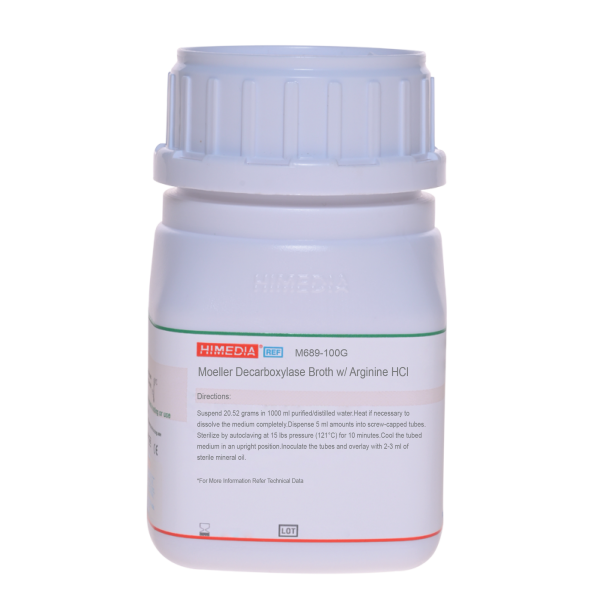
Suspend 20.52 grams in 1000 ml purified/distilled water. Heat if necessary to dissolve the medium completely. Dispense 5 ml amounts into screw-capped tubes. Sterilize by autoclaving at 15 lbs pressure (121°C) for 10 minutes. Cool the tubed medium in an upright position. Inoculate the tubes and overlay with 2-3 ml of sterile mineral oil.
Moeller Decarboxylase Broth with Arginine hydrochloride is used for differentiating gram-negative enteric bacilli on the basis of their ability to decarboxylate L-Arginine hydrochloride. Decarboxylase Broth was introduced by Moeller for detecting the production of lysine and ornithine decarboxylase and arginine dihydrolase (1). Prior to Moellers work, bacterial amino acid decarboxylases were studied by Gale (2) and Gale and Epps (3). Decarboxylase media are also recommended by standard methods for identification of bacteria (4,5,6,7).
This medium contains HM peptone B and peptone which provide nitrogenous nutrients for the growth of bacteria. Dextrose is the fermentable carbohydrate and pyridoxal is the co-factor for the decarboxylase enzyme. Bromo cresol purple and cresol red are the pH indicators in this medium. When the medium is inoculated with dextrose fermenting bacteria, the pH is lowered due to acid production which changes the colour of the indicator from purple to yellow.
Acid produced stimulates decarboxylase enzyme. Arginine is first hydrolyzed to ornithine which is then decarboxylated to form putrescine. Formation of the amine putrescine increases the pH of the medium, changing the colour of the indicator from yellow to purple. If the organisms do not produce the appropriate enzyme, the medium remains acidic, yellow in colour. Each isolate to be tested should also be inoculated into the basal medium tube lacking the amino acid. After incubation, a decarboxylase test may show two layers of different colours, yellow and purple. Shake the tube gently before interpreting the results (8).
Inoculated tubes must be protected from air with a layer of sterile mineral oil. Exposure to air may cause alkalinization at the surface of the medium which makes the test invalid.
Isolated Microorganism from clinical and non-clinical samples.
For clinical samples follow appropriate techniques for handling specimens as per established guidelines (6,9).
After use, contaminated materials must be sterilized by autoclaving before discarding.
In Vitro diagnostic use. For professional use only. Read the label before opening the container. Wear protective gloves/protective clothing/eye protection/face protection. Follow good microbiological lab practices while handling specimens and culture. Standard precautions as per established guidelines should be followed while handling specimens. Safety guidelines may be referred in individual safety data sheets.
Performance of the medium is expected when used as per the direction on the label within the expiry period when stored at recommended temperature.
Appearance: Light yellow to greenish yellow homogeneous free flowing powder
Colour and Clarity of prepared medium: Purple coloured clear solution without any precipitate
Reaction: Reaction of 2.05% w/v aqueous solution at 25°C. pH : 6.0±0.2
pH: 5.80-6.20
Cultural Response: Cultural characteristics observed after an incubation at 35-37°C for upto 4 days (Inoculated tubes are overlaid with sterile mineral oil).
| Organism | Arginine decarboxylation |
|---|---|
| Citrobacter freundii ATCC 8090 | variable reaction |
| # Klebsiella aerogenes ATCC 13048 (00175*) | negative reaction, yellow colour |
| Escherichia coli ATCC 25922 (00013*) | variable reaction |
| Klebsiella pneumoniae ATCC 13883 (00097*) | negative reaction, yellow colour |
| Proteus mirabilis ATCC 25933 | negative reaction, yellow colour |
| $ Proteus hauseri ATCC 13315 | negative reaction, yellow colour |
| ^ Pseudomonas aeruginosa ATCC 9027 (00026*) | positive reaction, purple colour |
| Salmonella Paratyphi A ATCC 9150 | delayed positive reaction/positive reaction, purple colour |
| Salmonella Typhi ATCC 6539 | delayed positive reaction /negative reaction, yellow colour |
| Serratia marcescens ATCC 8100 | negative reaction, yellow colour |
| Shigella dysenteriae ATCC 13313 | delayed positive reaction/negative reaction, yellow colour |
| Shigella flexneri ATCC 12022 (00126*) | delayed positive reaction/negative reaction, yellow colour |
| Shigella sonnei ATCC 25931 | variable reaction |
Key : *Corresponding WDCM numbers.
$ Formerly known as Proteus vulgaris
^ Formerly known as Pseudomonas aeruginosa (Note: Name correction likely intended as *paraeruginosa* in source based on OCR, but *aeruginosa* is standard - retained source text logic).
Store between 10-30°C in a tightly closed container and the prepared medium at 15-30°C. Use before expiry date on the label. On opening, product should be properly stored dry, after tightly capping the bottle in order to prevent lump formation due to the hygroscopic nature of the product. Improper storage of the product may lead to lump formation. Store in dry ventilated area protected from extremes of temperature and sources of ignition. Seal the container tightly after use. Product performance is best if used within stated expiry period.
User must ensure safe disposal by autoclaving and/or incineration of used or unusable preparations of this product. Follow established laboratory procedures in disposing of infectious materials and material that comes into contact with sample must be decontaminated and disposed of in accordance with current laboratory techniques (6,9).
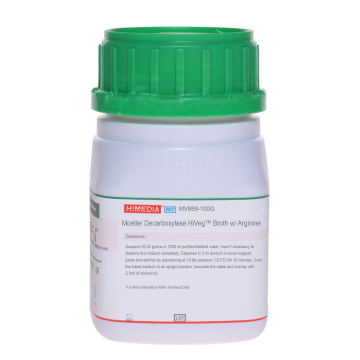
| Product Name | Moeller Decarboxylase Broth w/ Arginine HCl |
|---|---|
| SKU | M689 |
| Product Type | Regular |
| Physical Form | Powder |
| Origin | Animal |
| Packaging type | HDPE |
| References | 1. Moeller V., 1955, Acta Pathol. Microbiol. Scand. 36:158. 2.Gale G. F., 1940, Biochem. J., 34:392. 3.Gale and Epps, 1943, Nature, 152:327. 4.Isenberg (Ed.), 1992, Clinical Microbiology Procedures Handbook, Vol. I, ASM, Washington, D. C. 5.FDA Bacteriological Analytical Manual, 8th Ed., AOAC International, Gaithersburg, Md. 6.Eaton A. D., Clesceri L. S. and Greenberg A. E., (Ed.), 1998, Standard Methods for the Examination of Water andWastewater, 20th Ed., American Public Health Association, Washington, D.C |
| Customized Product Available | No |