 HiMedia Laboratories GmbH, Marie-Curie-Str. 3, 64683, Einhausen, Germany.

 Your enquiry has been submitted
Something problem with the server. Try again.

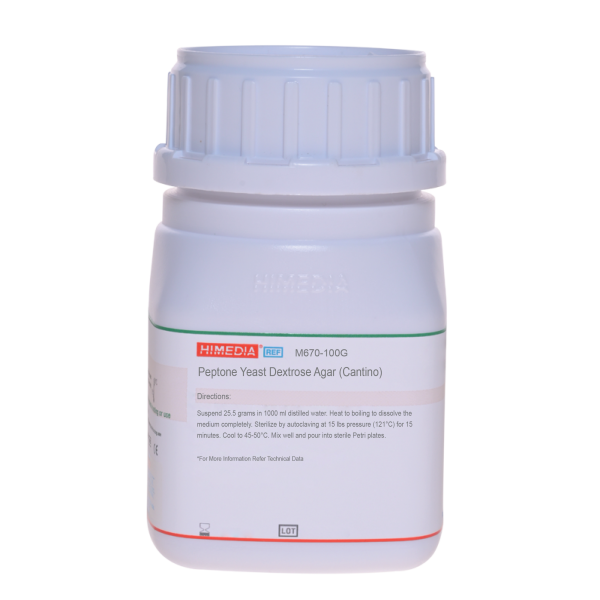
Peptone Yeast Dextrose Agar (Cantino) is used for the cultivation of aquatic fungi like Blastocladiella species.
| Ingredients | Gms / Litre |
|---|---|
| Peptic digest of animal tissue | 1.250 |
| Yeast extract | 1.250 |
| Dextrose | 3.000 |
| Agar | 20.000 |
Final pH (at 25°C): 6.8±0.2
**Formula adjusted, standardized to suit performance parameters
Suspend 25.5 grams in 1000 ml distilled water. Heat to boiling to dissolve the medium completely. Sterilize by autoclaving at 15 lbs pressure (121°C) for 15 minutes. Mix well and dispense as desired.
Peptone Yeast Dextrose Agar (Cantino) was formulated by Cantino (1) for use in the cultivation of aquatic fungi like Blastocladiella species (2). These aquatic fungi grow well when a sugar like dextrose is present in the medium. Cantino reported that Blastocladiella grow luxuriantly under visible light illumination due to increased CO2 fixation. Peptone Yeast Dextrose Agar (Cantino) is also recommended for the cultivation of Eikenella corrodens (3). E. corrodens is part of the resident microflora of mucous membrane surfaces in humans. Even though E. corrodens is generally regarded as organism of low virulence, it is usually involved in mixed bacterial infections, often with the viridans groups Streptococci and less frequently with various members of the Enterobacteriaceae (4).
The medium contains peptic digest of animal tissue and yeast extract, which supply the nitrogenous nutrients, vitamin B complex, peptides and trace ingredients for the growth of aquatic fungi and E. corrodens. Dextrose is the energy source.
Appearance: Off-white to yellow homogeneous free flowing powder
Gelling: Firm, comparable with 2.0% Agar gel.
Colour and Clarity of prepared medium: Yellow coloured clear to slightly opalescent gel forms in Petri plates
Reaction: Reaction of 2.55% w/v aqueous solution at 25°C. pH : 6.8±0.2
pH: 6.60-7.00
Cultural Response: M670: Cultural characteristics observed after an incubation at 25-30°C for upto 8 days.
| Organism | Growth |
|---|---|
| Blastocladiella emersonii ATCC 22665 | luxuriant |
| Candida albicans ATCC 10231 | luxuriant |
| Eikenella corrodens ATCC 23834 | luxuriant |
| Saccharomyces cerevisiae ATCC 9763 | luxuriant |
Store below 30°C in tightly closed container and the prepared medium at 2-8°C. Use before expiry date on the label.
| Product Name | Peptone Yeast Dextrose Agar (Cantino) |
|---|---|
| SKU | M670 |
| Product Type | Regular |
| Physical Form | Powder |
| Origin | Animal |
| Packaging type | HDPE |
| References | 1. Cantino E. C., 1961, Mycologia, 48: 225. 2.Recheigl Jr., (Ed.), 1978, Handbook Series in Nutrition and Food, Section G., Vol. III, CRC Press Inc. 3.Atlas R. M., 2004, Handbook of Microbiological Media, Lawrence C. Parks (Ed.), 3rd Edition, CRC Press. 4.Balows A., Truper H. G., Dworkin M., Harder W., Schleifer K. H., (Eds.), 1992, The Prokaryotes, 2nd Edi, Vol. III, Springer-Verlag. |
| Customized Product Available | No |