HiMedia Laboratories GmbH, Marie-Curie-Str. 3, 64683, Einhausen, Germany.

 Your enquiry has been submitted
Something problem with the server. Try again.

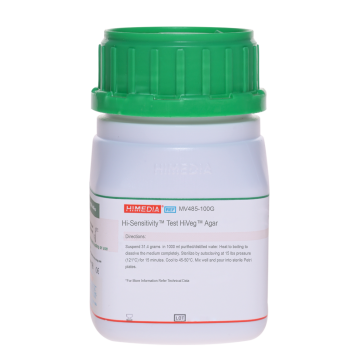
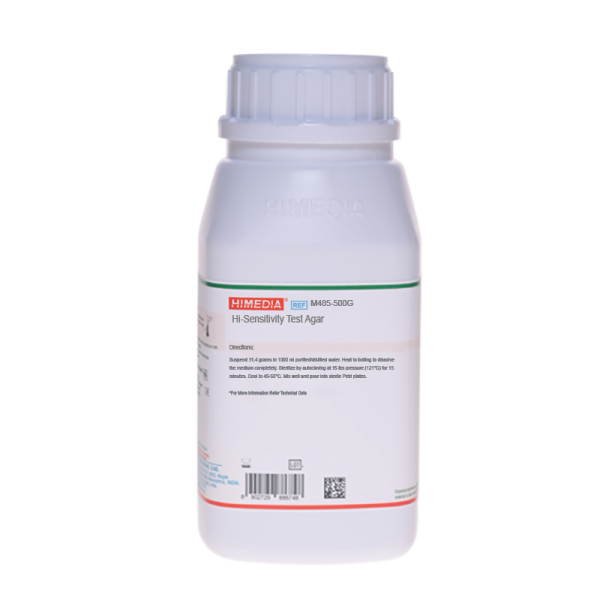
Hi-Sensitivity Test Agar is used for antimicrobial susceptibility tests.
| Ingredients | g / L |
|---|---|
| Tryptone | 11.000 |
| Peptone | 3.000 |
| Dextrose (Glucose) | 2.000 |
| Sodium chloride | 3.000 |
| Starch, soluble | 1.000 |
| Disodium hydrogen phosphate | 2.000 |
| Sodium acetate | 1.000 |
| Magnesium glycerophosphate | 0.200 |
| Calcium gluconate | 0.100 |
| Cobaltous sulphate | 0.001 |
| Cupric sulphate | 0.001 |
| Zinc sulphate | 0.001 |
| Ferrous sulphate | 0.001 |
| Manganous chloride | 0.002 |
| Menadione | 0.001 |
| Cyanocobalamin | 0.001 |
| L-Cysteine hydrochloride | 0.020 |
| L-Tryptophan | 0.020 |
| Pyridoxine hydrochloride | 0.003 |
| Calcium pantothenate | 0.003 |
| Nicotinamide | 0.003 |
| Biotin | 0.0003 |
| Thiamine hydrochloride | 0.00004 |
| Adenine | 0.010 |
| Guanine | 0.010 |
| Xanthine | 0.010 |
| Uracil | 0.010 |
| Agar | 8.000 |
Final pH (at 25°C): 7.4±0.2
**Formula adjusted, standardized to suit performance parameters
Suspend 31.4 grams in 1000 ml purified/distilled water. Heat to boiling to dissolve the medium completely. Sterilize by autoclaving at 15 lbs pressure (121°C) for 15 minutes. Cool to 45-50°C. Mix well and pour into sterile Petri plates.
The goal of an antimicrobial susceptibility test is to predict through an in vitro assessment the likelihood of successfully treating an infection with a particular antimicrobial agent. There are several continual or novel methods for performing antibacterial susceptibility testing. These include the disk diffusion test, broth microdilution, agar gradient and rapid automated instrument methods (1). Hi-Sensitivity Test Agar, which is used for antimicrobial susceptibility tests, is a semi-defined medium in which the mineral contents have been stabilized to give reproducible results. The thiamine and thymidine content is very low thus making it most suitable for testing antimicrobial activity of sulfonamide. However some mutant strains which are totally dependent on thiamine and thymidine for their growth, will not grow on Hi- Sensitivity Test Agar, due to very low levels of these compounds in the media as they are the naturally occurring antagonist of trimethoprim. These strains should be carefully recognized (2,3,4).
Hi-Sensitivity Test Agar has been so designed to overcome the problems occurring in Mueller-Hinton Media that are as
Clinical samples -Isolated Microorganisms from urine, stool etc.
For clinical samples follow appropriate techniques for handling specimens as per established guidelines (1,14).
After use, contaminated materials must be sterilized by autoclaving before discarding.
In vitro diagnostic use only. For professional use only. Read the label before opening the container. Wear protective gloves/ protective clothing/ eye protection/face protection. Follow good microbiological lab practices while handling specimens and culture. Standard precautions as per established guidelines should be followed while handling clinical specimens. Safety guidelines may be referred in individual safety data sheets.
Performance of the medium is expected when used as per the direction on the label within the expiry period when stored at recommended temperature.
Appearance: Cream to yellow homogeneous free flowing powder
Gelling: Firm, comparable with 0.8% Agar gel.
Basal medium: Light amber coloured, clear to slightly opalescent gel. After addition of 5%v/v laked blood : Red to chocolate coloured, opaque gel forms in Petri plates.
Reaction of 3.14% w/v aqueous solution at 25°C. pH: 7.4±0.2
pH: 7.20-7.60
Cultural characteristics observed with added 5%w/v laked blood, after an incubation at 35 - 37°C for 18 - 24 hours .
| Organism | Inoculum (CFU) | Growth | Recovery |
|---|---|---|---|
| ** Bacillus spizizenii ATCC 6633 (00003*) | 50-100 | good-luxuriant | >=70% |
| # Phocaeicola vulgatus ATCC 8482 | 50-100 | good-luxuriant | >=70% |
| Enterococcus faecalis ATCC 29212 (00087*) | 50-100 | good-luxuriant | >=70% |
| Salmonella Typhimurium ATCC14028 (00031*) | 50-100 | good-luxuriant | >=70% |
| Staphylococcus aureus subsp. aureus ATCC 25923(00034*) | 50-100 | good-luxuriant | >=70% |
| Streptococcus pyogenes ATCC 19615 | 50-100 | good-luxuriant | >=70% |
Key*- Corresponding WDCM numbers **Formerly known as Bacillus subtilis subsp. spizizenii * Formerly known as Bacteroides vulgatus
Store between 2-8°C in a tightly closed container and the prepared medium at 2-8°C. Use before expiry date on the label. On opening, product should be properly stored dry, after tightly capping the bottle in order to prevent lump formation due to the hygroscopic nature of the product. Improper storage of the product may lead to lump formation. Store in dry ventilated area protected from extremes of temperature and sources of ignition Seal the container tightly after use. Product performance is best if used within stated expiry period.
User must ensure safe disposal by autoclaving and/or incineration of used or unusable preparations of this product. Follow established laboratory procedures in disposing of infectious materials and material that comes into contact with clinical sample must be decontaminated and disposed of in accordance with current laboratory techniques (1,14).
| Product Name | Hi-Sensitivity™ Test Agar |
|---|---|
| SKU | M485 |
| Product Type | Regular |
| Physical Form | Powder |
| Origin | Animal |
| Packaging type | HDPE |
| References | 1.Murray P. R., Baron J. H., Pfaller M. A., Jorgensen J. H. and Yolken R. H., (Ed.). 2003, Manual of Clinical Microbiology,8th Ed.,American Society for Microbiology, Washington, D.C. 2.Tanner E. I. and Bullin C. H., 1974, J. Clin. Path., 27:565. 3.Thomas M. and Bond L., 1973, Med. Lab. Technol., 30:277. 4.Barker J., Healing D., and Hutchinson J. G. P., 1972, J. Clin. Path., 25:10865.Ericsson H. M. and Sherris J. C., 1971, Acta. Pathol. Microbiol Scand Suppl., 217:1. 6.Garrod L. P. and Waterworth P. M., 1971, J. Clin. Path., 24:779. 7.Reller L. B., Schoenknecbt F. D., Kenny M. A. and Sherris J. C., 1974, J. Infect. Dis., 130:454. 8.Duncan I. B. R., 1974, Antimicrob. Agents Chemother., 5:9.9.Yourassowsky E., Vanderlinden M. P. and Schoutens E., 1974, J. Clin. Path., 27:897.10.Neussil H., 1976, Chemother., Vol. 2 : 33. 11.Bridson E.Y., 1976, Arztl. Lab., 22:373. 12.Acar J. F., 1980, Antibiotics in Laboratory Medicine, Lorian V. (Ed.), Williams and Wilkins, Baltimore, USA, 48-51. 13.Hartzen S.H., Anderson L.P., Bremmelgaard A. et.al, 1997, Antimicrob. Agents Chemother., 41.2634-2639. |
| Customized Product Available | No |