 HiMedia Laboratories GmbH, Marie-Curie-Str. 3, 64683, Einhausen, Germany.

 Your enquiry has been submitted
Something problem with the server. Try again.
 Your enquiry has been submitted
Intended Use:
Recommended for microbiological assay of Niacin (Nicotinic acid) or Niacinamide using Lactobacillus plantarum ATCC 8014 as a test organism.
| Ingredients | Gms / Litre |
|---|---|
| Tryptone, vitamin free | 12.000 |
| Dextrose (Glucose) | 40.000 |
| Sodium acetate | 20.000 |
| L-Cystine | 0.400 |
| DL-Tryptophan | 0.200 |
| Adenine sulphate | 0.020 |
| Guanine hydrochloride | 0.020 |
| Uracil | 0.020 |
| Thiamine hydrochloride | 0.0002 |
| Calcium pantothenate | 0.0002 |
| Pyridoxine hydrochloride | 0.0004 |
| Riboflavin (Vitamin B2) | 0.0004 |
| p-Amino benzoic acid (PABA) | 0.0002 |
| Biotin | 0.0000008 |
| Dipotassium hydrogen phosphate | 1.000 |
| Potassium dihydrogen phosphate | 1.000 |
| Magnesium sulphate | 0.400 |
| Sodium chloride | 0.020 |
| Ferrous sulphate | 0.020 |
| Manganese sulphate | 0.020 |
Final pH (at 25°C): 6.8±0.2
**Formula adjusted, standardized to suit performance parameters
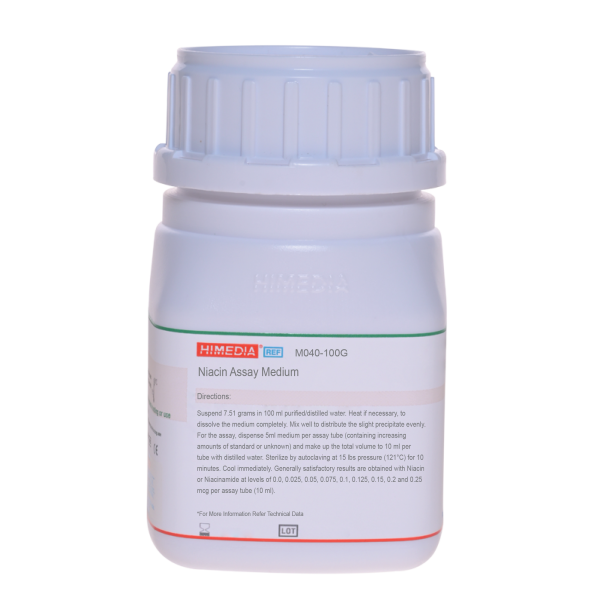
Suspend 7.51 grams in 100 ml purified / distilled water. Heat if necessary, to dissolve the medium completely. Mix well to distribute the slight precipitate evenly. For the assay, dispense 5 ml medium per assay tube (containing increasing amounts of standard or unknown) and make up the total volume to 10 ml per tube with distilled water. Sterilize by autoclaving at 15 lbs pressure (121°C) for 10 minutes. Cool immediately. Generally satisfactory results are obtained with niacin or niacinamide at levels of 0.0, 0.025, 0.05, 0.075, 0.1, 0.125, 0.15, 0.2 and 0.25 mcg per assay tube (10 ml).
Niacin Assay Medium is classified under the category of assay medium of vitamin assay medium. The other two categories of medium essential in vitamin assay are the inoculum media, used for preparation of inoculum to be used in the assay procedure, and maintenance media, used for maintenance of stock cultures used in assay procedures. Niacin Assay Medium is prepared according to the formula described by Snell and Wright (5) and modified by Krehl, Strong and Elvehjam (4) and Barton-Wright (1). This medium is recommended by AOAC (7) and USP (6). Niacin Assay Medium is used for the assay of Niacin (Nicotinamide) employing Lactobacillus plantarum ATCC 8014 as the test organism.
Microbiological assay of Niacin is carried out by using L. plantarum ATCC 8014 as the test organism. Standard curve is obtained by using USP (6) Niacin reference standard with levels of 0.0, 0.025, 0.05, 0.075, 0.1, 0.125, 0.15, 0.2 and 0.25 mcg niacin per assay tube (10 ml). Niacin Assay Medium is used for both turbidimetric and acidimetric analysis. Turbidimetric determination is made after 16-18 hours incubation at 35-37°C. Acidimetric determinations are best made following 72 hours incubation at 35-37°C.
Niacin Assay Medium is devoid of nicotinic acid but contains all other nutrients and vitamins essential for the cultivation of L. plantarum ATCC 8014. Addition of Niacin (Nicotinic acid) in specified increasing concentrations gives a corresponding growth response that can be measured turbidimetrically or titrimetrically.
Stock cultures of L. plantarum ATCC 8014 are maintained on Lactobacilli Agar, AOAC (M366). Culture for assay is obtained by inoculating Lactobacilli Agar, AOAC (M366) and incubating at 35-37°C for 24-48 hours. These cultures are then inoculated into Lactobacilli Broth, AOAC (M367), to prepare the inoculum. Following an incubation at 35-37°C for 18-24 hours, the cells are centrifuged and washed thrice with 0.85% saline. The appropriate dilution of cells so obtained is used to inoculate tubes of Niacin Assay Medium (M040), containing increasing concentrations of Niacin. Using standard Niacin concentration, a standard curve is obtained. This standard is used to extrapolate the unknown niacin concentration. For detailed procedure, refer standard procedures (6,7).
Extreme care must be taken to avoid contamination of media or glassware used for microbiological assay procedures. Detergent-free clean glassware should be used. Even small amount of contamination by foreign material can lead to erroneous results.
Pure isolates.
Stock cultures of L. plantarum ATCC 8014 are maintained on Lactobacilli Agar, AOAC (M366). Culture for assay is obtained by inoculating Lactobacilli Agar, AOAC (M366) and incubating at 35-37°C for 24-48 hours. These cultures are then inoculated into Lactobacilli Broth, AOAC (M367), to prepare the inoculum. Following an incubation at 35-37°C for 18-24 hours, the cells are centrifuged and washed thrice with 0.85% saline. The appropriate dilution of cells so obtained is used to inoculate tubes of Niacin Assay Medium (M040), containing increasing concentrations of Niacin. Using standard Niacin concentration, a standard curve is obtained. This standard is used to extrapolate the unknown niacin concentration. For detailed procedure, refer standard procedures (6,7).
Read the label before opening the container. Wear protective gloves/protective clothing/eye protection/ face protection. Follow good microbiological lab practices while handling specimens and culture. Standard precautions as per established guidelines should be followed while handling specimens. Safety guidelines may be referred in individual safety data sheets.
Performance of the medium is expected when used as per the direction on the label within the expiry period when stored at recommended temperature.
Appearance Off-white to yellow homogeneous free flowing powder
Colour and Clarity of Prepared medium Light amber coloured clear solution which may contain a slight precipitate.
Reaction Reaction of 7.51% w/v aqueous solution at 25°C. pH: 6.8±0.2
pH 6.60-7.00
Cultural Response Microbiological assay of Niacin is carried out using L.plantarum ATCC 8014 after an incubation at 35-37°C for 16-18 hrs.
Gradual increase in growth with increasing conc. of Std Niacin-0.0,0.025,0.05,0.075,0.1,0.125, 0.15,0.2 & 0.25mcg per assay tube is recorded asequivalent increase in absorbance at 620nm.
Store dehydrated and the prepared medium at 2-8°C. Use before expiry date on the label. On opening, product should be properly stored dry, after tightly capping the bottle in order to prevent lump formation due to the hygroscopic nature of the product. Improper storage of the product may lead to lump formation. Store in dry ventilated area protected from extremes of temperature and sources of ignition Seal the container tightly after use. Use before expiry date on the label.
Product performance is best if used within stated expiry period.
User must ensure safe disposal by autoclaving and/or incineration of used or unusable preparations of this product. Follow established laboratory procedures in disposing of infectious materials and material that comes into contact with sample must be decontaminated and disposed of in accordance with current laboratory techniques (2,3).
| Product Name | Niacin Assay Medium |
|---|---|
| SKU | M040 |
| Product Type | Regular |
| Physical Form | Powder |
| Origin | Animal |
| Packaging type | Glass Bottle |
| References | 1. Snell and Wright, 1941, J. Biol. Chem. 13:675. 2.Krehl, Strong and Elvehjem, 1943, Ind. & Eng. Chem., Ann. Ed. 15:471. 3.Barton-Wright, 1944, J. Biochem., 38:314. 4.Williams, (Ed.), 2005, Official Methods of Analysis of the Association of Official Analytical Chemists, 19th Ed., AOAC,Washington, D.C. 5.The United States Pharmacopoeia, 2006, USP29/NF24, The United States Pharmacopoeial Convention, Rockville, MD. |
| Customized Product Available | No |