HiMedia Laboratories GmbH, Marie-Curie-Str. 3, 64683, Einhausen, Germany.

 Your enquiry has been submitted
Something problem with the server. Try again.

Recommended for detection of bacterial contamination of surfaces in unprotected and protected areas.
| Ingredients | Gms / Litre |
|---|---|
| Tryptone | 15.000 |
| Soya peptone | 5.000 |
| Sodium chloride | 5.000 |
| Lecithin | 0.700 |
| Polysorbate 80 (Tween 80) | 5.000 |
| Sodium thiosulphate | 1.000 |
| L-Histidine | 1.000 |
| Agar | 20.500 |
Final pH (at 25°C): 7.3±0.2
**Formula adjusted, standardized to suit performance parameters
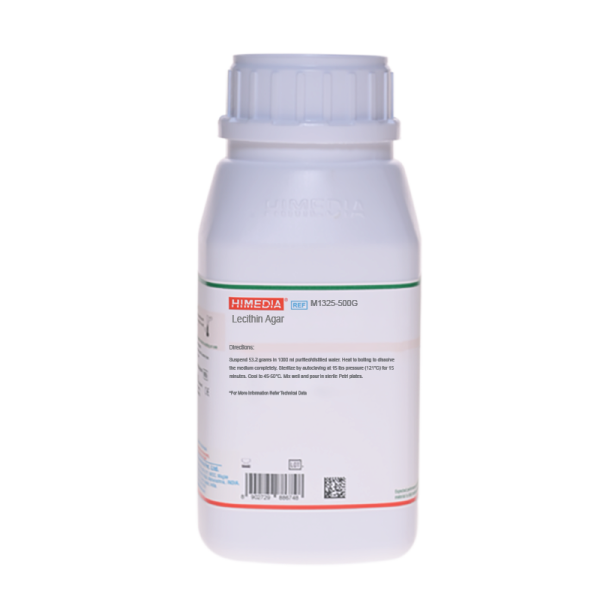
Suspend 53.2 grams in 1000 ml purified/distilled water. Heat to boiling to dissolve the medium completely. Sterilize by autoclaving at 15 lbs pressure (121°C) for 15 minutes. Cool to 45-50°C. Mix well and pour in sterile Petri plates.
This medium was originally recommended by APHA for use in microbial testing of water (1). Lecithin and polysorbate 80 were added to this medium by Weber and Black as a result of their research of the relative efficiencies of inhibitors for quaternary ammonium compounds (5). This medium is recommended for screening cosmetic products for microbial contamination. In this medium, soya peptone and tryptone provide nitrogenous compounds, carbon, sulphur and trace ingredients. Lecithin neutralizes quaternary ammonium compounds and polysorbate 80 is added to nullify phenolic compounds, hexachlorophene, formalin and alongwith lecithin neutralizes ethyl alcohol (2). Histidine acts as a reducing agent, Sodium thiosulphate neutralizes mercurial, halogens, aldehydes etc.
Water samples
For water samples, follow appropriate techniques for sample collection, processing as per pharmaceutical guidelines (1). After use, contaminated materials must be sterilized by autoclaving before discarding.
Read the label before opening the container. Wear protective gloves/protective clothing/eye protection/face protection. Follow good microbiological lab practices while handling specimens and culture. Standard precautions as per established guidelines should be followed while handling specimens. Safety guidelines may be referred in individual safety data sheets.
Performance of the medium is expected when used as per the direction on the label within the expiry period when stored at recommended temperature.
Appearance: Cream to yellow coloured homogeneous free flowing powder
Gelling: Firm, comparable with 2.05% Agar gel.
Colour and Clarity of prepared medium: Yellow coloured clear to slightly opalescent gel forms in Petri plates
Reaction: Reaction of 5.32% w/v auqeous solution at 25°C. pH: 7.3±0.2
pH: 7.10-7.50
Cultural characteristics observed after an incubation at 35-37°C for 18-24 hours.
| Organism | Inoculum (CFU) | Growth |
|---|---|---|
| Escherichia coli ATCC 25922 (00013*) | 50-100 | luxuriant |
| Staphylococcus aureus subsp. aureus ATCC 25923 (00034*) | 50-100 | luxuriant |
Key: (*) Corresponding WDCM numbers
Store dehydrated and the prepared medium at 2-8°C. Use before expiry date on thelabel. On opening, product should be properly stored dry, after tightly capping the bottle in order to prevent lump formation due to the hygroscopic nature of the product. Improper storage of the product may lead to lump formation. Store in dry ventilated area protected from extremes of temperature and sources of ignition Seal the container tightly after use. Product performance is best if used within stated expiry period.
User must ensure safe disposal by autoclaving and/or incineration of used or unusable preparations of this product. Follow established laboratory procedures in disposing of infectious materials and material that comes into contact with sample must be decontaminated and disposed of in accordance with current laboratory techniques (3,4).
| Product Name | Lecithin Agar |
|---|---|
| SKU | M1325 |
| Product Type | Regular |
| Physical Form | Powder |
| Origin | Animal |
| Packaging type | HDPE |
| References | 1.APHA, 1960, Standard Methods for the Examination of Water and Wastewater, 11th ed., American Public HealthAssociation, New York.2.Weber and Black, 1948, Soap Sanitary Chem., 24:134.3.Favero (Chm.), 1967, A State of the Art Report, Biological Contamination Control Committee, American Association forContamination Control. |