HiMedia Laboratories GmbH, Marie-Curie-Str. 3, 64683, Einhausen, Germany.

 Your enquiry has been submitted
Something problem with the server. Try again.
 Your enquiry has been submitted
Recommended for selective isolation of Campylobacter species from faecal specimens, food and environmental specimens.
| Ingredients | g/L |
|---|---|
| Proteose peptone | 15.000 |
| HL Digest# | 2.500 |
| Yeast extract | 5.000 |
| Sodium chloride | 5.000 |
| Agar | 12.000 |
| Final pH (at 25°C) | 7.4±0.2 |
**Formula adjusted, standardized to suit performance parameters
# Equivalent to Liver digest
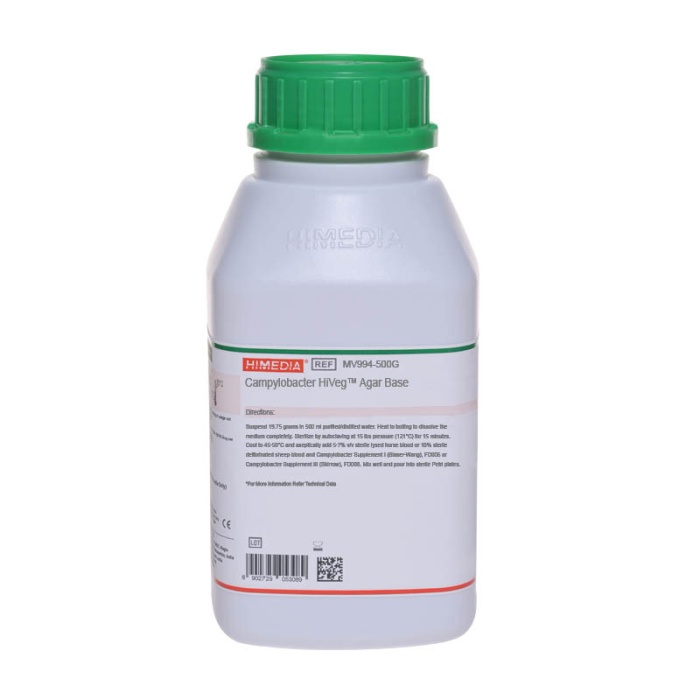
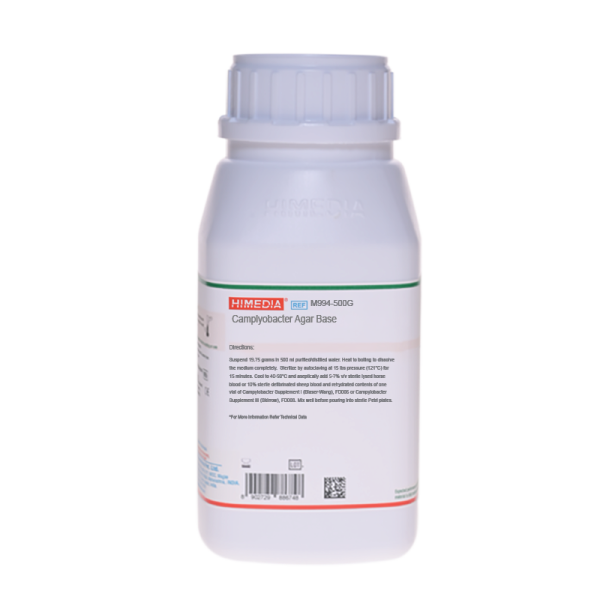
Suspend 19.75 grams in 500 ml purified/distilled water. Heat to boiling to dissolve the medium completely. Sterilize by autoclaving at 15 lbs pressure (121°C) for 15 minutes. Cool to 40-50°C and aseptically add 5-7% v/v sterile lysed horse blood or 10% sterile defibrinated sheep blood and rehydrated contents of one vial of Blaser-Wang Selective Supplement, FD006 or Skirrow Selective Supplement, FD008. Mix well before pouring into sterile Petri plates.
Campylobacter species are ubiquitous in the environment inhabiting a wide variety of ecological niches (1). Infection with a Campylobacter species is one of the most common causes of human bacterial gastroenteritis (1). Most species are found in animals (cattle, swine) and cause infertility and abortion (2). C.jejuni was originally isolated on a blood-containing media with antibiotics (3). Skirrow described a selective medium for Campylobacter species consisting of Blood Agar Base No. 2 supplemented with horse blood and antibiotics (4). Subsequently, Blaser et al isolated C.jejuni on Brucella Agar supplemented with sheep blood and four antibiotics (5). Later on, a fifth antibiotic, cephalothin was added to improve the selectivity of the medium by inhibition of accompanying faecal bacteria (6). Campylobacter Agar Base is recommended by APHA for selective isolation of Campylobacter species (7).
Campylobacter Agar Base is well supplemented to support luxuriant growth of Campylobacter species. Osmotic equilibrium of the medium is maintained by sodium chloride. Blood serves as an additional source of nutrients including X-factor. The antibiotic supplements namely Blaser-Wang (FD006) and Skirrow (FD008) markedly reduce the growth of normal enteric bacteria while enhancing the growth and recovery of C.jejuni from faecal specimens. Amphotericin B in Blaser-Wang supplement greatly or completely inhibits growth of fungi. C.jejuni colonies appear non-haemolytic, flat and gray with an irregular edge or raised and round with a mucoid appearance. Some strains may appear tan or slightly pink. Swarming may be observed on moist surfaces. Incubation at 35-37°C may show a delayed growth of C.jejuni cultures. Incubating the plates at 42°C can fasten this.
The contaminated food sample (10 to 25 grams) is enriched in Campylobacter Enrichment Broth Base (M899 + FD042). The broth is incubated with agitation under a micro aerobic atmosphere for 16-18 hrs. The enrichment culture is then plated onto the selective media i.e. Campylobacter Agar Base (M994) (7).
Clinical samples - faeces; Food and dairy samples; Environmental samples.
For food and dairy samples, follow appropriate techniques for sample collection and processing as per guidelines (8,9).
For clinical, environmental samples follow appropriate techniques for handling specimens as per established guidelines (10,11).
After use, contaminated materials must be sterilized by autoclaving before discarding.
In Vitro diagnostic use. For professional use only. Read the label before opening the container. Wear protective gloves/protective clothing/eye protection/face protection. Follow good microbiological lab practices while handling specimens and culture. Standard precautions as per established guidelines should be followed while handling clinical specimens. Safety guidelines may be referred in individual safety data sheets.
Performance of the medium is expected when used as per the direction on the label within the expiry period when stored at recommended temperature.
Appearance
Cream to yellow homogeneous free flowing powder
Gelling
Firm, comparable with 1.2% Agar gel.
Colour and Clarity of prepared medium
Basal medium: Yellow coloured clear gel
After addition of 5-7% v/v lysed blood: Reddish brown coloured opaque gel forms in Petri plates
Reaction
Reaction of 3.95% w/v aqueous solution at 25°C. pH: 7.4±0.2
pH
7.20-7.60
Cultural characteristics observed under reduced oxygen atmosphere after an incubation at 35-37°C for 24-48 hours. (FD006-Blaser-Wang Selective Supplement/ FD008-Skirrow Selective Supplement)
| Organism | Growth w/ added FD006 |
Growth w/ added FD008 |
|---|---|---|
| Candida albicans ATCC 10231 (00054*) | none - poor | moderate |
| Campylobacter jejuni ATCC 29428 (00156*) | good-luxuriant | good-luxuriant |
| Escherichia coli ATCC 25922 (00013*) | none - poor | none - poor |
| Enterococcus faecalis ATCC 29212 (00087*) | none - poor | none - poor |
Key: *Corresponding WDCM numbers.
Store between 10-30°C in a tightly closed container and the prepared medium at 2-8°C. Use before expiry date on the label. On opening, product should be properly stored dry, after tightly capping the bottle in order to prevent lump formation due to the hygroscopic nature of the product. Improper storage of the product may lead to lump formation. Store in dry ventilated area protected from extremes of temperature and sources of ignition. Seal the container tightly after use. Product performance is best if used within stated expiry period.
User must ensure safe disposal by autoclaving and/or incineration of used or unusable preparations of this product. Follow established laboratory procedures in disposing of infectious materials and material that comes into contact with clinical sample must be decontaminated and disposed of in accordance with current laboratory techniques (10,11).
| Product Name | Campylobacter Agar Base |
|---|---|
| SKU | M994 |
| Product Type | Regular |
| Physical Form | Powder |
| Origin | Animal |
| Packaging type | HDPE |
| References | 1. Koneman E. W, Allen S. D., Janda W. M, Schreckenberger P. C., Winn W. C. Jr, 1992, Colour Atlas and Textbook ofClinical Microbiology, 4th Edition, J. B. Lippincott Company. |
| Customized Product Available | No |