HiMedia Laboratories GmbH, Marie-Curie-Str. 3, 64683, Einhausen, Germany.

 Your enquiry has been submitted
Something problem with the server. Try again.

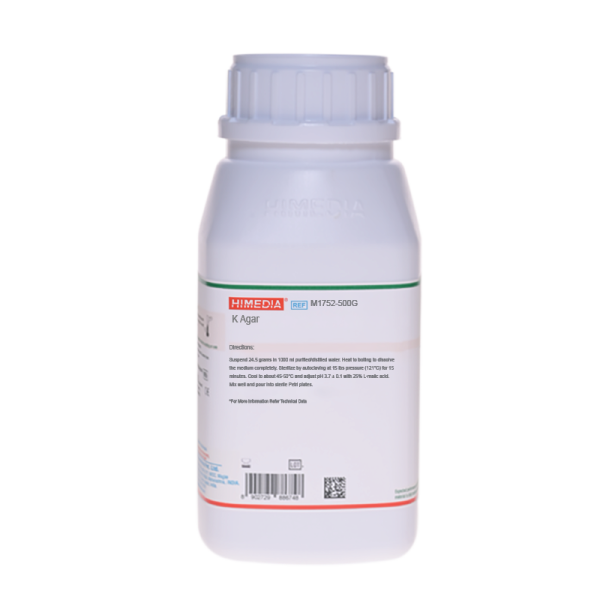
K Agar is recommended for isolation and cultivation of Alicyclobacillus in fruit juices in accordance Official Method of IFU.
| Ingredients | Gms / Litre |
|---|---|
| Yeast extract | 2.500 |
| Peptone | 5.000 |
| Glucose | 1.000 |
| Tween | 1.000 |
| Agar | 15.000 |
Final pH ( at 25°C): 3.7±0.1
**Formula adjusted, standardized to suit performance parameters
Suspend 24.5 grams in 1000 ml distilled water. Heat to boiling to dissolve the medium completely. Sterilize by autoclaving at 15 lbs pressure (121°C) for 15 minutes. Cool to about 50°C and adjust pH 3.7 ± 0.1 with 25% L-malic acid.
Alicyclobacillus are aerobic thermophilic non-pathogenic, spore forming bacteria that can survive the relatively mild pasteurization temperatures used for fruit juices and concentrates. Even very low numbers of Alicyclobacillus cause spoilage and off flavors in the beverages, damaging the brand (3). These bacteria are able to grow at pH values as low as 2.5 and also at elevated temperatures above 200C. Their spores survive for long period in fruit concentrates and similar environments.
A. acidoterrestris is the most commonly occurring species that produce taints in juice and similar products, however other species may also produce taints.
Acidified environment are required to detect and isolate A. acidoterrestris (1, 2), therefore, K-Agar is recommended for detection of taint producing Alicyclobacillus acidoterrestris as per IFU (1) (standard IFU method No.12).
Peptone and yeast extract serve as a source of nitrogen, amino acids, vitamins, and other essential growth requirements. Glucose serves as a carbon source. Polysorbate 80 serves as an additional source of growth factor and fatty acid. The low acidic pH (3.7) of medium obtained by addition of L-malic acid is inhibitory to several bacterial species.
K-Agar (when incubated at 45°C) supports the growth of predominant A. acidoterrestris and limited growth of other species. If the sample is filterable, filter it through 0.45µm membrane after pretreatment. Filter aseptically and transfer one membrane on to K- Agar and other membrane on YSG Agar (M1753). Simultaneously, streak standard cultures of Alicyclobacillus acidoterrestris and Alicyclobacillus acidocaldarius for comparison. Incubate at 45±1°C for 2-5 days. Examine daily, for detailed procedure refer standard IFU method N0.12 (1)
Appearance: Cream to yellow homogeneous free flowing powder
Gelling: Firm, comparable with 1.5% Agar gel
Colour and Clarity of prepared medium: Pale yellow coloured Clear to slightly opalescent gel forms in Petri plates.
Reaction: Reaction of 2.45% w/v aqueous solution at 25°C. pH : 3.7±0.1
pH: 3.60-3.80
M1752: Cultural characteristics observed after an incubation at 45- 46°C for 2 -5 days.
| Organism | Inoculum (CFU) | Growth | Recovery |
|---|---|---|---|
| Alicyclobacillus acidocaldarius ATCC 27009 | 50-100 | Poor-good | 30-40% |
| Alicyclobacillus acidoterrestris ATCC 49028 | 50-100 | luxuriant | >=50% |
| Alicyclobacillus acidocaldarius ATCC 43030 | 50-100 | Poor-good | 30-40% |
| Escherichia coli ATCC 25922 | >=10³ | inhibited | 0% |
| Staphylococcus aureus ATCC 25923 | >=10³ | inhibited | 0% |
Store below 30°C in tightly closed container and the prepared medium at 2 - 8°C. Use before expiry date on the label.
| Product Name | K Agar |
|---|---|
| SKU | M1752 |
| Product Type | Regular |
| Physical Form | Powder |
| Origin | Animal |
| Packaging type | HDPE |
| References | 1. IFU (2004). Standard IFU method No.12- Microbiological detection of Alicyclobacillus infruit juices. International Federation of fruit juice producer, Paris2 Matsubara et al. (2002). Alicyclobacillus acidiphilus sp. nov., a novel thermo-acidophilic–alicyclic fatty acid-containingbacterium isolated from acidic beverages. Int. J. Syst. Environment. Microbiol. 52, 1681-1685. |
| Customized Product Available | No |