HiMedia Laboratories GmbH, Marie-Curie-Str. 3, 64683, Einhausen, Germany.

 Your enquiry has been submitted
Something problem with the server. Try again.

Recommended for the enumeration and identification of Aeromonas hydrophila from food samples in accordance with APHA.
| Ingredients | g / L |
|---|---|
| Proteose peptone | 5.000 |
| Yeast extract | 3.000 |
| Tryptone | 10.000 |
| L-Ornithine monohydrochloride | 5.000 |
| Mannitol | 1.000 |
| Inositol | 10.000 |
| Sodium thiosulphate | 0.400 |
| Ferric ammonium citrate | 0.500 |
| Bromocresol purple | 0.020 |
| Agar | 3.000 |
Final pH (at 25°C): 6.7±0.2
**Formula adjusted, standardized to suit performance parameters
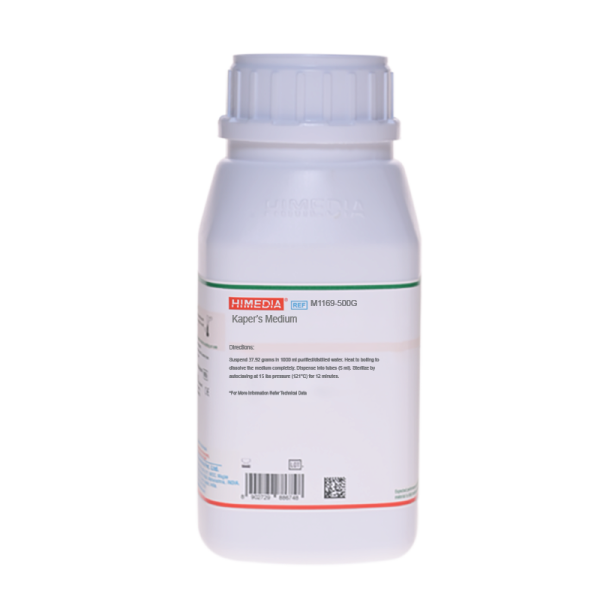
Suspend 37.92 grams in 1000 ml purified/distilled water. Heat to boiling to dissolve the medium completely. Dispense into tubes (5 ml). Sterilize by autoclaving at 15 lbs pressure (121°C) for 12 minutes.
Aeromonas hydrophila (often referred as motile aeromonads) is a facultative anaerobe, which is characterized by growth at 37°C and motility. The detection of Aeromonas species in foods and environmental samples is usually quite easy. However difficulties may arise when quantitative recovery is required or in cases where large number of other organisms are present (1). Kaper et al (2) described a single tube medium for the rapid presumptive identification of A. hydrophila, which is also recommended by APHA (3). This single tube medium shows the following reactions: mannitol and inositol fermentation, ornithine decarboxylation and deamination, motility, indole and H2S production. The food samples should be processed as soon as possible upon arrival at the laboratory. Motile aeromonads are somewhat sensitive to pH values below 5.5; therefore, acidic foods should be processed soon after arrival in the laboratory. On the basis of biochemical characterization, Aeromonas can be differentiated as mannitol fermenters, inositol non-fermenters, absence of ornithine decarboxylase, and hydrogen sulfide not produced from thiosulphate.
Tryptone, proteose peptone and yeast extract provide essential nitrogenous compounds and B vitamin etc. Sodium thiosulphate and ferric ammonium citrate acts as indicators of H2S production. Inositol and mannitol are the fermentable carbohydrates; L-ornithine hydrochloride is an amino acid. Bromocresol purple is the pH indicator, which is yellow at acidic pH and purple at neutral to alkaline pH values. Usually in tubes containing Kapers Medium inoculated with A. hydrophila, the butts turn yellow due to acid formation and an alkaline band is formed at the top of the medium. Small amount of agar facilitates motility determination.
A. hydrophilla is inoculated in Kapers Medium for the verification of the isolates. After 18-24 hours, Aeromonas shows motility, are H2S negative and indole positive (add 2 drops of Kovacs Reagent (R008) to the tubes and look for a red colour).
Food samples
For food samples, follow appropriate techniques for sample collection and processing as per guidelines (5). After use, contaminated materials must be sterilized by autoclaving before discarding.
Read the label before opening the container. Wear protective gloves/protective clothing/eye protection/face protection. Follow good microbiological lab practices while handling specimens and culture. Standard precautions as per established guidelines should be followed while handling specimens. Safety guidelines may be referred in individual safety data sheets.
Performance of the medium is expected when used as per the direction on the label within the expiry period when stored at recommended temperature.
Appearance: Cream to yellow homogeneous free flowing powder
Gelling: Semisolid, comparable with 0.3% Agar gel.
Colour and Clarity of prepared medium: Purple coloured, clear to slightly opalescent gel forms in tubes as butts
Reaction: Reaction of 3.79% w/v aqueous solution at 25°C. pH: 6.7±0.2
pH: 6.50-6.90
Cultural characteristics observed after an incubation at 35-37°C for 24-48 hours.
| Organism | Inoculum (CFU) | Growth | Medium |
|---|---|---|---|
| Aeromonas hydrophila ATCC 7966 (00063*) | 50-100 | luxuriant | acidic butt, with alkaline band at the top |
Key:(*) Corresponding WDCM numbers.
Store between 10-30°C in a tightly closed container and the prepared medium at 15-30°C. Use before expiry date on the label. On opening, product should be properly stored dry, after tightly capping the bottle in order to prevent lump formation due to the hygroscopic nature of the product. Improper storage of the product may lead to lump formation. Store in dry ventilated area protected from extremes of temperature and sources of ignition. Seal the container tightly after use. Product performance is best if used within stated expiry period.
User must ensure safe disposal by autoclaving and/or incineration of used or unusable preparations of this product. Follow established laboratory procedures in disposing of infectious materials and material that comes into contact with sample must be decontaminated and disposed of in accordance with current laboratory techniques (4,5).
| Product Name | Kaper’s Medium |
|---|---|
| SKU | M1169 |
| Product Type | Regular |
| Physical Form | Powder |
| Origin | Animal |
| Packaging type | HDPE |
| References | 1.Corry J. E. L., Curtis G. D. W., and Baird R. M., Culture Media for Food Microbiology, Vol. 34, Progress in Industrial Microbiology, 1995, Elsevier, Amsterdam.2.Kaper J., Seidler R. J., Lockman H. and Colwell R. R., 1979, Appl. Environ. Microbiol., 38:1023.3.Downes F. P. and Ito K., (Eds.), 2001, Compendium of Methods for the Microbiological Examination of Foods, 4th Ed.,APHA, Washington, D.C. |
| Customized Product Available | No |