HiMedia Laboratories GmbH, Marie-Curie-Str. 3, 64683, Einhausen, Germany.

 Your enquiry has been submitted
Something problem with the server. Try again.
 Your enquiry has been submitted
| Ingredients | Gms / Litre |
|---|---|
| Casein enzymic hydrolysate | 5.000 |
| Yeast extract | 2.500 |
| Dextrose | 1.000 |
| Sodium caseinate | 10.000 |
| Trisodium citrate | 4.410 |
| Calcium chloride | 2.220 |
| Agar | 15.000 |
**Formula adjusted, standardized to suit performance parameters
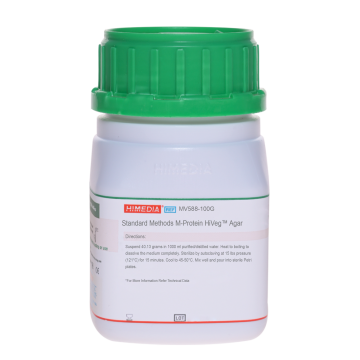
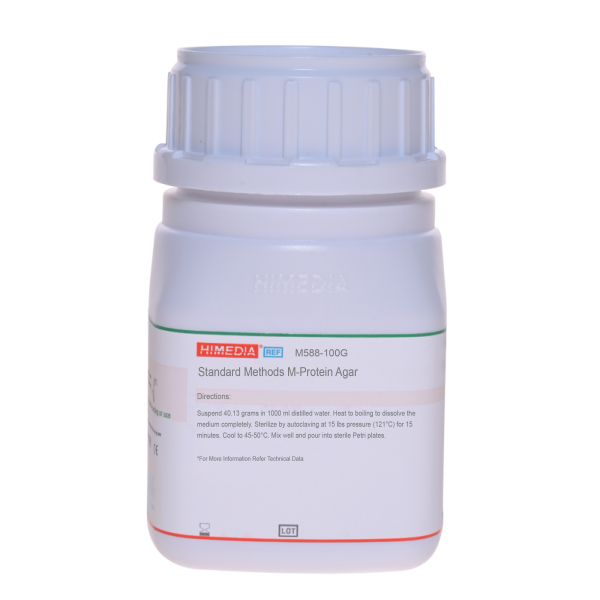
Suspend 40.13 grams in 1000 ml distilled water. Heat to boiling to dissolve the medium completely. Sterilize by autoclaving at 15 lbs pressure (121°C) for 15 minutes. Mix well and pour into sterile Petri plates.
Protein hydrolysis by microorganisms in foods may produce a variety of odour and flavour defects. Some of the common psychrotrophic spoilage bacteria are strongly proteolytic and cause undesirable changes in dairy, meat, poultry and seafood products, particularly when high populations are reached after extended refrigerated storage. Standard Methods Caseinate Agar, recommended by APHA (1) is used for detection of proteolytic microorganisms. The medium is formulated as per Martley et al (2) and exhibits greater sensitivity in the detection of the early stages of casein breakdown by the formation of zone of precipitation (insoluble paracaseins) in the transparent medium. Standard Methods Caseinate Agar is well buffered, and this reduces the occurrence of the false positive zones caused by acid production. This medium can be used for the simultaneous detection of total and proteolytic counts (1).
Sodium caseinate is the major protein source for the proteolytic organisms. Casein enzymic hydrolysate and yeast extract provide nitrogenous nutrients to the proteolytic organisms. Dextrose is the carbohydrate source. Protelolytic organisms form white or off-white precipitate around the colony. Organisms that are strongly proteolytic can breakdown the precipitate formed around the colonies to soluble components with the formation of an inner transparent zone. For the enumeration of proteolytic psychrotrophic bacteria, inoculated plates should be incubated for 10 days at 7°C.
Appearance
Cream to yellow homogeneous free flowing powder
Gelling
Firm, comparable with 1.5% Agar gel
Colour and Clarity of prepared medium
Yellow coloured clear to slightly opalescent gel forms in Petri plates
M588: Cultural characteristics observed after an incubation at 35-37°C for 18-24 hours.
| Organism | Inoculum (CFU) | Growth | Proteolytic activity |
|---|---|---|---|
| Cultural Response | |||
| Bacillus cereus ATCC 11778 | 50-100 | luxuriant | positive, opaque or clear zones around colonies |
| Pseudomonas aeruginosa ATCC 27853 | 50-100 | luxuriant | positive, opaque or clear zones around colonies |
| Escherichia coli ATCC 25922 | 50-100 | luxuriant | negative, no opaque or clear zones around colonies |
Store below 30°C in tightly closed container and the prepared medium at 2 - 8°C. Use before expiry date on the label.
| Product Name | Standard Methods Caseinate Agar (Revised as Standard Methods M-Protein Agar) |
|---|---|
| SKU | M588 |
| Product Type | Regular |
| Physical Form | Powder |
| Origin | Animal |
| Packaging type | HDPE |
| References | 1. Downes F. P. and Ito K., (Eds.), 2001, Compendium of Methods for the Microbiological Examination of Foods, 4th Ed.,APHA, Washington, D.C. 2.Martley F. G., Jayashankar S. R. and Lawrence R. C., 1970, J. Appl. Bacteriol., 3:363. |
| Customized Product Available | No |