HiMedia Laboratories GmbH, Marie-Curie-Str. 3, 64683, Einhausen, Germany.

 Your enquiry has been submitted
Something problem with the server. Try again.
 Your enquiry has been submitted
Recommended as a synthetic medium for differentiation between faecal coliforms and members of the aerogenes group on the basis of citrate utilization.
| Ingredients | g / L |
|---|---|
| Magnesium sulphate | 0.200 |
| Ammonium dihydrogen phosphate | 0.200 |
| Sodium ammonium phosphate | 0.800 |
| Sodium chloride | 5.000 |
| Bromothymol blue | 0.080 |
| Agar | 15.000 |
Final pH (at 25°C) 7.0±0.2
**Formula adjusted, standardized to suit performance parameters
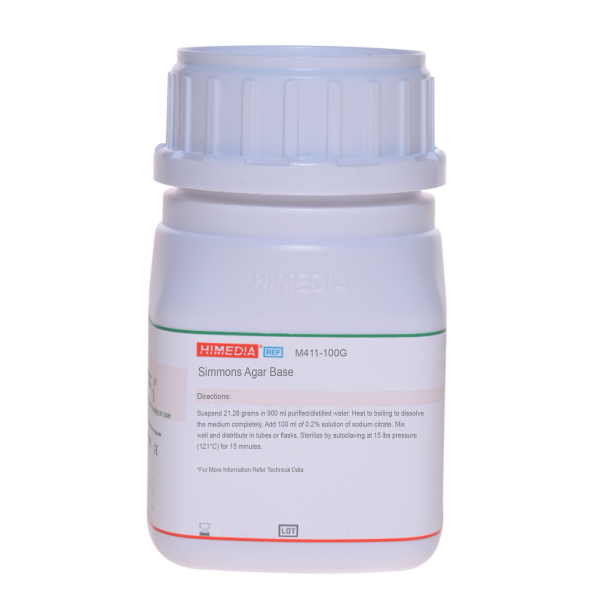
Suspend 21.28 grams in 900 ml purified/distilled water. Heat to boiling to dissolve the medium completely. Add 100 ml of 0.2% solution of sodium citrate. Mix well and distribute in tubes or flasks as desired. Sterilize by autoclaving at 15 lbs pressure (121°C) for 15 minutes.
These media are used for the differentiation between Enterobacteriaceae and the members of aerogenes group on the basis of citrate utilization as sole carbon source. Initially the citrate medium was developed by Koser (1) containing ammonium salt as the only nitrogen source and citrate as the only carbon source for differentiating Escherichia coli and Enterobacter aerogenes by IMViC tests. Later on Simmons (2) modified Kosers formulation by adding agar and bromo thymol blue (3). It is recommended by APHA (4).
Ammonium dihydrogen phosphate and sodium citrate serve as the sole nitrogen and carbon source respectively. Microorganisms also use inorganic ammonium salts as their sole nitrogen source. Metabolism of these salts causes the medium to become alkaline, indicated by a change in colour of the pH indicator from green to blue. Bromothymol blue is the pH indicator. The medium should be freshly prepared because in dry conditions, changes in colour may appear even before inoculation, especially at the bottom of the slant.
Isolated microorganism from clinical- faecal samples and non clinical samples.
For clinical samples follow appropriate techniques for handling specimens as per established guidelines (3,5). For food and dairy samples, follow appropriate techniques for sample collection and processing as per guidelines (6,7,8). For water samples, follow appropriate techniques for sample collection, processing as per guidelines and local standards (4). After use, contaminated materials must be sterilized by autoclaving before discarding.
In Vitro diagnostic use. For professional use only. Read the label before opening the container. Wear protective gloves/ protective clothing/eye protection/face protection. Follow good microbiological lab practices while handling specimens and culture. Standard precautions as per established guidelines should be followed while handling clinical specimens. Safety guidelines may be referred in individual safety data sheets.
Performance of the medium is expected when used as per the direction on the label within the expiry period when stored at recommended temperature.
Appearance Cream to yellow homogeneous free flowing powder
Gelling Firm, comparable with 1.5% Agar gel
Colour and Clarity of prepared medium Forest green coloured clear to slightly opalescent gel forms in tubes as slants
Reaction Reaction of 2.13% w/v aqueous solution at 25°C pH : 7.0±0.2
pH 6.80-7.20
Cultural characteristics observed after an incubation at 35-37°C for 18-24 hours with added 0.2% solution of Sodium citrate.
| Organism | Growth | Citrate utilisation |
|---|---|---|
| # Klebsiella aerogenes ATCC 13048 (00175*) | good-luxuriant | positive reaction, blue colour |
| Escherichia coli ATCC 25922 | inhibited | negative reaction, green colour |
| Salmonella Typhi ATCC 6539 | fair-good | negative reaction, green colour |
| Salmonella Typhimurium ATCC 14028 | good-luxuriant | positive reaction, blue colour |
| Salmonella Enteritidis ATCC 13076 | good-luxuriant | positive reaction, blue colour |
| Shigella dysenteriae ATCC 13313 | inhibited | negative reaction, green colour |
Key: (*) Corresponding WDCM numbers. (#) Formerly known as Enterobacter aerogenes
Store between 10-30°C in a tightly closed container and the prepared medium at 20-30°C. Use before expiry date on the label. On opening, product should be properly stored dry, after tightly capping the bottle in order to prevent lump formation due to the hygroscopic nature of the product. Improper storage of the product may lead to lump formation. Store in dry ventilated area protected from extremes of temperature and sources of ignition Seal the container tightly after use. Product performance is best if used within stated expiry period.
User must ensure safe disposal by autoclaving and/or incineration of used or unusable preparations of this product. Follow established laboratory procedures in disposing of infectious materials and material that comes into contact with clinical sample must be decontaminated and disposed of in accordance with current laboratory techniques (3,5).
| Product Name | Simmons Agar Base |
|---|---|
| SKU | M411 |
| Product Type | Regular |
| Physical Form | Powder |
| Origin | Chemically defined |
| Packaging type | HDPE |
| References | 1. Green S. R. and Gray P. P., 1950, Wallerstein Lab. Commun., 12:43 2.Green S. R. and Gray P. P., 1950, Wallerstein Lab. Commun., 13:357 3.MacFaddin J. F., 1985, Media for Isolation- Cultivation- Identification- Maintenance of Medical Bacteria, Vol.1,Williams & Wilkins, Baltimore, Md. . |
| Customized Product Available | No |