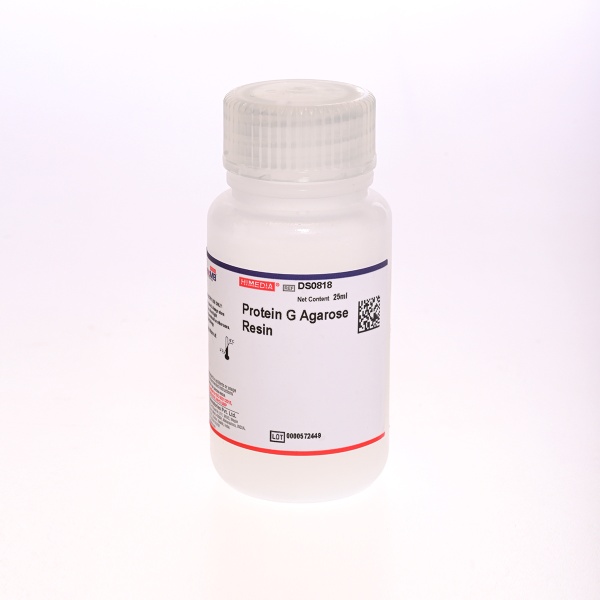
HiMedia's Protein G Agarose Resin consists of rProtein G covalently bound to crosslinked agarose beads and has a very high affinity for IgG (immunoglobulins). rProtein G is a genetically engineered recombinant protein which contains three IgG-binding regions of native Protein G. The cell wall binding region, albumin binding region and other non-specific regions have been eliminated from the recombinant Protein G to ensure the maximum specific IgG binding. The recombinant Protein G has been covalently immobilized onto 4% cross-linked agarose. Immobilized Protein G is ideal for polyclonal IgG purification from mouse, human, cow, goat and sheep serum, including human IgG3 and mouse IgG1 isotypes. When a suspension (e.g. serum, ascites fluid, tissue culture supernatant) containing mixture of substances along with IgG are loaded on the column, the IgG binds to Protein G and is recovered by elution. This resin is used for batch or column purifications of classes, subclasses and fragments of immunoglobulins from serum, ascites fluid, tissue culture supernatant. It provides a very stable bond that can greatly minimize leakage of the Protein G allowing for reuse of the affinity resin in several purification steps. This product is supplied as a slurry suspension of Protein G Agarose Resin in 20% ethanol. 1 ml resin corresponds to 2 ml of 50 % (v/v) Protein G Agarose slurry suspension
HiMedia’s Protein G Agarose Resin consists of rProtein G covalently bound to crosslinked agarose beads and has a very high affinity for IgG (immunoglobulins). Protein G is a genetically engineered recombinant protein which
contains three IgG-binding regions of native Protein G. The recombinant Protein G has been covalently immobilized onto 4% cross-linked agarose. Immobilized Protein G is ideal for polyclonal IgG purification from mouse, human, cow, goat and sheep serum, including human IgG3 and mouse IgG1 isotypes. When a suspension (e.g. serum, ascites fluid, tissue culture supernatant) containing mixture of substances along with IgG are loaded on the column, the IgG binds to Protein G and is recovered by elution.
 HiMedia Laboratories GmbH, Marie-Curie-Str. 3, 64683, Einhausen, Germany.

 Your enquiry has been submitted