 Plot No. C40, Road No. 21Y, MIDC, Wagle Industrial Estate, Thane(W)-400604, MH, India


-
-
-

Essential Guide to Routine Testing for Legionella in 2026
January 23 2026 -

-

Guide to Pharmaceutical Testing Culture Media
January 22 2026
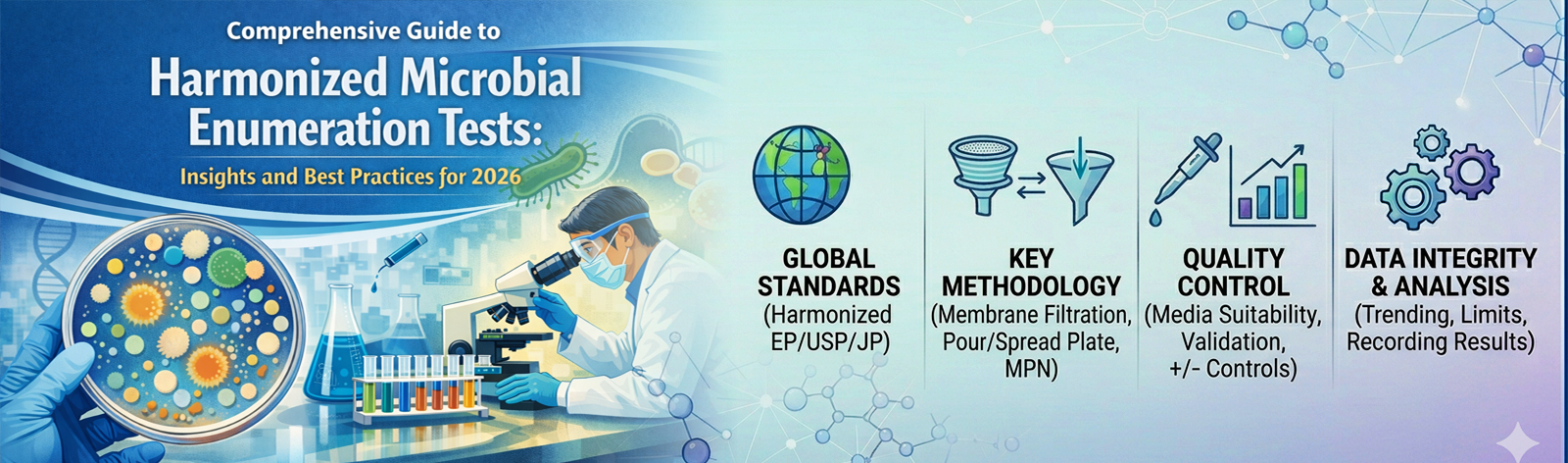
Comprehensive Guide to Harmonized Microbial Enumeration Tests: Insights and Best Practices for 2026
In pharmaceutical manufacturing, ensuring microbiological safety is not merely a regulatory requirement, it is a critical safeguard for patient health. Even trace microbial contamination in non-sterile pharmaceutical products can compromise product stability, efficacy, and safety. This is where microbial enumeration tests play a pivotal role. These tests help quantify viable microorganisms present in raw materials, finished products, and manufacturing environments, enabling manufacturers to confirm compliance with microbiological quality standards.
Over the past two decades, the pharmaceutical industry has witnessed a significant shift toward harmonized microbial testing standards across major pharmacopeias, including the United States Pharmacopeia (USP), European Pharmacopoeia (EP), and Japanese Pharmacopoeia (JP). Harmonization ensures that microbial testing procedures remain consistent across global regulatory frameworks, allowing pharmaceutical companies to streamline quality control processes and facilitate international product approvals.
While earlier guidance such as the USP’s 2008 article on microbial enumeration laid the groundwork for harmonized testing approaches, the landscape has evolved considerably. Updated pharmacopeial chapters, improved culture media, advanced incubation systems, and enhanced validation strategies have refined the accuracy and reliability of microbial testing.
This comprehensive guide explores the evolution, current standards, practical applications, and best practices of harmonized microbial enumeration tests in 2026, providing actionable insights for microbiologists, quality control professionals, and regulatory specialists.
1. Evolution of Microbial Enumeration Tests
Microbial enumeration testing has long been a cornerstone of pharmaceutical microbiology, playing a critical role in ensuring the microbiological quality and safety of pharmaceutical products. In the early years, microbial testing methodologies varied considerably across different pharmacopeias and regulatory jurisdictions. Laboratories followed diverse protocols for microbial count determination, which often resulted in inconsistencies in test outcomes and posed significant challenges for multinational pharmaceutical manufacturers striving to comply with multiple regulatory frameworks.
These challenges were further compounded by the inherent ability of microorganisms to rapidly adapt to changing environmental conditions. Microbes possess dynamic genetic mechanisms that enable them to evolve and survive under selective pressures, such as exposure to antimicrobial agents. This rapid adaptability is driven by processes including horizontal gene transfer, spontaneous mutations, and genome reduction, which allow microorganisms to acquire advantageous traits, such as antibiotic resistance and enhanced survival capabilities. Consequently, understanding microbial adaptability and evolution is essential for designing robust and reliable microbial enumeration methods that remain effective in detecting diverse and evolving microbial populations.
1.1. Early Microbial Testing Approaches
Traditional microbial enumeration methods primarily relied on:
- Plate count methods.
- Membrane filtration techniques.
- Direct inoculation approaches.
- Most Probable Number (MPN) Method.
Although these methods were effective in detecting microbial contamination, variations often led to inconsistencies across regulatory frameworks. As a result, a pharmaceutical product that complied with microbial limits in one region might not necessarily meet the requirements in another due to differences in testing procedures.
1.2. Need for Global Harmonization
As pharmaceutical supply chains became increasingly global, regulatory authorities recognized the need for standardized testing methodologies. The Pharmacopeial Discussion Group (PDG), a collaborative initiative involving the United States Pharmacopeia (USP), European Pharmacopoeia (EP), and Japanese Pharmacopeia (JP), initiated efforts to harmonize microbiological testing chapters.
The harmonization initiative focused on aligning key microbial testing standards, particularly:
- Microbial Enumeration Tests.
- Tests for Specified Microorganisms.
- Sterility Testing Methods.
1.3. Benefits of Harmonized Testing
The harmonization of microbial enumeration tests brought several advantages to the pharmaceutical industry:
- Global consistency in microbiological testing.
- Reduced duplication of testing requirements.
- Simplified regulatory submissions.
- Improved reliability of microbial quality assessments.
These developments laid the foundation for the modern harmonized standards currently used in pharmaceutical quality control laboratories worldwide.
2. Current Harmonized Standards and Their Implications
Modern harmonized microbial enumeration tests are outlined in pharmacopeial chapters such as USP <61> Microbial Enumeration Tests, along with the corresponding chapters in the European and Japanese pharmacopeias—Microbiological Examination of Non-Sterile Products: Microbial Enumeration Tests (e.g., USP <61>, Ph. Eur. 2.6.12, and JP 4.05). These guidelines establish standardized methodologies for the detection and quantification of microbial contamination in non-sterile pharmaceutical products, thereby ensuring consistency, reliability, and regulatory compliance across global pharmaceutical testing laboratories.
2.1. Key Microbiological Parameters
Harmonized microbial enumeration testing primarily focuses on two parameters:
- Total Aerobic Microbial Count (TAMC): Measures the number of viable aerobic microorganisms present in a medium.
- Total Yeast and Mold Count (TYMC): Determines the number of fungal microorganisms, including yeasts and molds.
Together, these parameters provide a comprehensive assessment of microbial contamination in pharmaceutical products and support the globally standardized determination of bioburden in both raw materials and finished pharmaceutical products.
2.2. Test for Suitability of Media for Growth Promotion
Each batch of dehydrated medium or ready-prepared or medium prepared using the ingredients as specified is tested for growth promoting properties. The test medium is inoculated with less than 100 cfu.
Growth on Soyabean Casein Digest Agar is observed after incubation at 30–35°C for <= 3 days for bacterial growth and <= 5 days for fungal growth.
Growth on Sabouraud Dextrose Agar is observed after incubation at 20–25°C for <= 5 days for fungal growth. For solid media, growth obtained must not differ by a factor greater than 2 from the calculated value for a standardized inoculum.
The Growth Promotion Test (GPT) ensures that every batch of culture media is capable of supporting the growth of specific microorganisms. The test medium is inoculated with less than 100 cfu.
For solid media, growth obtained must not differ by a factor greater than 2 from the calculated value for a standardized inoculum.
2.2.1. Incubation Parameters
| Medium | Target Organism | Incubation Temp | Duration |
|---|---|---|---|
| Soyabean Casein Digest Agar (SCDA) | Bacteria | 30–35°C | <= 3 days |
| Soyabean Casein Digest Agar (SCDA) | Fungi/Yeast | 30–35°C | <= 5 days |
| Sabouraud Dextrose Agar (SDA) | Fungi/Yeast | 20–25°C | <= 5 days |
2.3. Updated USP Guidance and Method Suitability
Recent updates to pharmacopeial standards have emphasized method suitability testing, ensuring that the test method used can reliably detect microorganisms in the presence of the product matrix.
Many pharmaceutical products contain ingredients with antimicrobial properties, such as preservatives or active pharmaceutical ingredients (APIs), which may inhibit microbial growth during testing. Method suitability studies verify that the chosen testing method can effectively recover microorganisms despite these inhibitory factors.
2.3.1. Key Considerations for Selecting Appropriate Neutralizers
| Interfering Substance | Potential Neutralizing Agents/Method |
|---|---|
| Glutaraldehyde, mercurials | Sodium hydrogen sulfite (Sodium bisulfite) |
| Phenolics, alcohol, aldehydes, sorbate | Dilution |
| Aldehydes | Glycine |
| Quaternary ammonium compounds (QACs), parahydroxybenzoates (parabens), bis-biguanides | Lecithin |
| QACs, iodine, parabens | Polysorbate |
| Mercurials | Thioglycollate |
| Mercurials, halogens, aldehydes | Thiosulfate |
| EDTA (edetate) | Mg or Ca ions |
Note: If no suitable neutralizing method can be found, it can be assumed that the failure requires further evaluation.
2.4. Validation of Culture Media Performance
The media used for TAMC and TYMC is initially validated as defined to check suitability of media for Growth Promotion.
2.5. Demonstration of Microbial Recovery
The media on performing growth promotion is incubated at specified temperature for specified period to check for the microbial recovery as described.
2.6. Impact on Pharmaceutical Manufacturing
Harmonized microbial enumeration standards significantly influence several aspects of pharmaceutical manufacturing:
- Quality Control Testing: Standardized procedures ensure consistent microbial quality assessments across global laboratories.
- Process Monitoring: Routine microbial enumeration helps detect contamination risks during manufacturing.
- Interpreting Microbial Limits: Acceptance criteria for microbial counts vary depending on product type, route of administration, and patient population.
For instance:
- Oral dosage forms generally permit higher microbial counts than sterile products.
- Topical products may have stricter fungal limits.
- Products for immunocompromised patients often require tighter microbial control.
Understanding these limits is essential for ensuring product safety while maintaining regulatory compliance.
3. Practical Applications and Case Studies
Although harmonized standards provide clear guidelines, implementing microbial enumeration tests in real-world laboratory settings can present practical challenges.
3.1. Common Pitfalls in Microbial Enumeration Testing
Laboratories often encounter challenges that affect the accuracy of microbial counts:
- Inadequate sample preparation: Improper dilution or dispersion can lead to inaccurate counts.
- Inhibitory product matrices: Certain formulations suppress microbial growth during testing.
- Improper incubation conditions: Incorrect temperature or incubation duration can affect microbial recovery.
- Poor culture media quality: Suboptimal media formulations may fail to support microbial growth.
Addressing these issues requires robust laboratory protocols and strict adherence to harmonized testing guidelines.
3.2. Best Practices for Reliable Testing
- Use validated culture media that supports the growth of a broad spectrum of microorganisms.
- Perform method suitability testing for each product formulation.
- Maintain strict aseptic and accurate techniques during sample preparation.
- Regularly verify incubator performance and temperature uniformity.
- Implement quality control checks for microbial recovery.
These measures help ensure accurate, reproducible microbial enumeration results.
3.3. Case Study: Improving Microbial Recovery in Preservative-Containing Products
A pharmaceutical manufacturer producing liquid oral formulations encountered difficulties during microbial enumeration testing. The product contained a preservative system that inhibited microbial growth during testing, resulting in inconsistent recovery of test microorganisms.
The quality control team conducted a method suitability study and identified the need for an appropriate neutralizing agent. After incorporating a validated neutralizer into the testing protocol, microbial recovery rates improved significantly, ensuring compliance with pharmacopeial requirements.
This case highlights the importance of method validation and suitability testing when working with antimicrobial formulations.
4. 10 Essential Steps for Implementing Harmonized Microbial Enumeration Tests
To streamline microbial testing workflows, laboratories can follow this practical implementation checklist:
- Understand pharmacopeial requirements for microbial enumeration testing.
- Select appropriate testing methods, such as plate count or membrane filtration.
- Perform method suitability studies to confirm microbial recovery.
- Validate culture media performance using appropriate test organisms.
- Prepare samples correctly by ensuring proper dilution and thorough homogenization, as accurate sample preparation is critical for reliable microbial enumeration. This process must adhere to strict compliance requirements, where each batch of culture medium is validated for its growth-promoting capability by demonstrating the ability to support the growth of specified ATCC strains at a low inoculum level of approximately 10 to 100 CFU.
- Neutralize inhibitory substances present in the product formulation.
- Maintain controlled incubation conditions for optimal microbial growth.
- Implement strict aseptic laboratory practices during testing procedures.
- Document all testing parameters and results including colony morphology for regulatory compliance.
- Review microbial data trends regularly to identify potential contamination risks.
Following this checklist helps laboratories establish a reliable microbial testing framework aligned with harmonized pharmacopeial standards.
5. Future Trends in Microbial Enumeration Testing
As pharmaceutical manufacturing technologies continue to evolve, microbial testing methods are also advancing. Emerging developments include:
- Automated microbial detection systems
- Rapid microbiological methods (RMM)
- AI-assisted microbial identification
- Advanced microbial monitoring platforms
Although traditional culture-based methods remain the gold standard for regulatory compliance, these emerging technologies are expected to enhance efficiency and reduce testing turnaround times in the future.
6. Conclusion
Harmonized microbial enumeration tests form the backbone of microbiological quality control in the pharmaceutical industry. By standardizing testing procedures across major pharmacopeias, these guidelines help ensure consistent microbial safety assessments for pharmaceutical products distributed worldwide. Modern updates to pharmacopeial standards have strengthened the reliability of microbial testing through improved method suitability requirements, validated culture media, and clearer microbial acceptance criteria.
For pharmaceutical manufacturers and quality control laboratories, adopting best practices in microbial enumeration testing is essential for maintaining regulatory compliance, safeguarding product quality, and protecting patient health. As microbial testing technologies continue to evolve, laboratories that stay aligned with harmonized standards will be better equipped to meet the challenges of modern pharmaceutical manufacturing.
Acknowledgement
The authors express their sincere gratitude to Dr. Rahul Warke (Director, Microbiology Department) and Dr. Girish Mahajan (Senior Vice President, Microbiology Department) for their exceptional scientific guidance, critical insights, and continuous support throughout the development of this work. The authors also thank Ms. Vrutti Mistry (Scientific Writer) for her support in drafting the manuscript.
References
- United States Pharmacopeia (USP). (2024). USP General Chapter <61> Microbial Enumeration Tests. United States Pharmacopeial Convention, Rockville, MD.
- European Directorate for Quality of Medicines (EDQM). (2024). European Pharmacopoeia, Chapter 2.6.12: Microbiological Examination of Non-Sterile Products – Microbial Enumeration Tests. Council of Europe, Strasbourg.
- Japanese Pharmacopoeia (JP). (2021). Chapter 4.05. General Tests – Microbial Limit Tests. Ministry of Health, Labour and Welfare, Japan.
- Food and Drug Administration (FDA). (2004). Guidance for Industry: Sterile Drug Products Produced by Aseptic Processing – Current Good Manufacturing Practice.