Plot No. C40, Road No. 21Y, MIDC, Wagle Industrial Estate, Thane(W)-400604, MH, India


 Your enquiry has been submitted
Something problem with the server. Try again.
 Your enquiry has been submitted
Recommended for sterility testing of biologicals and for cultivation of aerobes, anaerobes and microaerophiles in accordance with EP.
| Ingredients | Gms / Litre |
|---|---|
| Tryptone | 15.000 |
| Yeast extract | 5.000 |
| Glucose monohydrate | 5.500 |
| Sodium chloride | 2.500 |
| L-Cystine | 0.500 |
| Sodium thioglycollate | 0.500 |
| Resazurin sodium | 0.001 |
| Agar | 0.750 |
| pH after sterilization (at 25°C) | 7.1±0.2 |
**Formula adjusted, standardized to suit performance parameters
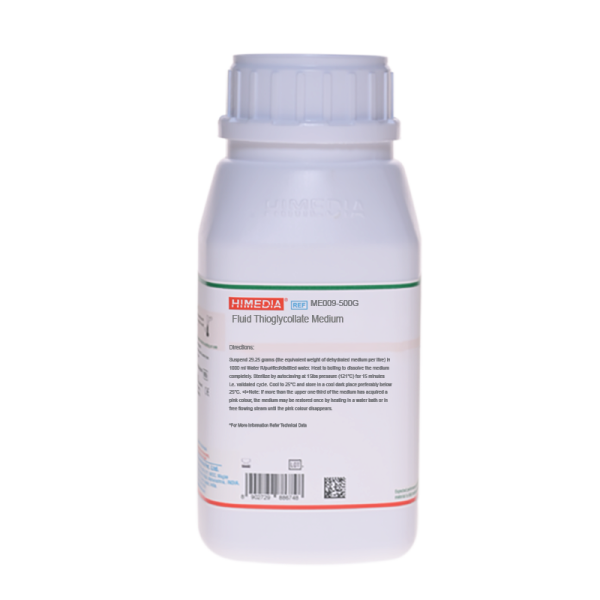
Suspend 29.25 grams (the equivalent weight of dehydrated medium per litre) in 1000 ml Water R/purified/distilled water. Heat to boiling to dissolve the medium completely. Sterilize by autoclaving at 15lbs pressure (121°C) for 15 minutes i.e. validated cycle. Cool to 25°C and store in a cool dark place preferably below 25°C.
Note: If more than the upper one-third of the medium has acquired a pink-purple colour, the medium may be restored once by heating in a water bath or in free flowing steam until the pink-purple colour disappears.
Brewer (1) formulated Fluid Thioglycollate Medium for rapid cultivation of aerobes as well as anaerobes by adding a reducing agent and small amount of agar. The European Pharmacopoeia (3), USP (10), BP (2) and AOAC (11) have recommended the media for sterility testing of antibiotics, biologicals and foods and for determining the phenol coefficient and sporicidal effect of disinfectants. However, it is intended for the examination of clear liquid or water-soluble materials. Glucose monohydrate, tryptone, yeast extract provide necessary nutrients and growth factors necessary for bacterial multiplication. Sodium thioglycollate, L-cystine lower the oxidation-reduction potential of the medium by removing oxygen to maintain a low Eh. By creating an environment with a low Eh, the reducing agents prevent the accumulation of peroxides which can be toxic to some organisms. The sulphahydryl groups (-SH) of these compounds neutralizes the antibacterial effect of mercurial preservatives and other heavy metal compounds which exert a bacteriostatic effect in the materials under examination. Any increase in the oxygen content is indicated by a colour change of redox indicator, resazurin to pink (7,8,9). The small amount of agar helps in maintaining low redox potential for stabilizing the medium (6). In sterility checking, when the sample contains preservatives, it is recommended to dilute the sample with this broth to reduce the toxicity and enhance the growth of contaminants, if any.
Pharmaceutical samples for sterility testing
For pharmaceutical samples, follow appropriate techniques for sample collection, processing as per guidelines (3)
After use, contaminated materials must be sterilized by autoclaving before discarding.
Read the label before opening the container. Wear protective gloves/protective clothing/eye protection/face protection. Follow good microbiological lab practices while handling specimens and culture. Standard precautions as per established guidelines should be followed while handling specimens. Safety guidelines may be referred in individual safety data sheets.
Performance of the medium is expected when used as per the direction on the label within the expiry period when stored at recommended temperature.
Appearance
Cream to yellow homogeneous free flowing powder
Colour and Clarity of prepared medium
Light straw coloured clear to slightly opalescent solution with upper 10% or less medium pink to purple on standing.
Reaction
After sterilization, reaction of 2.92% w/v aqueous solution at 25°C. pH : 7.1±0.2
pH
6.90-7.30
Growth Promotion Test
As per European Pharmacopoeia
Stability test
Light yellow coloured clear solution without any precipitation sedimentation at room temperature for 7 days
Cultural response
Cultural characteristics observed after an incubation at 30-35°C for not more than 3 days.
| Organism | Inoculum (CFU) | Growth |
|---|---|---|
| When incubated anaerobically | ||
| Clostridium sporogenes ATCC 19404 (00008*) | 50-100 | luxuriant |
| Clostridium sporogenes ATCC 11437 | 50-100 | luxuriant |
| Clostridium sporogenes NBRC 14293 | 50-100 | luxuriant |
| Clostridium perfringens ATCC 13124 (00007*) | 50-100 | luxuriant |
| Bacteroides fragilis ATCC 23745 | 50-100 | luxuriant |
| Bacteroides vulgatus ATCC 8482 | 50-100 | luxuriant |
| When incubated aerobically | ||
| Staphylococcus aureus subsp. aureus ATCC 25923 (00034*) | 50-100 | luxuriant |
| Staphylococcus aureus subsp. aureus ATCC 6538 (00032*) | 50-100 | luxuriant |
| Pseudomonas aeruginosa ATCC 27853 (00025*) | 50-100 | luxuriant |
| Pseudomonas aeruginosa ATCC 9027 (00026*) | 50-100 | luxuriant |
| Micrococcus luteus ATCC 9341 | 50-100 | luxuriant |
| Streptococcus pneumoniae ATCC 6305 | 50-100 | luxuriant |
| Escherichia coli ATCC 25922 (00013*) | 50-100 | luxuriant |
| Escherichia coli ATCC 8739 (00012*) | 50-100 | luxuriant |
| Escherichia coli NCTC 9002 | 50-100 | luxuriant |
| Salmonella Typhimurium ATCC 14028 (00031*) | 50-100 | luxuriant |
| Salmonella Abony NCTC 6017 (00029*) | 50-100 | luxuriant |
| Bacillus subtilis subsp. spizizenii ATCC 6633 (00003*) | 50-100 | luxuriant |
Key : * Corresponding WDCM numbers.
Store between 10-30°C in a tightly closed container and the prepared medium at 15-25°C. Use before expiry date on the label. On opening, product should be properly stored dry, after tightly capping the bottle in order to prevent lump formation due to the hygroscopic nature of the product. Improper storage of the product may lead to lump formation. Store in dry ventilated area protected from extremes of temperature and sources of ignition. Seal the container tightly after use. Product performance is best if used within stated expiry period.
User must ensure safe disposal by autoclaving and/or incineration of used or unusable preparations of this product. Follow established laboratory procedures in disposing of infectious materials and material that comes into contact with sample must be decontaminated and disposed of in accordance with current laboratory techniques (4,5).
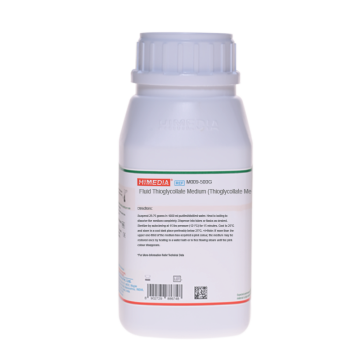
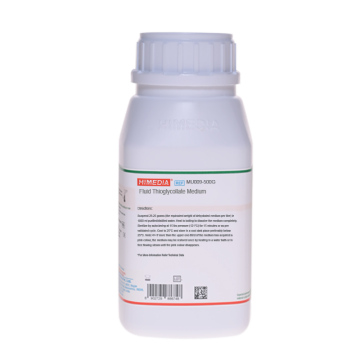
| Product Name | Fluid Thioglycollate Medium |
|---|---|
| SKU | ME009 |
| Product Type | Regular |
| Physical Form | Powder |
| Origin | Animal |
| Packaging type | HDPE |
| References | 1.Brewer, 1940, J. Am. Med. Assoc., 115:598. 2.The United States Pharmacopoeia, 2018, The United States Pharmacopoeial Convention, Rockville, MD. 3.British Pharmacopoeia, 2016, The Stationery office British Pharmacopoeia4.European Pharmacopoeia, 2017, European Dept. for the quality of Medicines. 5.Williams H., (Ed.), 2005, Official Methods of Analysis of the Association of Official Analytical Chemists, 19th Ed., AOAC,Washington, D.C 6.Marshall, Gunnison and Luxen, 1940, Proc. Soc. Exp. Biol. Med., 43:672. 7.Nungester, Hood and Warren, 1943, Proc. Soc. Exp. Biol. Med., 52:287. 8.Portwood, 1944, J. Bact., 48:255. 9.MacFaddin J.F., 1985, Media for Isolation-Cultivation-Identification-Maintenance of Medical Bacteria, Vol. 1, Williamsand Wilkins, Baltimore. 10.Federal Register, 1992, Fed. Regist., 21:640.0.. 11. Quastel and Stephenson, 1926, J.Biochem., 20:1.. 12.Isenberg, H.D. Clinical Microbiology Procedures Handb0ook. 2nd Edition.13Jorgensen,J.H., Pfaller , M.A., Carroll, K.C., Funke, G., Landry, M.L., Richter, S.S and Warnock., D.W. (2015)Manual of Clinical Microbiology, 11th Edition. Vol. 1. |