HiMedia Laboratories GmbH, Marie-Curie-Str. 3, 64683, Einhausen, Germany.

 Your enquiry has been submitted
Something problem with the server. Try again.

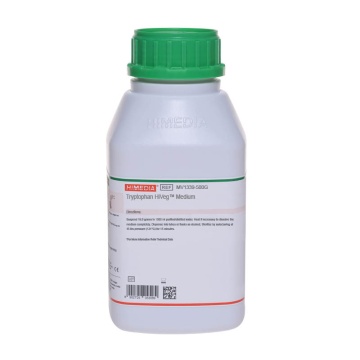
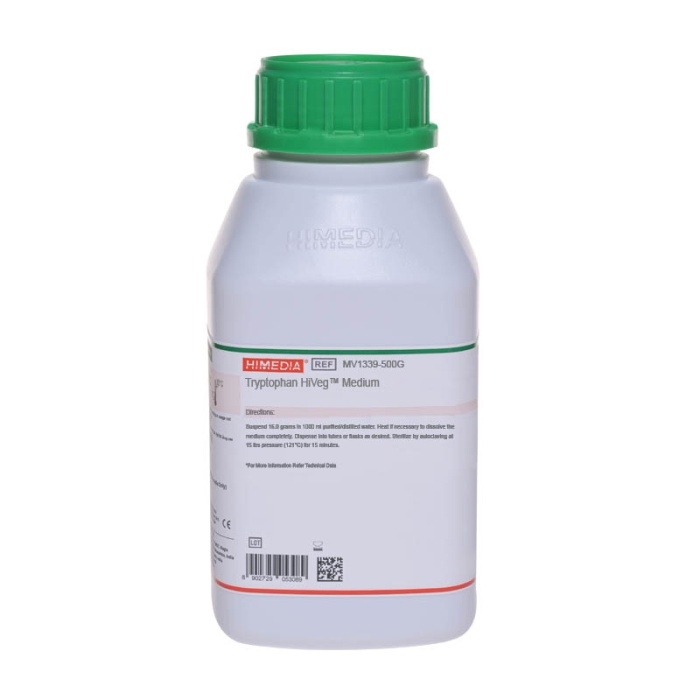
Recommended for detection of indole reaction. The composition and performance criteria of this medium are as per specifications laid down in ISO/DIS 16654.
| Ingredients | g/L |
|---|---|
| Tryptone | 10.000 |
| Sodium chloride | 5.000 |
| DL-Tryptophan | 1.000 |
| Final pH (at 25°C) | 7.5±0.2 |
| Ingredients | g/L |
|---|---|
| Tryptone | 10.000 |
| Sodium chloride | 5.000 |
| DL-Tryptophan | 1.000 |
| Final pH (at 25°C) | 7.5±0.2 |
**Formula adjusted, standardized to suit performance parameters
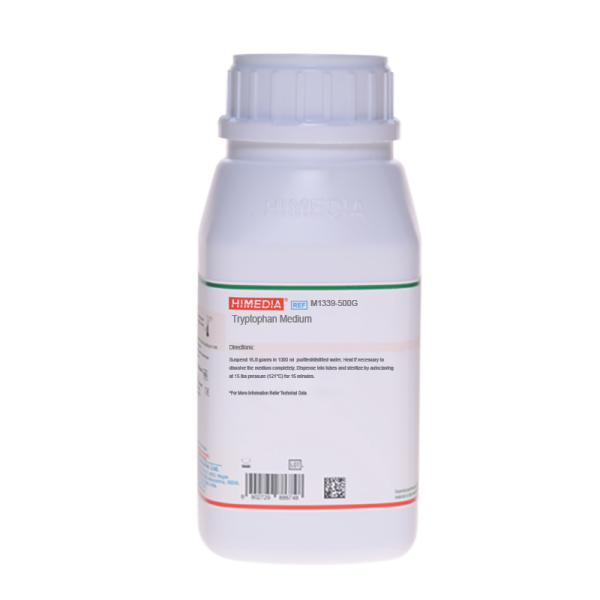
Suspend 16.0 grams in 1000 ml purified/distilled water. Heat if necessary to dissolve the medium completely. Dispense into tubes and sterilize by autoclaving at 15 lbs pressure (121°C) for 15 minutes.
Enterohemorrhagic Escherichia coli (EHEC) is a defined subset of Shiga-like (vero) toxin-producing E.coli. EHEC infections are waterborne or food borne. EHEC is ingested most commonly with undercooked ground beef (1,2,3). There are more than 50 serotypes of EHEC. However, E. coli O157:H7 is the prototype EHEC.E. coli O157:H7 can cause an asymptomatic infection, mild diarrhea, or a diarrheal illness that is characterized by non-bloody (progressing to bloody) diarrhea and abdominal cramps (together known as hemorrhagic colitis), few leukocytes in stools and lack of significant fever (1,2,4).Tryptophan Medium is prepared as per the formula approved by ISO Committee (5), that is a modification of original formula of APHA where the medium is devoid of tryptophan (6). This medium is useful for the detection of indole production by Escherichia coli O157: H7, which is a key feature in differentiation of coliforms.
Tryptone provides carbonaceous and nitrogenous sources required for the growth of microorganisms. Tryptophan is an amino acid, which serves as a substrate to study indole reaction. Certain microorganisms breakdown tryptophan with the help of the enzyme tryptophanase that mediate the production of indole by hydrolytic activity (7). The indole produced can be detected by Kovacs or Ehrlichs reagent (8). Indole combines with the aldehyde present in the above reagent to give red colour in the alcohol layer. The alcohol layer extracts and concentrates the red colour complex.
Clinical and non-clinical samples, Water samples
The test sample is enriched in Modified Soyabean Bile Broth Base (M12861) by incubating at 42°C for 18-24 hours. E. coli O157:H7 is then isolated on MacConkey Sorbitol Agar Base (M2981). Pale coloured colonies obtained on incubation at 35-37°C for 18-24 hours are reported as presumptive E.coli O157:H7. Presumptive colonies are subjected to indole test that makes the use of Tryptophan Medium (M1339). After use, contaminated materials must be sterilized by autoclaving before discarding.
In Vitro diagnostic use. For professional use only. Read the label before opening the container. Wear protective gloves/ protective clothing/eye protection/ face protection. Follow good microbiological lab practices while handling specimens and culture. Standard precautions as per established guidelines should be followed while handling specimens. Safety guidelines may be referred in individual safety data sheets.
Performance of the medium is expected when used as per the direction on the label within the expiry period when stored at recommended temperature.
Appearance Cream to yellow homogeneous free flowing powder
Colour and Clarity of prepared medium Yellow coloured clear solution without any precipitate.
Reaction Reaction of 1.6% aqueous solution at 25°C. pH : 7.5±0.2
pH 7.30-7.70
Cultural characteristics observed after an incubation at 35-37°C for 18-24 hours.
| Organism | Inoculum | Growth | Indole |
|---|---|---|---|
| #Klebsiella aerogenes ATCC 13048 (00175*) | 50-100 | luxuriant | production negative reaction, no colour development cloudy ring |
| Escherichia coli O157:H7 NCTC 12900 (00014*) | 50-100 | luxuriant | positive reaction, red ring at the interface of the medium |
| Escherichia coli ATCC 25922 (00013*) | 50-100 | luxuriant | positive reaction, red ring at the interface of the medium |
Key: *Corresponding WDCM numbers. (#) Formerly known as Enterobacter aerogenes
Store between 10-30°C in a tightly closed container and the prepared medium at 15-30°C. Use before expiry date on the label. On opening, product should be properly stored dry, after tightly capping the bottle in order to prevent lump formation due to the hygroscopic nature of the product. Improper storage of the product may lead to lump formation. Store in dry ventilated area protected from extremes of temperature and sources of ignition. Seal the container tightly after use. Product performance is best if used within stated expiry period.
User must ensure safe disposal by autoclaving and/or incineration of used or unusable preparations of this product. Follow established laboratory procedures in disposing of infectious materials and material that comes into contact with sample must be decontaminated and disposed of in accordance with current laboratory techniques (9,10).
| Product Name | Tryptophan Medium |
|---|---|
| SKU | M1339 |
| Product Type | Regular |
| Physical Form | Powder |
| Origin | Animal |
| Packaging type | HDPE |
| References | 1. Centers for Disease Control and Prevention, 1993, Morbid. Mortal. Weekly Rep. 42: 257:253. |
| Customized Product Available | No |