HiMedia Laboratories GmbH, Marie-Curie-Str. 3, 64683, Einhausen, Germany.

 Your enquiry has been submitted
Something problem with the server. Try again.
 Your enquiry has been submitted
Recommended for identification of microorganisms from clinical and non-clinical samples on the basis of nitrate reduction and indole production.
| Ingredients | g / L |
|---|---|
| Tryptone | 20.000 |
| Disodium hydrogen phosphate | 2.000 |
| Dextrose (Glucose) | 1.000 |
| Potassium nitrate | 1.000 |
| Agar | 1.000 |
Final pH (at 25°C): 7.2±0.2
**Formula adjusted, standardized to suit performance parameters
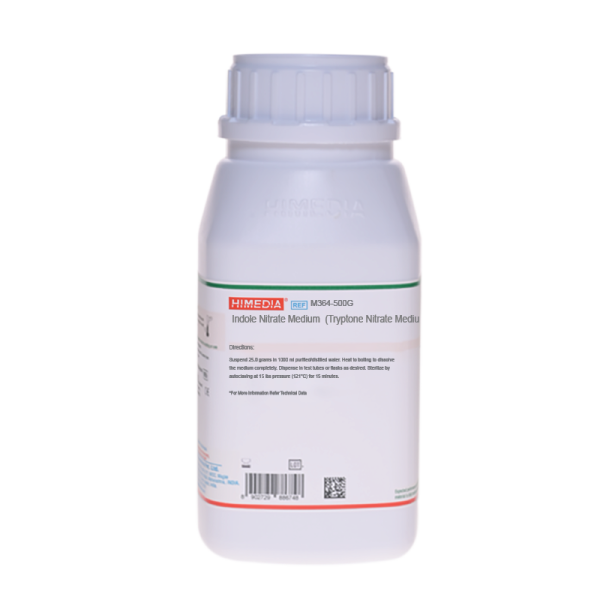
Suspend 25.0 grams in 1000 ml purified/distilled water. Heat to boiling to dissolve the medium completely. Dispense in test tubes or flasks as desired. Sterilize by autoclaving at 15 lbs pressure (121°C) for 15 minutes.
Indole Nitrate Medium (Tryptone Nitrate Medium), due to the nutritive content, supports growth of aerobes, microaerophiles, and facultative as well as obligate anaerobes. It serves a dual purpose of detecting indole production and nitrate reduction in a wide range of microorganisms.
Tryptone contains tryptophan, which is acted upon by certain microorganisms, resulting in the production of indole. Potassium nitrate acts as the substrate for determining nitrate reduction by microorganisms.
Clinical samples; Food and dairy samples; Water samples
Duplicate tubes of Indole Nitrate Medium may be inoculated and tested for the presence of nitrates or indole after incubation for various lengths of time. Nitrate test is performed by addition of 0.5 ml each of Sulphanilic Acid (R015) and α- Naphthylamine (R009). The development of pink colour indicates nitrate reduction. The colour develops due to presence of nitrite generated from reduction of nitrate. When nitrate is further reduced to ammonia, no colour develops. Add a pinch of zinc dust to the tube. The formation of pink colour after addition of zinc dust indicates that nitrate is not reduced. Indole production can be tested by the addition of Kovac's Reagent (R008) or Ehrlich reagent (R005) (1,2). The formation of a deep red colour in the reagent layer after gentle agitation indicates positive indole test. Indole Nitrate Medium is not recommended for indole test in coliform and other enteric bacteria, as they reduce nitrate to nitrite, which prevents the detection of indole (3). Indole Nitrite Medium should not be used for detecting indole production by members of the Enterobacteriaceae. The tubed medium should be boiled for 2 minutes and cooled, without agitation, before use.
In Vitro diagnostic Use. For professional use only. Read the label before opening the container. Wear protective gloves/ protective clothing/eye protection/ face protection. Follow good microbiological lab practices while handling specimens and culture. Standard precautions as per established guidelines should be followed while handling clinical specimens. Safety guidelines may be referred in individual safety data sheets.
Performance of the medium is expected when used as per the direction on the label within the expiry period when stored at recommended temperature.
Appearance: Cream to yellow homogeneous free flowing powder
Gelling: Semisolid, comparable with 0.1% Agar gel.
Colour and Clarity of prepared medium: Light amber coloured, clear to slightly opalescent gel forms in tubes as butts
Reaction: Reaction of 2.5% w/v aqueous solution at 25°C. pH : 7.2±0.2
pH: 7.00-7.40
Cultural Response: Cultural characteristics observed after an incubation at 35-37°C for 18-48 hours.
| Organism | Growth | Indole production | Nitrate reduction |
|---|---|---|---|
| Bacteroides corrodens ATCC 23834 | luxuriant | negative reaction | negative reaction |
| Bacteroides ovatus ATCC 8483 | luxuriant | negative reaction | variable reaction |
| Clostridium perfringens ATCC 12924 | luxuriant | negative reaction | positive reaction, red colour developed within 1-2 minutes |
| ##Paeniclostridium sordellii ATCC 9714 | luxuriant | positive reaction, red ring at the interface of the medium | negative reaction |
| Clostridium sporogenes ATCC 11437 | luxuriant | negative reaction | negative reaction |
| Escherichia coli ATCC 25922 (00013*) | luxuriant | not applicable | positive reaction, red colour developed within 1-2 minutes |
| Klebsiella pneumoniae ATCC 13883 (00097*) | luxuriant | not applicable | positive reaction, red colour developed within 1-2 minutes |
| Staphylococcus aureus subsp. aureus ATCC 25923 (00034*) | luxuriant | negative reaction | positive reaction, red colour developed within 1-2 minutes |
Key : *Corresponding WDCM numbers. ## Formerly known as Clostridium sordellii
Store between 10-30°C in a tightly closed container and the prepared medium at 15-30°C. Use before expiry date on the label. On opening, product should be properly stored dry, after tightly capping the bottle in order to prevent lump formation due to the hygroscopic nature of the product. Improper storage of the product may lead to lump formation. Store in dry ventilated area protected from extremes of temperature and sources of ignition. Seal the container tightly after use. Product performance is best if used within stated expiry period.
User must ensure safe disposal by autoclaving and/or incineration of used or unusable preparations of this product. Follow established laboratory procedures in disposing of infectious materials and material that comes into contact with clinical sample must be decontaminated and disposed of in accordance with current laboratory techniques (1,8).
| Product Name | Indole Nitrate Medium (Tryptone Nitrate Medium) |
|---|---|
| SKU | M364 |
| Product Type | Regular |
| Physical Form | Powder |
| Origin | Animal |
| Packaging type | HDPE |
| References | 1. Shirling E. B. and Gottlieb D., 1966, Methods for Characterization of Streptomyces species, Int. J. Syst. Bacteriol., 16:313. 2.Atlas R. M., 1993, Handbook of Microbiological Media, Parks L.C. (Ed .), CRC Press, Inc. |
| Customized Product Available | No |